“Historical Contingencies” at Antietam
I recently finished James McPherson’s Crossroads of Freedom, a treatment of the Maryland Campaign and its historical significance. The book partially explores the concept of the “historical contingencies,” or the concept that outcomes in history are not predetermined, but depend on random or unexpected events, decisions, and circumstances. In this vein, McPherson propagates the widely held belief that Antietam was one of the decisive turning points of the war. However, he also acknowledges that—if not for certain events and circumstances—the battle and the war could have gone a very different way.[1]
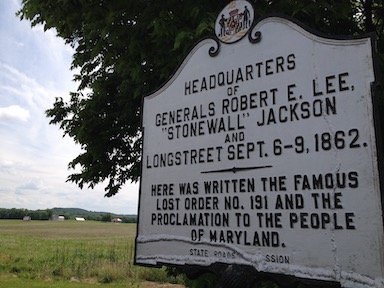
Perhaps the best example of this is the “Lost Orders” incident of September 1862. In an episode familiar to most students of the battle of Antietam, a copy of Lee’s Special Order 191, which detailed the positions of the Confederate divisions and their marching orders, was left haphazardly along the Georgetown Pike near Frederick, Maryland. Perhaps by sheer chance, Corp. Barton W. Mitchell of the 27th Indiana Volunteers discovered the orders wrapped around two cigars. He quickly turned the orders up the Union chain of command, first to Sgt. John M. Bloss, then to Col. Silas Colgrove, and eventually to Gen. George B. McClellan himself.[2]
Whether McClellan’s knowledge of Special Orders 191 helped him achieve greater success at Antietam than he otherwise would have is certainly up for debate. But the question of historical contingency is fascinating to ponder. What if Mitchell hadn’t discovered the orders by happenstance? What if XII Corps aide Samuel Pitman couldn’t corroborate the orders as the penmanship of the Confederate Assistant Adjutant General Robert Chilton, an acquaintance of his from before the war? Or better yet, what if Lee’s errant staff officer hadn’t lost the orders in the first place? It calls to mind how much of history could be made by sheer coincidence, circumstance, or random human actions.[3]
The ebb and flow of military victories throughout 1861 and 1862 also made the outcome of the war wholly uncertain by the time the battle of Antietam was fought. Victories in Virginia in the summer of 1862 arguably emboldened the Southern cause and threatened the Union war effort by renewing the potential of foreign powers in formally recognizing the Confederacy.
On the other hand, Confederate victories in the Shenandoah Valley, on the Virginia Peninsula, and at Second Bull Run threatened Lincoln’s policy of emancipation. What if Lee had scored a victory on Northern soil in the autumn of 1862? Would Lincoln have indefinitely tabled the Proclamation of Emancipation, or would it have seen the light of day at all?
Questions like these keep us coming back to the historical craft, and the study of the Civil War more specifically. They also beg the question, what are the “contingencies” driving and shaping history in our own lifetime?
[1] James McPherson, Crossroads of Freedom: Antietam: The Battle that Changed the Course of the Civil War, (New York: Oxford University Press, 2002), xiii, xiv.
[2] D. Scott Hartwig, To Antietam Creek: The Maryland Campaign of 1862, (Baltimore, MD: Johns Hopkins University Press, 2012), 282-284.
[3] McPherson, Crossroads of Freedom, 108.


I believe the key component regarding Special Orders 191 is not their recovery by McClellan, but what he did with them. For a moment he was not himself and became aggressive, writing Lincoln that he had Lee’s plans in hand and would destroy him. But then the real George McClellan took over, and he dawdled on the march, then, upon arriving at Sharpsburg, sat for a day watching Lee’s army as it rested and grew stronger. He undoubtedly busied himself with “planning,” because that’s what McClellan was: a staff officer, not a combat officer, but those plans were lousy, weren’t they? His two classic errors on September 17, 1862 were to attack piecemeal – first on Lee’s left, then in the center, then on Lee’s right – with the incompetent Burnside allowed to think for himself, always a disaster; and, he never seemed to grasp that Lee was well into enemy territory with the Potomac behind him running high, so at least one corps of the Army of the Potomac should have been sent marching to cut Lee’s lines of communication with Virginia and stymie any attempt at retreat. His third error came in the aftermath: he sat for days, then weeks, as Lee disappeared in the distance, refusing to follow up his partial success at Sharpsburg.
This is why Sharpsburg must be considered a Confederate victory, not a Federal one or a draw, and was one of Lee’s best battles. See it: Lee had invaded enemy territory, reduced Harpers Ferry with its prize of thousands of rifles, along with artillery and ammunition, and at the beginning of the one-day battle had 32,000 hungry, exhausted, ragged troops, with the Potomac behind him running too high to ford – thus there was no chance of escape – facing 95,000 well-rested, well-fed, well-armed, well-shod, well-equipped Federals on their own territory, and his foe had had his campaign plans in hand for several days. That Lee inflicted such grievous casualties on McClellan – more than 11,000 killed and wounded – and was not destroyed himself and then managed to escape – why, that is a significant victory.
My goodness, where to begin!
Suffice to say, your characterization of events and conclusion as to McClellan’s actions at Antietam and that it should be considered a great Confederate victory is opposed by detailed and contemporary evidence as well as the sum total of the highly analytical studies conducted on the battle since at least the 1980s. If you have not read the entirety of Joseph Harsh’s and Scott Hartwig’s works on the battle, I highly encourage you to do so. The evidence, subjected to excruciating analysis, irrefutably demonstrates the opposite of these conclusions in most respects.
By the standard you’ve applied – Chancellorsville, Spotsylvania and Chickamauga must be considered immense Union triumphs. They weren’t.
I think we can all agree that McClellan was outgeneraled, maybe even in the Maryland Campaign. But to call the battle of Antietam and the campaign at large a “Confederate victory” would be to betray Lee’s own words that the campaign produced mixed results. I would say it might have been a tactical Confederate victory, in that Lee held the high ground at the end of the day, but an operational defeat in that the casualties incurred forced him to abandon his offensive campaign.
“What Ifs” are a consistent theme on this ECW site. Has a “What If” based on the (mythical, iconic, infamous, etc….choose your own term) Special Order 191 that has that as NOT being lost and intercepted by the Union ever been proffered? How do the historians, experts, pundits, or others view that circumstance had that come to pass? RE Lee is loose in western Maryland. He takes Harper’s Ferry, and he splits his forces. But McClellan doesn’t know all that yet. He certainly isn’t going to learn that from a few gift-wrapped (from Lee’s own orders) cigars. How does that play out?
Hi, Evan. I thoroughly enjoyed your article and your articulation of the phenomenon of “historical contingencies.” Your particular framing of the phenomenon and your excellent examples caused some healthy perturbations in my personal mental models associated with operational planning and subsequent execution. As a 30-year Army officer (Aviation), I more or less embraced the idea of “contingencies” as future unplanned events, factors and/or “curveballs” that one sought to identify and evaluate for the purpose of preparing potential courses of action in the event such untoward occurrences indeed hazarded the campaign, operation, or plan of interest. By way of amplification, based on my operational military experience and my subsequent 25 years as a professor of military strategy and warfare at National Defense University, I grew up with and unabashedly embraced Clausewitz’s conceptualization of the nature of war and the impact of fog, friction, and chance (probabilities) in the conduct of warfare. In this sense, fog, friction and chance were “disrupters” that gave rise to the operation imperative of “contingency” planning and the development of subsequent contingency plans. In closing, taken at the flood, I suspect I’m probably splitting hairs with respect to “cause and effect” relationships and cascading (2nd/3rd order effects). Nonetheless, I enjoyed the opportunity to engage a bit in the sport of “intellectual popcorn.” Kindest personal wishes, Dr. Paul Severance
Thank you! Glad you enjoyed it