In Memory of Steve Davis: Chris Mackowski
EDITOR’S NOTE: The ECW community was saddened today to learn the news of the death of one of our alums, Steve Davis. Civil War News published a wonderful obituary for Steve, which you can read here. Among his extensive body of work, Steve contributed two books to the Emerging Civil War Series, All the Fighting They Want and A Long and Bloody Task, and he contributed essays to several of our collections, including Turning Points. He served as ECW’s book review editor from 2021–23, and he blogged with us as a regular contributor (see Steve’s archive of stories here).
————

I first met Steve Davis beneath the shadow of Kennesaw Mountain—fitting for a man who, I came to find out, towered among Atlanta’s Civil War historians. We met through an introduction by Ted Savas. Ted and I were recruiting Steve to write a pair of books on the Atlanta Campaign for the Emerging Civil War Series. “Steve is intense,” Ted told me. “If you sit with him, his eyes will burn right through you!” It wasn’t a warning so much as an observation, and it proved totally true. “Piercing stare” has become cliché, but that phrase may have originated describing Steve. His owl-wide eyes were unrelenting.
Despite Kennesaw’s shadow, the late-May sun felt welcoming, and so did Steve. Dressed in loafers, shorts, and a button-down shirt with its long sleeves rolled up, he was nonetheless eager to walk some trails and show off a little of the battlefield. My ECW colleague Dan Davis (no relation) was with us, as was my daughter Stephanie. Steve kept up a running commentary about the Atlanta Campaign, interspersed with tales about Ted; his mentor, Bell Wiley; and an assortment of other colorful characters, rogues, and scholars. He was a one-man Southern cocktail party of stories and insights. (You can read about that meeting here.)
Thereafter, Steve never failed to inquire how Steph was doing in any conversation we’d have. It was good manners to do so. He’d inquire about my wife, Jennifer, and my oldest son, Jackson (a name he loved because of its connection to Stonewall). When my son Maxwell was born the following March, Steve referred to him as “The Silver Hammer,” a reference to the Beatles’ song. He was delighted when I got the reference! Thereafter, we often dropped musical allusions like that during our interactions, sure that the other would understand. He took to calling me “Dr. Rock.”
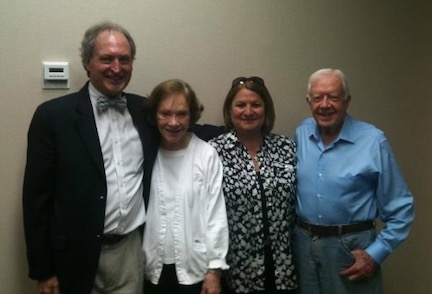
I, in turn, called him “Dr. Edge,” a name his fellow students had once bestowed upon him during his graduate studies and that he shared with me. Steve may have been molded after an old-time Southern gentleman, but a strong vein of 60s radical ran through him, and it came out in conversation in the most unexpected ways. He was somehow both a flaming liberal and an unreconstructed rebel, all neatly bedecked in a bow-tie.
Steve was unapologetically unreconstructed and fiercely Southern. One of his books, What the Yankees Did to Us: Sherman’s Bombardment and Wrecking of Atlanta, took its title from a civilian account of the campaign, but Steve seemed to take Sherman’s presences as personally as anyone who lived through it. He carried that 160-year-old grudge like a torch.
Not that he had much love for the Confederate commanders of the time, either. He would readily bad-mouth Joe Johnston and John Bell Hood alike, and do so as a matter of course.
Steve liked to do business over the phone. Sure, emails were quicker and allowed everyone to spell things out, but he believed in the courtesy of a call. “If someone wants a favor from me, they should be polite enough to call and ask,” he once told me. I adhered to that rule during all the years of working with him, and he responded over and over with fantastic essays and blog posts and book reviews. He could be a machine. He once cranked out almost 7,000 words about the Johnston/Hood change of command in less than a week. (That essay appears in ECW’s Turning Points of the Civil War collection.)
When Steve would call me, he would greet me with a three-second version of my name: “Chriiiiiiiiiiiisss.” My son Jackson once heard Steve on speakerphone and was so amused by Steve’s north-Georgia accent and speaking mannerisms that he insisted I answer Steve’s calls on speakerphone so he could hear Steve greet me. Jackson never met Steve but grew fond of him by his mere persona.
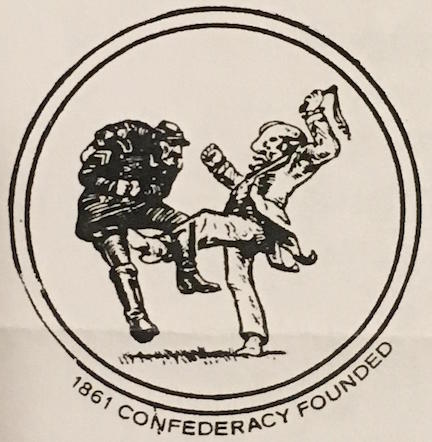 When COVID came, Steve refused to be cowed by the isolation many of us felt. He responded with his own brand of F-you to COVID: he initiated what he called “an epistolary lifestyle.” He started writing letters and postcards. He often sent newspaper clippings related to writers and writing, but his random notes were particular treasures. They usually came on photocopied letterhead given to him by an old friend, Ben Maryniak of the Buffalo (NY) Civil War Roundtable, which featured irreverent “Great Moments in Southern History.” My favorite note from him, though, came on a postcard that showed small Inca statues in an intimate pose. “Those lusty Incas!” he scrawled on the back—and that was all.
Steve wrote with a fountain pen and reveled in the small pleasure of ink on a page. I always answered in kind, aware that the act of writing and the time commitment it involved was part of the point. Over the last couple of years, I took to sending him a postcard any time I went on a Civil War adventure. (I credit my friend Curt Fields for this wonderful idea. Curt started sending me postcards from his many adventures, and I started reciprocating. I began sending postcards to my epistolary friend Steve, as well. You should try it with your pals, too!)
In fact, a postcard sat in the mailbox, waiting to go out to Steve, when I got the call from Steve’s wife on Tuesday morning.

Just the day before, I had visited Hollywood Cemetery in Richmond and had written a note to Steve about the stop. Of the many marvels to see in Hollywood, I always make a specific point to visit the memorial to Confederate Brig. Gen. Richard Garnett, which stands among the headstones of those Confederates killed at Gettysburg. The memorial, installed in 1991, suggests that Garnett is likely among the many unidentified soldiers buried in that section of the cemetery. Steve had played an instrumental role in the installation of that monument. (See Steve’s story here.)
A magnolia tree cast a cool shadow over the Gettysburg dead. The headstones stood at attention like men in line of battle, one long row followed immediately by another. The ground at Hollywood rolls and swells, and the rows of graves ride the landscape. The Garnett monument stands among them, like an officer on horseback among foot soldiers. I paid my respects to Garnett and to Steve’s efforts at remembering him. In turn, I remembered Steve. I had no way to know that, at that very moment, he was already dead, although none of us yet knew it.
I’ll never not think of Steve when I visit that memorial. I am pleased to think of him now, resting easy among the Confederate dead.


I didn’t know Steve, but he seemed like a wonderful man. Too many of his generation are leaving us.
It’s been a rough year so far and a rougher twelve months.
What a wonderful tribute. Chris, I always enjoy your writing. So sorry for your loss.
Thanks. I appreciate the kind words.
I’m glad to know about Steve; he must have been fun to know! I look forward to reading his books and columns.
Chris: Nicely done. Steve was my book review editor at CWN. Among the many things that stand out for me is that he was always a true gentleman and with everything else he had going on never failed to accommodate extension requests, etc. Suffice to say that he will be missed.
Chris: A heartfelt tribute to Steve. Thanks for posting. Steve wrote the most positive and insightful review of my biography book WILLIAM BARKSDALE, CSA for which I am eternally grateful. Also thank you for including the link for Steve’s heartfelt piece on Ben Maryniak who was a good friend of mine. During my time as a Confederate reenactor with the 18th Mississippi Co. B. Benton Rifles our group in our dress uniforms formed the honour guard for President Jefferson Davis (portrayed by a man from Western New York) who delivered fervent speeches on two separate occasions at the Buffalo Civil War Roundtable in the 1980’s. These videotapes probably still exist there somewhere. Ben was a great guy who has been sorely missed.
Ben was a legend in western NY Civil war circles. I wish I’d been able to meet him.
I met Steve Davis while attending a Civil War Conference ten years ago. We were doing a study of the Atlanta Campaign, and Steve introduced us to the few existing remnants of the “Shoupades that were constructed by the Confederates along the Chattahoochee River Line. After Sherman suffered a bloody nose at Kennesaw Mountain, he approached the River Line, bristling with those unusual triangular fortifications. After studying the prospects of another frontal attack against the interlocking fields of fire, he opted to pass on attacking the line of defensive “Shoupades,” and moved to outflank the River Line. Steve’s passion as he narrated the details of this element of the Atlanta Campaign was ever so evident during that tour, and remains to me as a special memory.
Thanks for sharing that story, Bill. I’m glad you have a good remembrance of Steve to keep with you!
Chris: Fine tribute.
Thanks, Gould. I hope you’re well!
Steve’s business card read: Steve Davis, Civil War Know-It-All. I don’t think there will be another like him.
I met Steve in 2013 when he came to speak at yet another Buffalo Civil War Roundtable meeting. He was a delight and the signed copy of his book is a treasured part of my library.
Great tribute Chris. I worked with Steve for many years at the insurance company and he was as entertaining in the corporate world as you described with his Civil War work. He was definitely one of a kind and I’ll forever miss his knowledge of the English language, his humor and searing stare!
Chip Goen