“Hounds of Blood”: Advertising “Negro Dogs” in Antebellum Southern Newspapers – Part I
The Tarborough, North Carolina, Southerner newspaper ran an article in its October 15, 1859, edition under the headline, “Desperate Encounter with Runaway Negroes.” The rather brief story explained that during the previous week, in a section of Nash County called Reed Marsh, “a desperate and sanguinary battle occurred . . . between Mr. J. W. Hamlet and negro dogs, on the one side and three negroes, armed with scythe blades on the other. Hamlet, along with another white man named Price, had been searching for the three runaways by using dogs to track them. When the trackers finally encountered the freedom seekers, “they showed resistance.”[1]
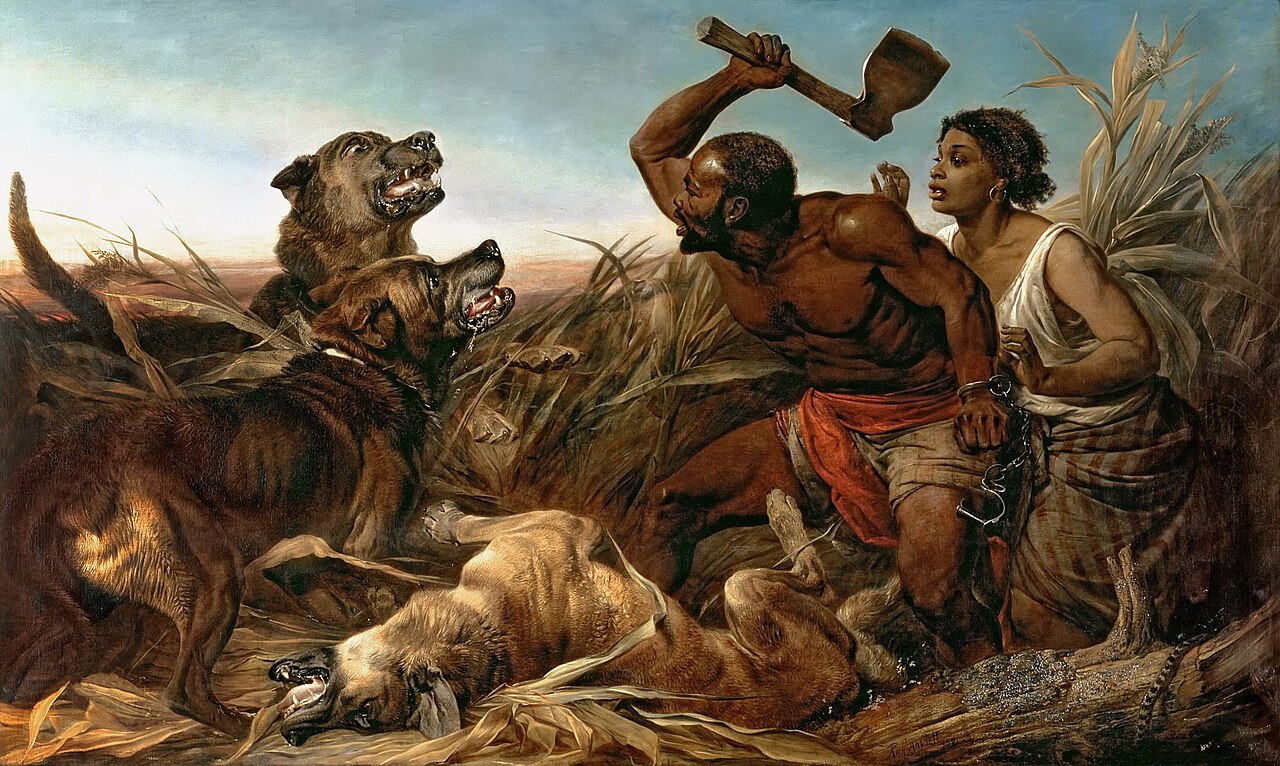
“On resorting to his pistols, Mr. Hamlet discovered, that in consequence to the powder being dampened, neither one of them would go off,” the article noted. Hamlet sent Price to find a nearby reliable firearm while Hamlet stayed “with his dogs preventing the negroes from either attacking him, or escaping themselves.” Price apparently found a gun quickly and returned. Both parties probably understanding that the situation was an uncompromisable standoff, “a regular melee took place, which resulted in the death of one dog and the maiming of a second—the serious if not fatal shooting of one negro through the head—one through the knee—and it is supposed, fatal cutting of the third.” The two least injured men were returned to their enslavers and the one most wounded “was left in charge of a physician in Nashville [North Carolina].[2]
Accounts such as the above were not unusual in the antebellum South. As this and other similar newspaper articles show, hunting runaway enslaved people with dogs did not only happen in published slave narratives such as Twelve Years a Slave[3] by Solomon Northup and Slavery in the United States: A Narrative of the Life and Adventures of Charles Ball, a Black Man,[4] and in fictional works like Harriet Beecher Stowe’s Uncle Tom’s Cabin, or Life among the Lowly,[5] and William Wells Brown’s Clotel; or The President’s Daughter,[6] it happened regularly in real life, too.
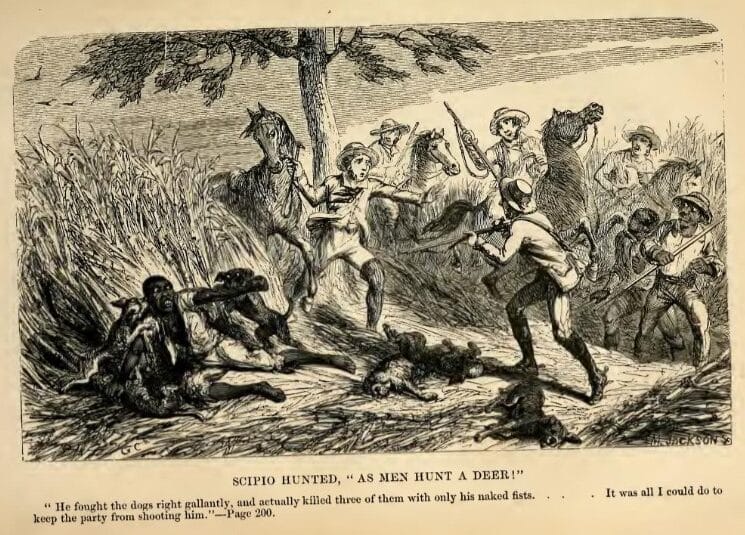
A significant amount of evidence concerning “Negro dogs” also comes from newspaper advertisements. Most of the advertisements that I was able to locate come from Deep South states like Louisiana, Mississippi, Alabama, and Texas. But there were a scattering, too, from upper South and Border States like Virginia, North Carolina, Tennessee, and Missouri.
Although some of the ads are from newspapers in the 1840s and early 1850s, the vast majority are from the second half of the 1850s and into the early 1860s, a period when the values of enslaved people were rising drastically. Prices for enslaved people rose along with the demand and price of cotton, the primary Deep South commodity that they were forced to grow. To an enslaver, the value of an escaped enslaved individual, along with their lost productive labor, made the cost and effort to reclaim them worth paying out the necessary expenses to do so. Additionally, in effort to maintain the ideal efficiency of the slave labor system, enslavers knew control, order, and coercive violence—or at least the threat of it—were of paramount importance. Measures like slave patrols, and slave catchers who utilized dogs, figured prominently into maintaining that order and control. The examples below provide abundant evidence of this. However, despite the many legal, social, and cultural efforts placed as obstacles and intended to regulate the lives of enslaved people, they continued to take enormous risks to search for freedom.
In the numerous examples given below I have attempted to provide ample evidence to show that the practice of using dogs to catch freedom seekers was very common. I have not posted every “Negro dog” advertisement and reference that I happened to find. These are just some located while searching on Newspapers.com. It staggers the mind to wonder how many ads no longer exist simply because the newspapers in which they appeared no longer survive, or were never copied or digitized. Further, one also wonders how many runaway hunters operated without advertising but instead relied on local word of mouth communication to promote their services.
It can be difficult for us to understand how individuals were unwilling to see the daily evidence—both at the time these ads were running, as well as following the Civil War in their retold versions of history—and claim that slavery was a benevolent institution, a positive good, and that the enslaved were contented with their situation. These untrue assertions flew directly in the face of a true mountain of clearly visible evidence that they witnessed regularly but refused to see it for what it really was.
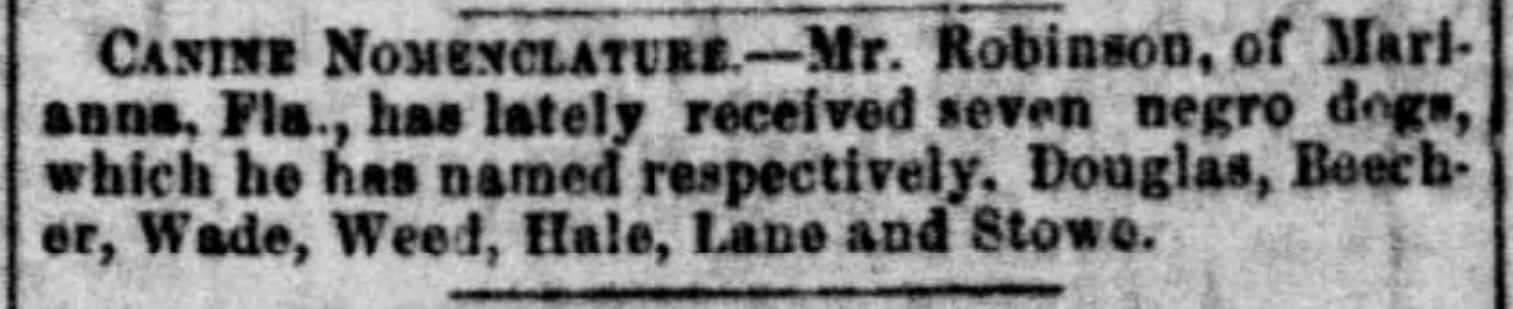
When one sees a brief notice like the one that appeared in the March 26, 1858, issue of the Richmond Daily Dispatch, it is a bit easier to understand this period mindset. This extremely brief notice, which was probably just a space filler, but instead spoke volumes, reads: “CANINE NOMENCLATURE—Mr. Robinson of Marianna, Fla., has lately received seven negro dogs, which he has named respectively, Douglas[s], Beecher, Wade, Weed, Hale, Lane and Stowe.”[7] Mr. Robinson blatantly naming his slave-hunting dogs for well-known abolitionists Frederick Douglass, Henry Ward Beecher, Benjamin Wade, Thurlow Weed, John P. Hale, James Lane, and Harriet Beecher Stowe is akin to ugly partisan political statements we see so often today. However, the advertisements themselves are even more revealing.
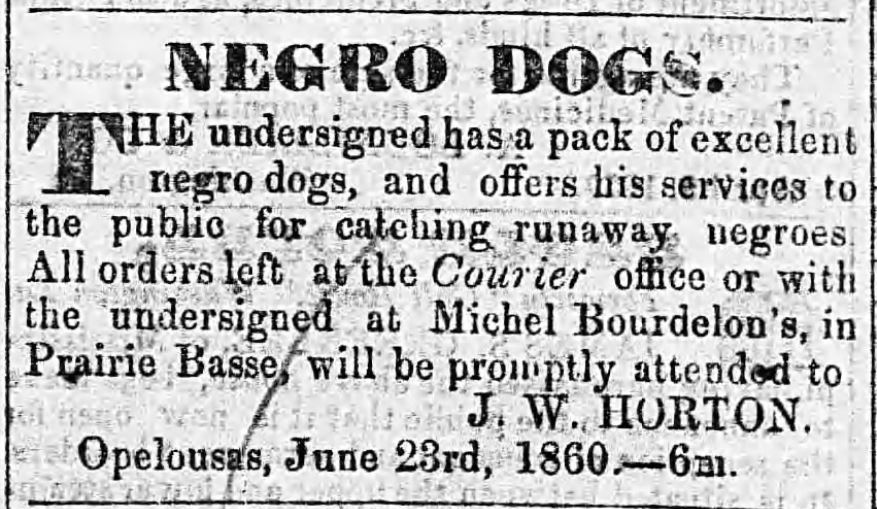
The Opelousas, Louisiana, Courier often ran an advertisement in 1859 and 1860 placed by J. W. Horton. It stated, “The undersigned has a pack of excellent negro dogs, and offers his services to the public for catching runaway negroes.” Horton encouraged interested parties to leave orders at the Courier office or to see him at Michel Bourdelon’s plantation in Prairie Basse. Horton noted that inquires “will be promptly attended to.”[8] As with any business, time was of the essence, and that was particularly true in slave catching. If one waited too long, the trail would grow cold and potential income lost. And like any business, if the provided services did not satisfy one’s customers, one’s reputation suffered along with the business.
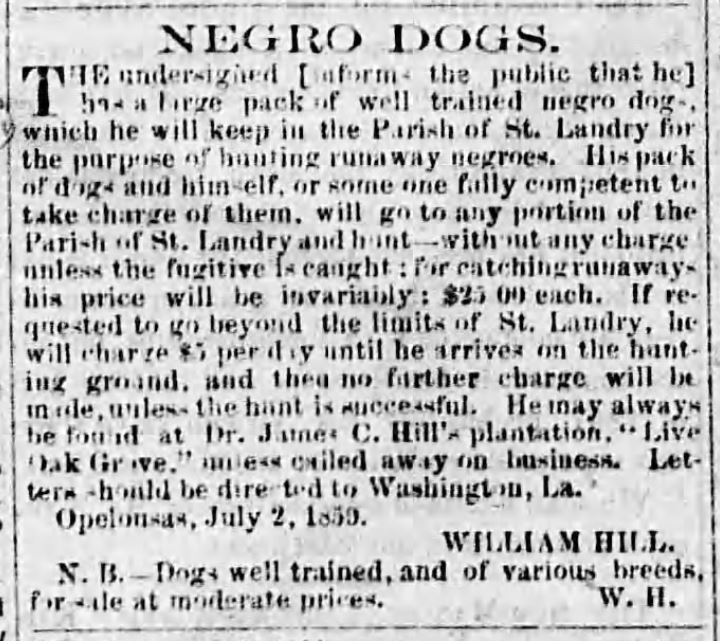
William Hill advertised in the same town and around the same time period, but used the Patriot newspaper to offer his Negro dog services. Hill shared that he “has a large pack of well trained negro dogs which he will keep in the Parish of St. Landry for the purpose of hunting runaway negroes,” and that he would “go to any portion of the Parish . . . and hunt—without any charge unless the fugitive is caught.” Hill then explained his pricing as $25.00 each for “catching runaways,” and if he had to go beyond St. Landry Parish he charged $5.00 per day, but not any more “unless the hunt is successful.” Hill and his dogs could be found at Dr. James C. Hill’s Live Oak plantation. He also sold dogs that were “well trained and of various breeds.”[9]
The Harrisonburg, Louisiana, Independent ran an eye-catching ad headlined in bold type: “Who wants Dogs!” The notice then proceeded to offer “A pack of well trained negro dogs for sale on reasonable terms.” Those interested could find particulars about the sale at the newspaper office.[10]
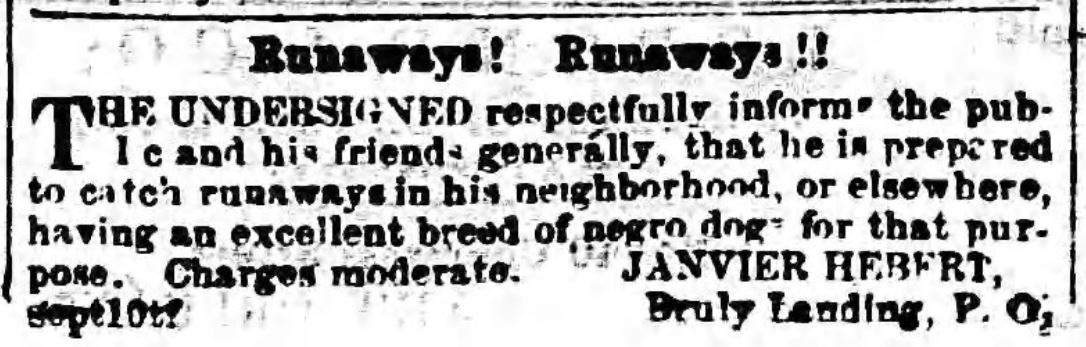
“Runaways! Runaways!” headed Janvier Herbert’s ad in West Baton Rouge, Louisiana’s The Sugar Planter on October 8, 1859. Herbert wanted to “respectfully inform the public and his friends generally, that he is prepared to catch runaways in his neighborhood and elsewhere having an excellent breed of negro dogs for that purpose.” He closed that prices for his services were moderate.[11]
Joseph Dismukes of Barbour County, Alabama, advertised for “two valuable negro DOGS” that he thought had strayed or that someone had stolen. Dismukes gave brief descriptions of the canines and offered a reward of $10.00 “for their apprehension and delivery at Andrews, Ridgeway & Cos” in Columbus, Georgia. The reward was not an inconsiderable amount at that time.[12]
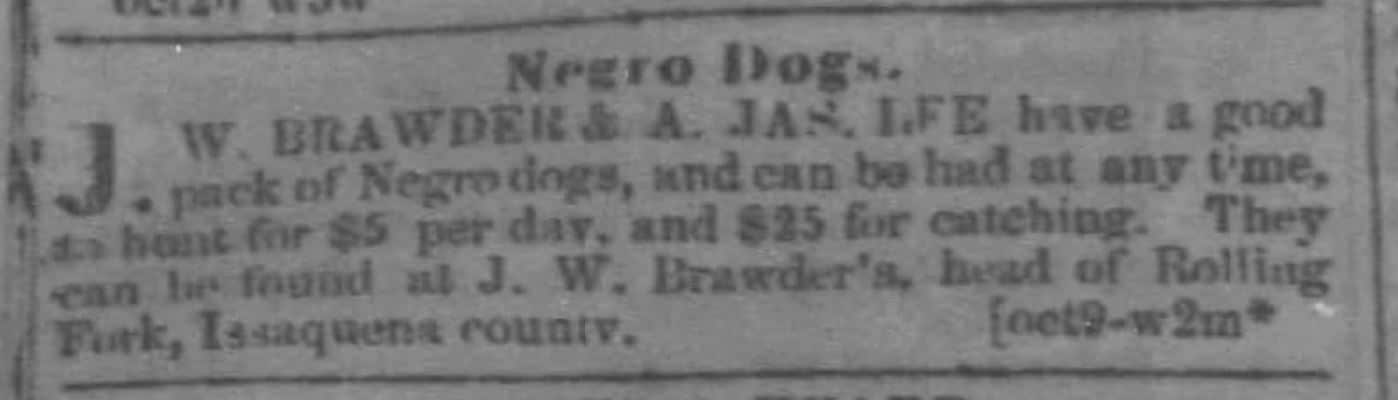
Issaquena County, Mississippi’s J. W. Brawder and A. James Lee advertised in the Weekly Vicksburg Whig as having “a good pack of Negro dogs” that “can be had at any time to hunt for $5 per day, and $25 for catching.” The partners ran a similar ad, but with a woodcut image of a dog on it, in the daily edition of the Whig.[13]
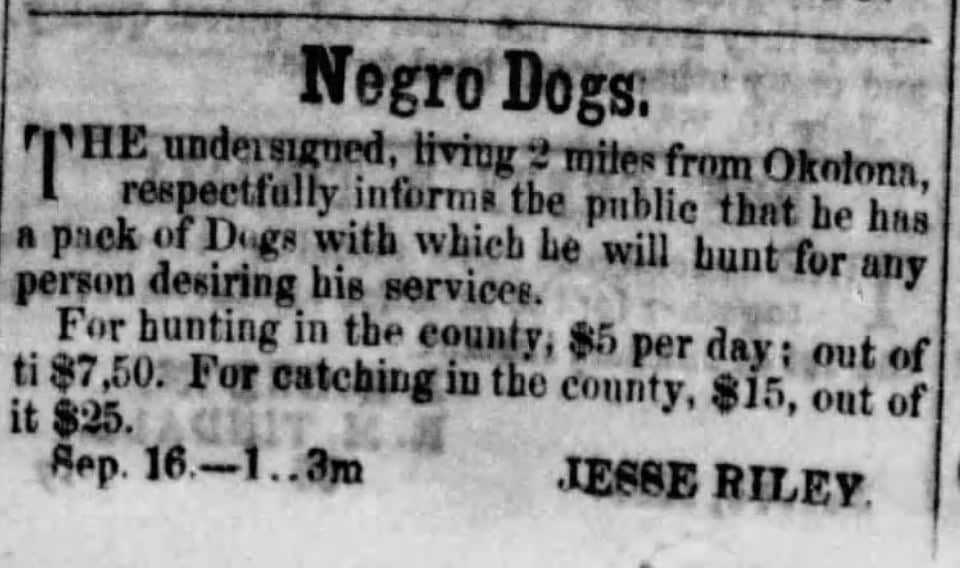
The rates for Jesse Riley’s Negro dog hunting service in Okolona, Mississippi, was a common $5.00 per day in Chickasaw County, but he charged $7.50 if he had to travel outside county lines. If he caught the person or persons he charged $15.00 in the county and $25.00 out of the county. With his pack of dogs, Riley offered that “he will hunt for any person desiring his services.”[14]
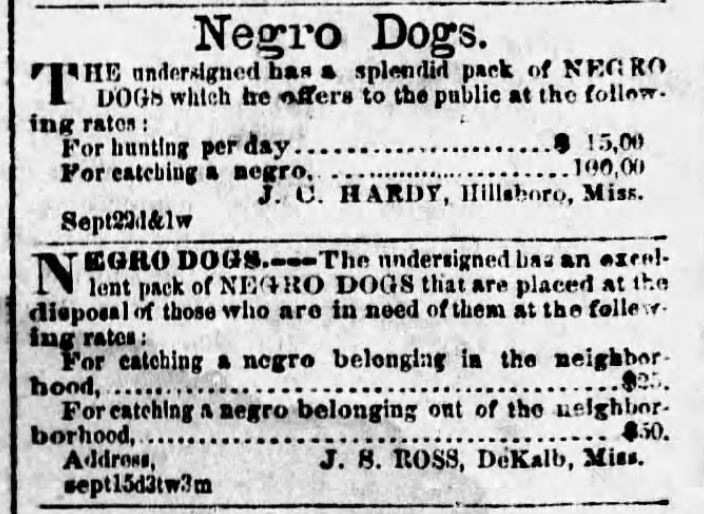
Two slave catchers advertised in Meridian, Mississippi’s Daily Clarion, in 1863. The newspaper stacked the ads placed by J. C. Hardy of Hillsboro, and J. S. Ross of DeKalb. One wonders what the advertisers felt about having their competing business notices placed together. Hardy charged 15.00 per day for hunting and $100.00 for “catching a negro.” Ross expected $25.00 for “catching a negro belonging in the neighborhood,” and $50.00 for apprehending one “belonging out of the neighborhood.” What actually constituted the neighborhood went unstated.[15]
Purporting to have the best dogs in the state, W. F. Smith advertised in the Natchez newspaper, The Mississippi Free Trader. Yazoo City’s C. J. Blackman advertised for a “Mr. Jones,” perhaps his overseer at White Hall, and claimed that Jones, who “with my dogs, and Mr. Boyd’s celebrated negro dogs” were available “for hunting runaway slaves on reasonable terms.” Blackman may have also dabbled in slave trading, as in an adjoining ad he posted “JUST RECEIVED—A few negroes for sale.”[16]
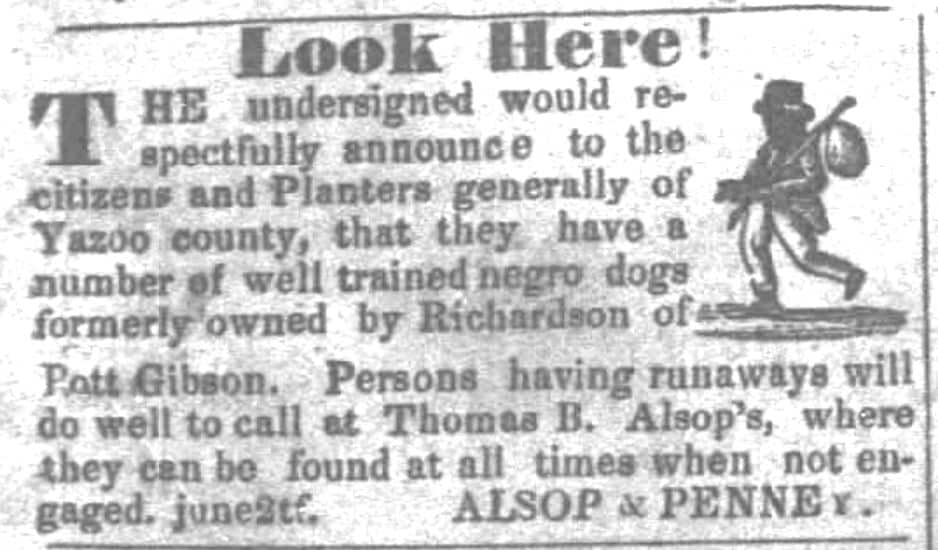
Sprinkled among the classified ads offering guano, champaign wine, children’s clothes, mosquito netting, and guns and pistols in Yazoo City’s Weekly American Banner, Thomas B. Alsop placed an ad meant to catch readers’ attention. Headlined “Look Here,” Alsop told the “citizens and planters generally of Yazoo City, that they have a number of well trained negro dogs formerly owned by Richardson of Port Gibson.” They advised that “Persons having runaways will do well to call. . . .”[17]
This article will continue with Part II.
[1] The Southerner, October 15, 1859.
[2] Ibid.
[3] Solomon Northup, Twelve Years A Slave (Auburn, NY: Derby and Miller, 1853), 136-139.
[4] Charles Ball, Slavery in the United States: A Narrative of the Life and Adventures of Charles Ball, a Black Man (New York: John S. Taylor, 1836), 354-357.
[5] Harriet Beecher Stowe, Uncle Tom’s Cabin, or Life among the Lowly (Boston: John P. Jewett and Company, 1852), 200.
[6] William Wells Brown, Clotel; or The President’s Daughter (London: Partridge and Oakey, 1853), 73-77.
[7] The Daily Dispatch, March 26, 1858.
[8] Opelousas Courier, June 23, 1860
[9] Opelousas Patriot, August 27, 1859.
[10] The Independent, January 26, 1859.
[11] The Sugar Planter, October 8, 1859.
[12] Columbus Enquirer, May 22, 1855.
[13] Weekly Vicksburg Whig, November 21, 1860; Vicksburg Daily Whig, October 9, 1860.
[14] The Prairie News, October 14, 1858.
[15] The Daily Clarion, September 27, 1863.
[16] The Mississippi Free Trader, March 26, 1856; The Yazoo Democrat, September 14, 1853.
[17] The Weekly American Banner, June 2, 1854.


This is fantastic!