“Hounds of Blood”: Advertising “Negro Dogs” in Antebellum Southern Newspapers – Part II
If you missed Part I, you can read it here.
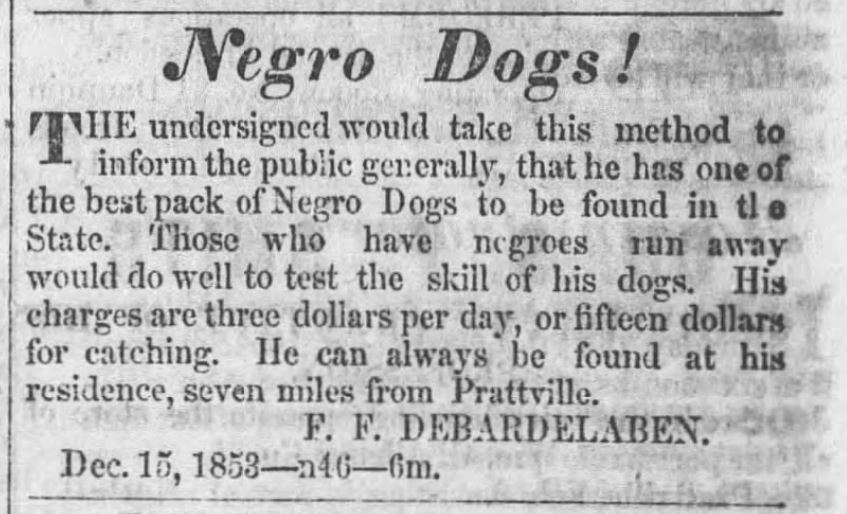
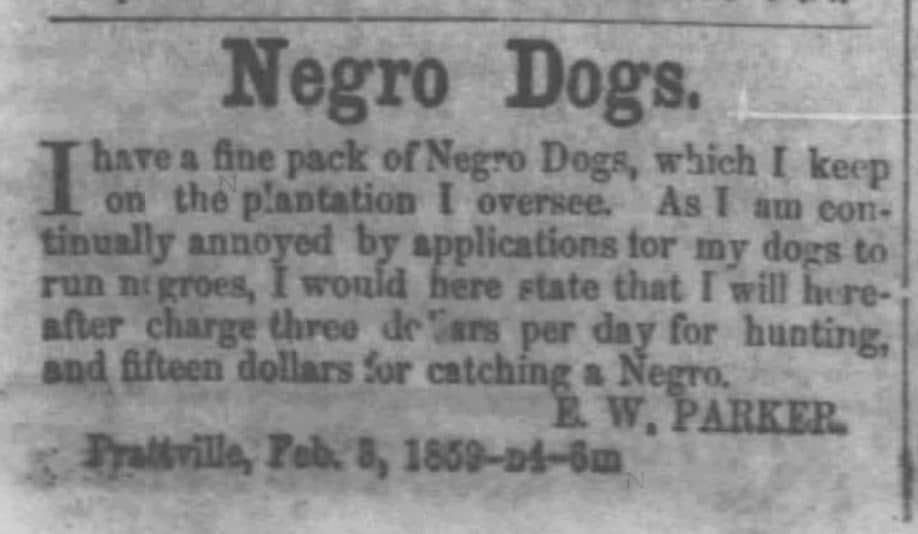
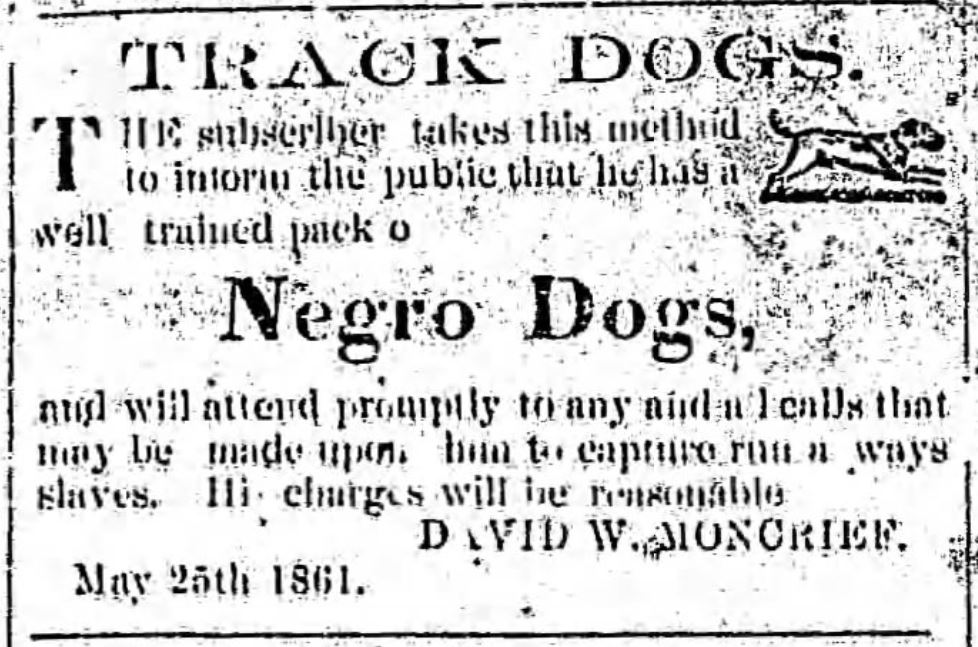
Alabama ranked right with and probably exceeded Mississippi for numbers of Negro dog advertisements. Prattville’s Autauga Citizen ran many ads. Like W. F. Smith mentioned above in Mississippi, F. F. Debardelaben, who lived six miles outside of town claimed to have “one of the best packs of Negro Dogs to be found in the State,” and encouraged those needing such services to “test the skill of his dogs.” Overseer E. W. Parker advertised his “fine pack of Negro Dogs” in the same paper six years later. Business must have been good, as he noted, “As I am continually annoyed by applications for my dogs to run negroes,” and he shared his service rates for all to read. Parker’s ad ran weekly for several months. Another Prattville newspaper, The Southern Statesman, ran an ad for David W. Moncrief in 1861, offering his pack of Negro dogs and explaining “His charges will be reasonable.”[18]
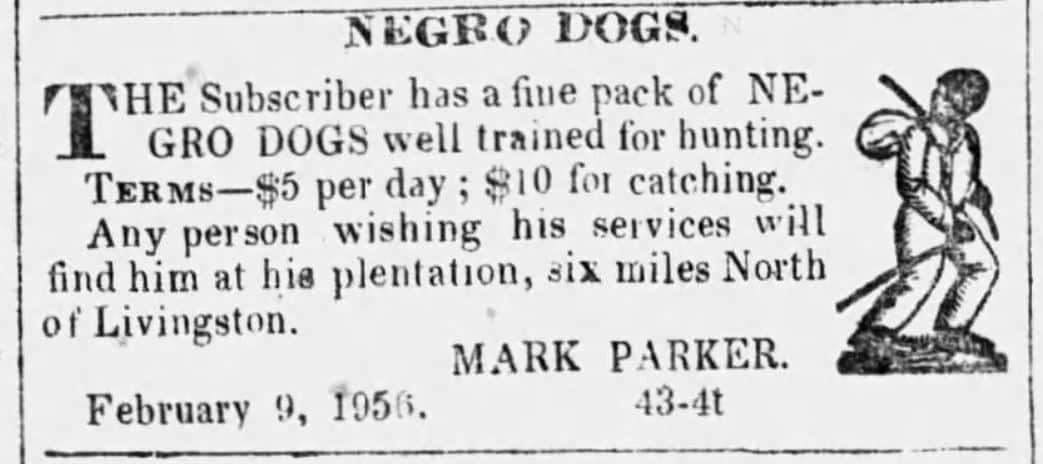
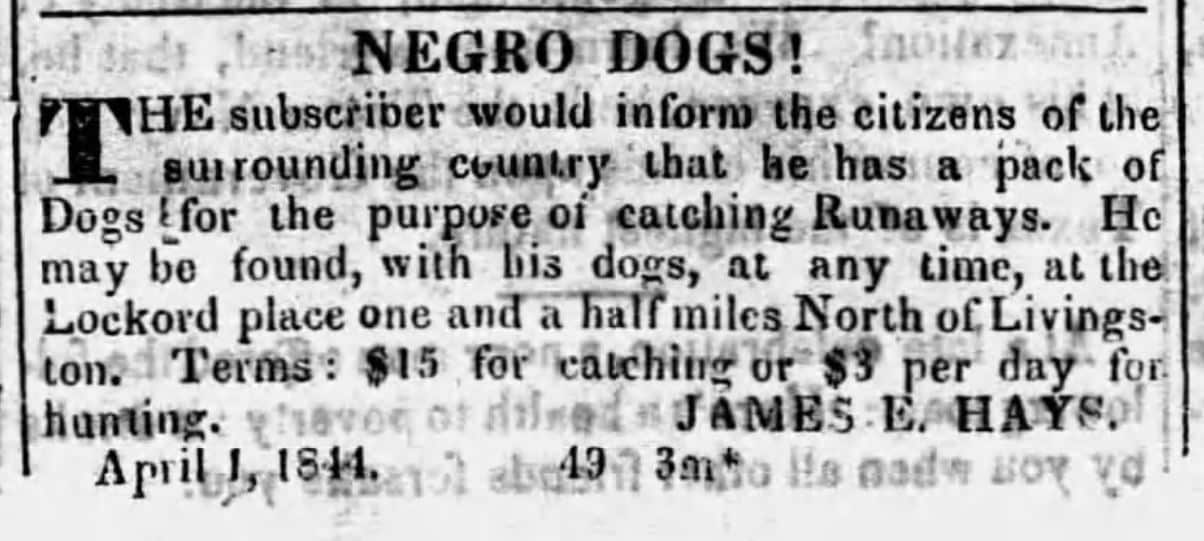
Like a number of the ads for Negro dogs, Mark Parker’s included a small woodcut image of a runaway man, probably in hope of drawing attention to it. His advertisement ran in Livingston, Alabama’s Sumter County Whig. He posted his rates and where interested parties could find him for the services of his “fine pack of NEGRO DOGS well trained for hunting.” The Whig also posted one of the older ads that I located. In this 1844 ad, James E. Hays relayed that “he has a pack of Dogs for the purpose of catching Runaways.”[19]
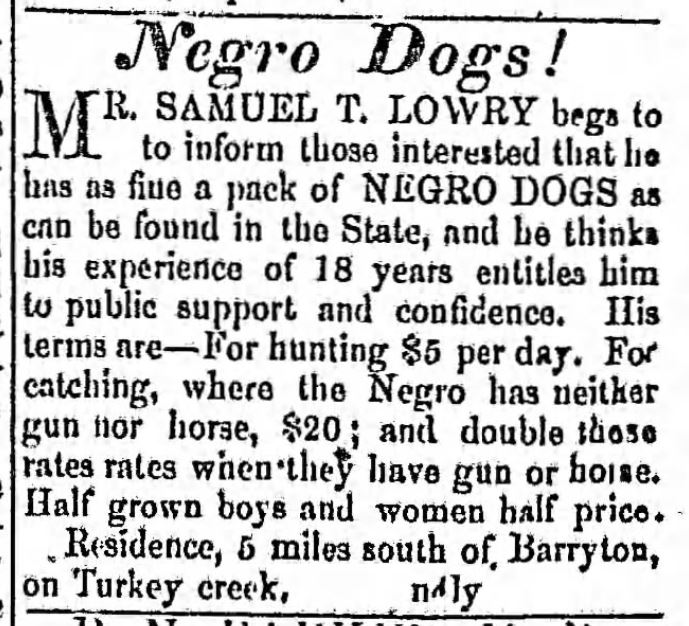
Published in Butler, Alabama, The Southern Democrat ran an ad for Samuel T. Lowry and his Negro dogs. Lowry played up his belief that “his experience of 18 years entitles him to the public support and confidence.” He apparently charged depending on the risk involved. “For catching, where the Negro has neither gun nor horse, $20; and double those rates when they have gun or horse,” Lowry’s ad explained. He offered half price for catching “Half grown boys and women. . . .”[20]
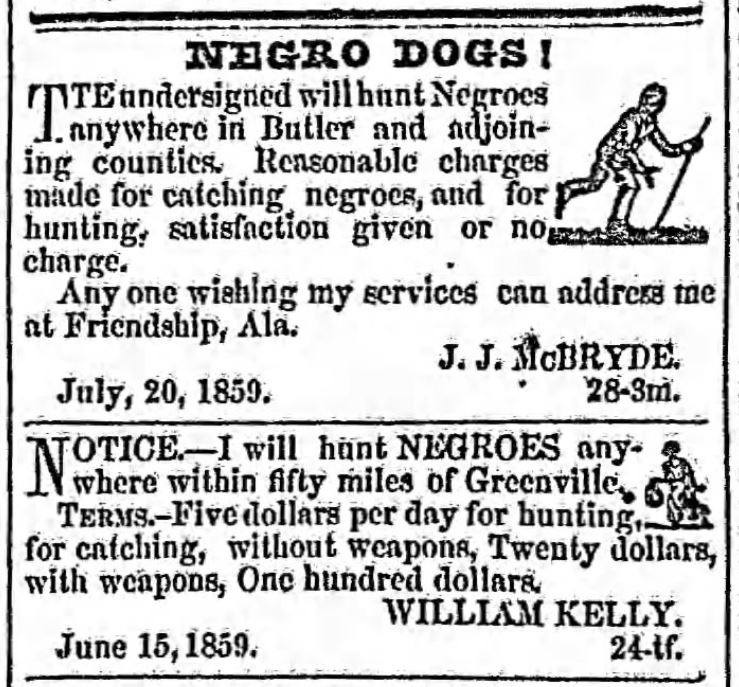
Greenville, Alabama, which was in the heart of the state’s cotton growing region, apparently had enough runaways to support at least two slave hunters. The town’s Southern Messenger ran stacked ads for competitors J. J. McBryde and William Kelly. McBryde offered “satisfaction or no charge,” while Kelly offered to hunt runaways “anywhere within fifty miles of Greenville.”[21]
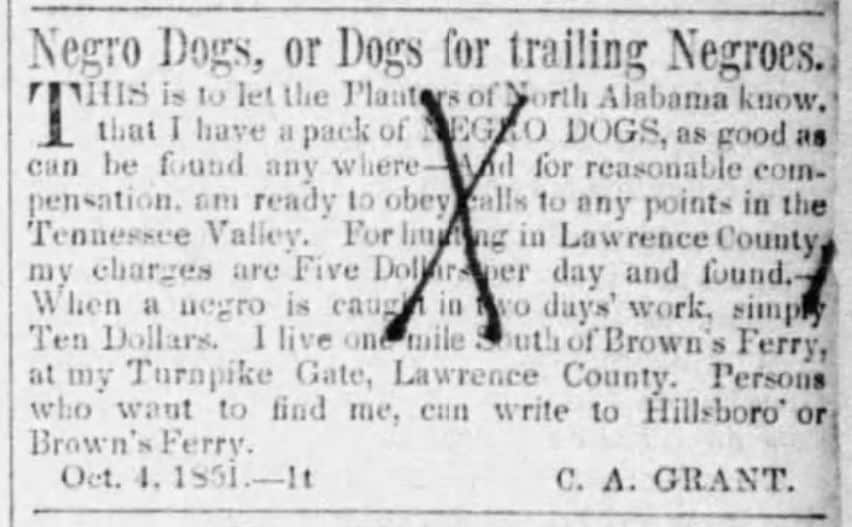
“Negro Dogs, or Dogs for trailing Negroes,” is how northern Alabama runaway tracker C. A. Grant headlined his advertisement. His ad was “to let the Planters of North Alabama know” about his pack of “NEGRO DOGS” and that he was “ready to obey calls to any points in the Tennessee [River] Valley.” Grant lived at Brown’s Ferry on the Tennessee River, which is just west of Huntsville. He advised those wanting to reach him to write to Hillsboro or Brown’s Ferry.”[22]
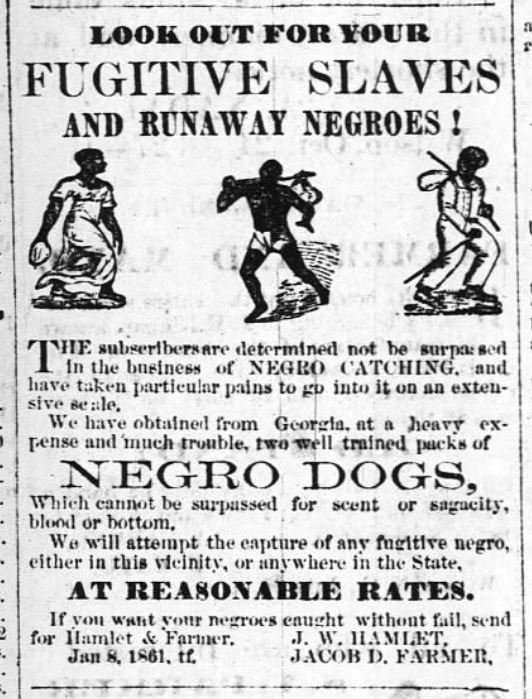
The Wilson, North Carolina, Ledger ran an ad for J. W. Hamlet and Jacob D. Farmer noting that the two men had “determined to go into the Negro catching business on an extensive scale” . . . having “procured from Georgia at considerable expense and trouble, two well trained packs of Negro Dogs, which for sagacity and bottom cannot be beat.” They offered their services to not only their area, but also “throughout the state.” This is almost certainly the same Hamlet as is mentioned in the opening account of Part I, as both the ad and the account are from the same area of the state. Hamlet and Farmer ran another ad a few months later with essentially the same information, but it included woodcut illustrations of three runaway individuals to help catch a reader’s eye. The later ad concluded, “If you want your negroes caught without fail, send for Hamlet and Farmer.”[23]
Many of the newspapers (or copies) in which Negro dog advertisements appeared no longer exist. However, as it was a common practice for newspapers in different regions of the country to reprint information from newspapers in other areas, some Negro dog ads appear in northern papers, often for the purpose of offering criticism about southern institutions and practices. These perspectives are important to include here, as they often clearly show a growing difference in thinking between the sections over the institution of slavery. Additionally, some of these ads point particularly well toward one of the arguments that several of the eventual seceding states claimed to be at grievance over; that being the unwillingness of those in the Free States to help assist in the catching of escaped enslaved people.
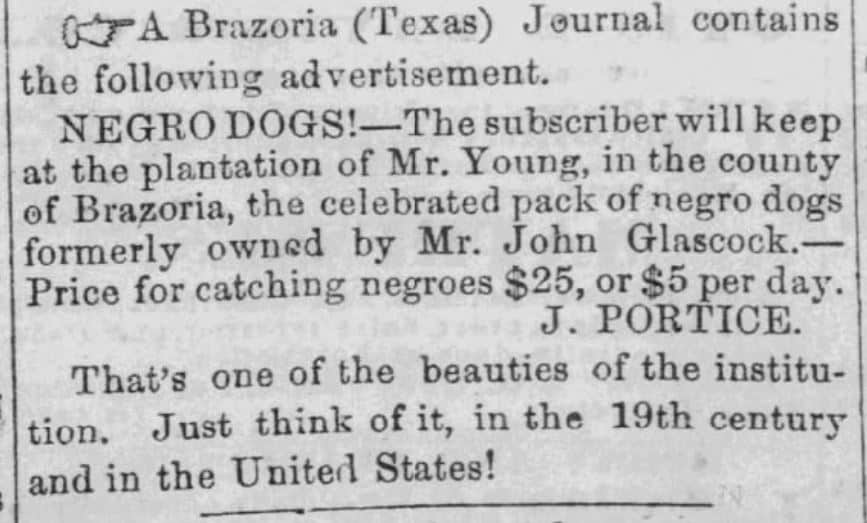
For example, the Lafayette, Indiana, Daily Courier copied an ad from the Brazoria, Texas, Journal. It gave information about the Negro dog service offered by J. Portice, who resided at the plantation of Mr. Young in Brazoria County, and used a pack of dogs formerly owned by Mr. John Glascock. It also gave Portice’s pricing. The Indiana paper added the following commentary: “That’s one of the beauties of the institution. Just think of it, in the 19th century and in the United States!”[24]
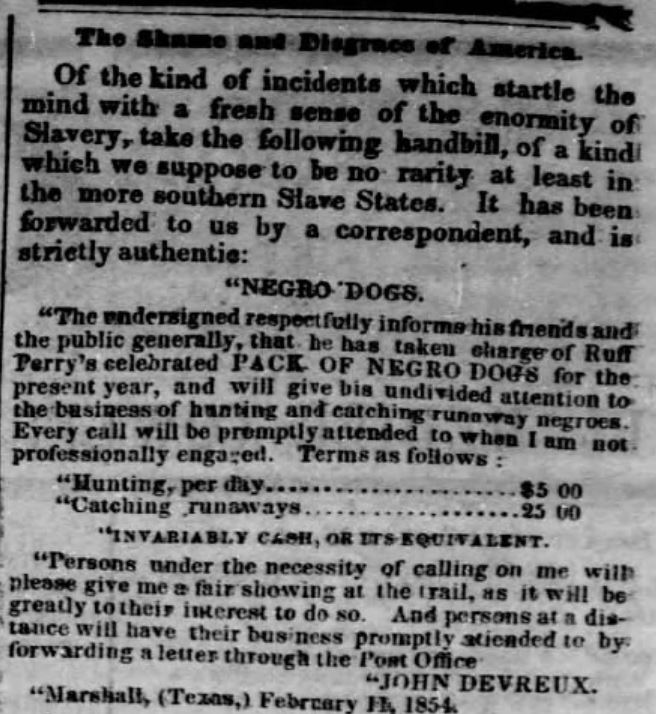
Another Texas Negro dog ad appeared in the Cleveland Weekly Leader. The original ad was apparently a handbill posted in Marshall, Texas, and dated February 11, 1854, by John Devreaux. Devreaux had “taken charge of Ruff Perry’s celebrated PACK OF NEGRO DOGS for the present year,” and offered to “give his undivided attention to the business of hunting and catching runaway negroes.” As a lead to the text of the handbill, The Weekly Leader used the headline, “The Shame and Disgrace of America,” and commented that “Of the kind of incidents which startle the mind with a fresh sense of the enormity of Slavery, take the following handbill, of a kind which we suppose to be no rarity at least in the more southern Slave States. It has been forwarded to us by a correspondent and is strictly authentic.”[25]
The Randolph County Journal of Winchester, Indiana, did not offer their thoughts (perhaps they felt the ad explained itself well enough for their community) on a Negro dog advertisement that they came across originally printed in the Napoleon, Arkansas, Weekly Planter. The ad, placed by A. J. Bridges of Red Fork, Arkansas, explained, “I have four superior NEGRO DOGS, with which I can catch any Runaway Negro, provided the track has not been made longer than sixteen hours.” Bridges apparently had a fellow associate as he stated, “Mr. Jones, or myself, will attend promptly to any and all calls.”[26]
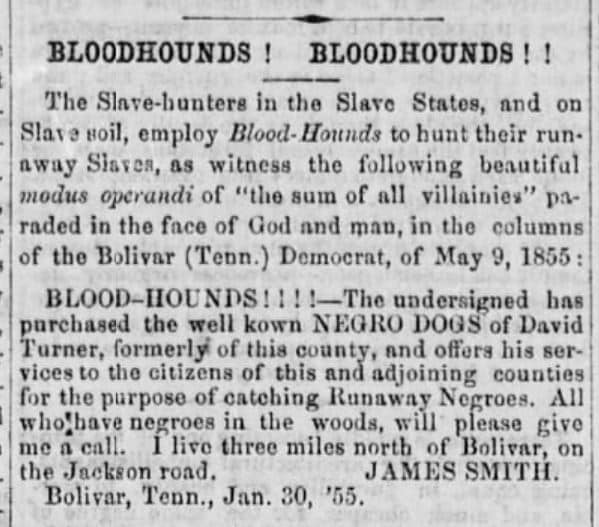
Lisbon, Ohio’s Anti-Slavery Bugle reposted an ad from Bolivar, Tennessee. James Smith posted, “BLOOD-HOUNDS ! ! ! !” Smith explained that he had “purchased the well known NEGRO DOGS of David Turner, formerly of this county” and sought clients who needed his services in “catching Runaway Negroes.” As one might image, this abolitionist newspaper abhorred that “The Slave-hunters in the Slave States, and on Slave soil, employ Blood-Hounds to hunt their runaway Slaves,” and offered “as witness the beautiful modus operandi of ‘the sum of all villainies’ paraded in the face of God and man in the columns of the Bolivar (Tennessee) Democrat, of May 9, 1855.”[27]
Frederick Douglass made it a point to run ads from slave state newspapers in his own newspapers as a way of exposing slavery’s brutal practices while using Southerners’ own words. In the February 1, 1859, issue of Douglass’ Monthly, he included an ad from Upshur County, Texas, slave hunter J. J. Dudley. The catcher included his rates, claimed “The character of the dogs need no recommendation,” and offered not to charge by the day for hunting if he caught “the negro.”[28]
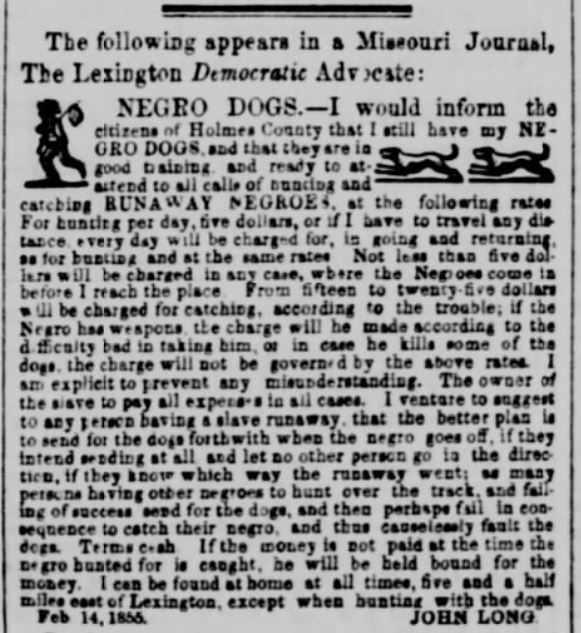
The antislavery New York Tribune, shared a Lexington, Missouri, ad in its March 10, 1855, issue. In it, John Long advertised his Negro dogs, by offering them to the “citizens of Holmes county.” Long explained how he charged, which included stipulations “according to the trouble.” He noted that “if the Negro has weapons, the charge will be made according to the difficulty in taking him, or in case he kills some of the dogs, the charge will not be governed by the above rates.” Like some other ads, Long suggested for best success to get him and his dogs on the trail of the escapee as soon as possible. He demanded “cash. If the money is not paid at the time the negro hunted for is caught, [the enslaved person] will be held bound for the money.” The Tribune remarked, “If there is a single reader of THE TRIBUNE with heart so dark and skull so dense as to uphold that system, with its blazing pyres and hounds of blood, let him examine the simple, unadorned brutality of the above advertisement.”[29]
The Madison, Indiana, Daily Courier reprinted an ad from the Sumter, Alabama, Democrat, that was originally posted by slave catchers Arnold Seale and Carter A. Seale. The Seales noted, “We have near Gaston in Sumter county, a pack of Negro Dogs, they have been well trained, and perform well . . . .” The Daily Courier asked rhetorically, “Who in Madison or Jefferson county so stultify himself as to be willing to be a ‘Negro Dog’ for Southern masters? We are no abolitionists, but if one of the human chattels escapes from the other side of the river and comes into Indiana, its owner must follow it as he would have to follow his horse, his ox or his ass, and capture it without our assistance. We don’t like the fugitive slave law any better now than we did in 1850, though numbers of [white] freemen in Indiana have agreed to make dogs of themselves to hunt runaway negroes since that time. ”[30]
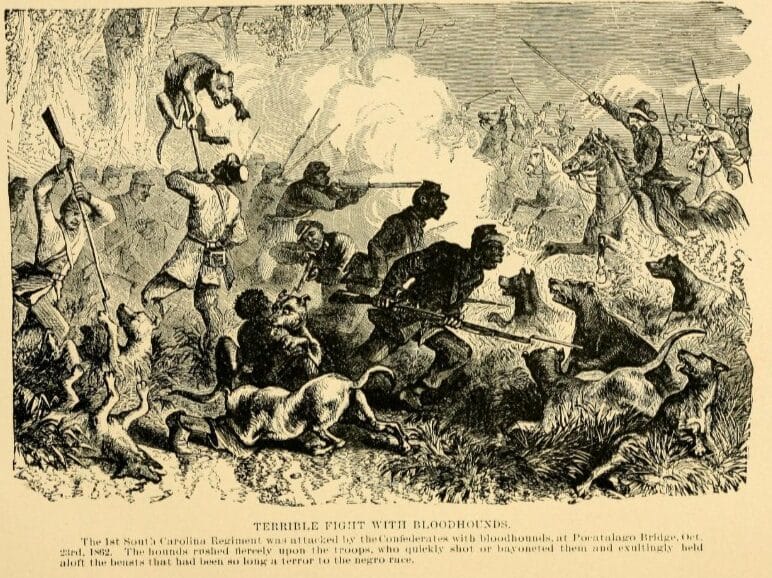
When war came, white Southerners continued to weaponize canines. Col. Thomas Wentworth Higginson, who commanded the 1st South Carolina Colored Infantry (later known as the 33rd United States Colored Infantry) commented on such in his book Army Life in a Black Regiment, published in 1869. During a raid led by Sgt. Harry Williams of Company K, and involving only Black soldiers, “The whole command was attacked on the return by a rebel force, which turned out to be what was called in those regions a ‘dog-company,’ consisting of mounted riflemen with half a dozen trained bloodhounds.” Col. Higginson explained that “The men met these dogs with their bayonets, killed four or five of their tormentors with great relish, and brought away the carcass of one.”[31]
Confederates also utilized dogs to guard prisoners of war camps and to track both Black and white escaped Federal soldiers. Historian Lorien Foote notes that at Camp Sumter, also known more popularly as Andersonville, a man named “Benjamin Harris, who owned a pack of dogs, used them to hunt down the escapees. When he earned a contract from prison authorities, Harris had his dogs make a circuit of the stockade every morning to catch the scent of any prisoners who may have escaped overnight.”[32]
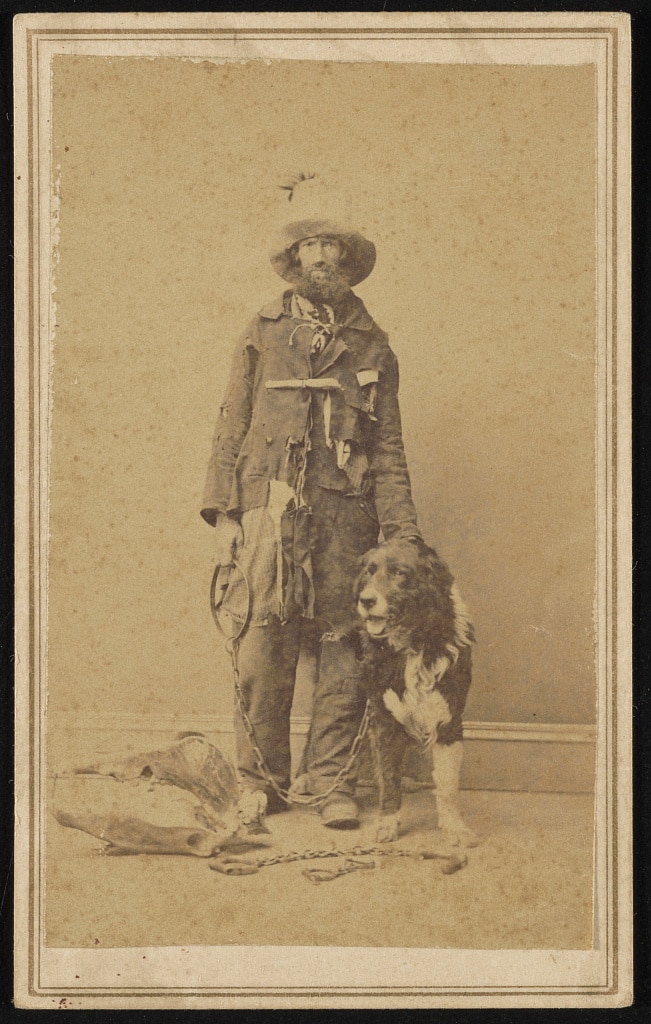
Over the ages dogs have often been referred to as “man’s best friend,” but under the training and command of some humans there are instances in the past where canines became tools for people to control and subjugate other people, leaving yet another example of the complicated history of us.
[18] The Autauga Citizen, December 29, 1853; The Autauga Citizen, February 17, 1859; The Southern Statesman, May 25, 1861.
[19] Sumter County Whig, December 20, 1856; Sumter County Whig, May 28, 1844.
[20] The Southern Democrat, August 8, 1859;
[21] Southern Messenger, August 24, 1859.
[22] The Democrat, October 16, 1851.
[23] The Wilson Ledger, November 13, 1860; The Wilson Ledger, January 15, 1861.
[24] Lafayette Daily Courier, September 4, 1854.
[25] Cleveland Weekly Leader, March 15, 1854.
[26] Randolph County Journal, April 5, 1860.
[27] The Anti-Slavery Bugle, October 13, 1855.
[28] Douglass’ Monthly, February 1, 1859.
[29] New York Daily Tribune, March 10, 1855.
[30] The Madison Daily Courier, March 23, 1853.
[31] Thomas Wentworth Higginson, Army Life in a Black Regiment (New York: W. W. Norton, 1984 reprint), 220.
[32] Lorien Foot, “Dogs of War,” in The Civil War Monitor, Vol. 13, no. 2 (Summer 2023), 32.


This two-parter was an awesome piece.
It is sad that articles like this still have to be written to prove the obvious over and over, but it was still important to do.
Great work, I really enjoyed this!
I find this article series as one more argument against the bovine scatology that, quote, “slaves liked slavery,” unquote.
I haven’t read the full Civil War Monitor article cited in footnote 32, but I read Benjamin Harris’ claim, “… his dogs make a circuit of the stockade every morning to catch the scent of any prisoners who may have escaped overnight” with a bit of salt. Maybe it was the intimidation factor of the dogs checking the perimeter to prevent further tunnel efforts like the one in May, 1864, which occurred before Harris was contracted. The dogs can differentiate the smell of starving Yankees vs hungry Rebs outside the lines? At Andersonville it was common for prisoners to go outside the confines of the POW camp, for example, daily wood chopping groups of prisoners, who, btw, would manage to smuggle in persimmons.
Tim, a wonderful series on a terrible subject. I found it particularly interesting that abolitionists used copies of the advertisements against slave holders who claimed slavery was benign. Very clever.
Thanks, Kevin. I was amazed that hits kept popping up. Although I’d come across mentions of dogs for this purpose, I never knew that such a service was so pervasive and well advertised.
thanks Tim … great series …. i was surprised to learn how commonplace this practice was … and interesting to see that the dog owners offered two services — tracking for $5.00 (where i guess the slaveowner catches the escapee) and $10.00 for tracking and capture …. then most surprised that Confederates had “dog companies” assigned to their infantry units.