The battle of Gettysburg, July 3, 1863, Cemetery Ridge, Part II: “Don’t Crowd, boys; don’t crowd.”
Previous: Cemetery Ridge, Part I
While makeshift companies from Brig. Gen. Joseph Kemper’s brigade dueled with the 13th and 16th Vermont regiments on the right flank, other Virginians bunched to the right. Captain Thomas J. Lewis of “Dinwiddie Grays” Company C, 3rd Virginia, yelled out: “Don’t crowd, boys; don’t crowd.” Unorganized groups of Confederates stepped over the crude defenses on Cemetery Ridge where the already depleted blue-clad regiments awaited. This was just south of the Copse of Trees.
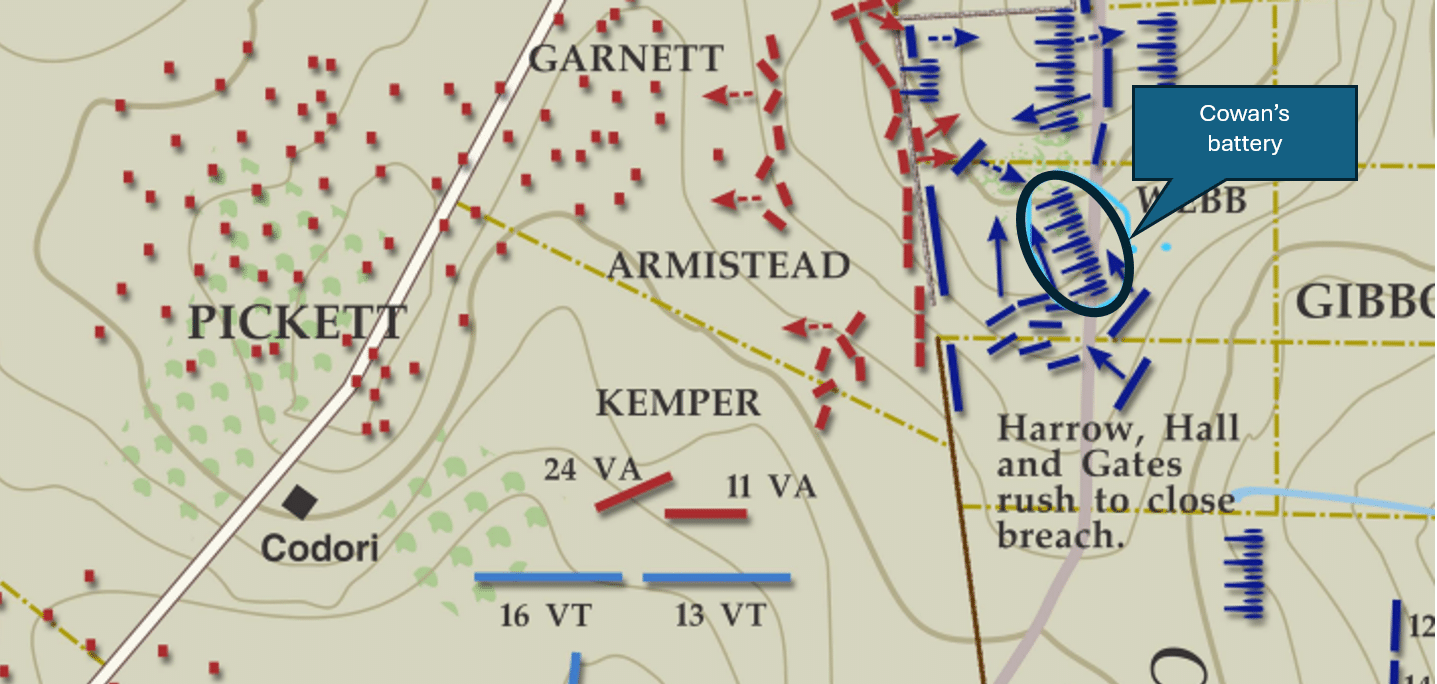
Captain Andrew Cowan’s 1st New York Independent battery supported the Union line. His five guns had deployed behind the infantry. They first opened up with shell. Brigadier General Henry Hunt monitored the situation on horse back, concerned that their fire was hitting the Union line. Cowan assured his commander that it wasn’t. Hunt then emptied his pistol at the Virginians as Cowan’s crew loaded another round.
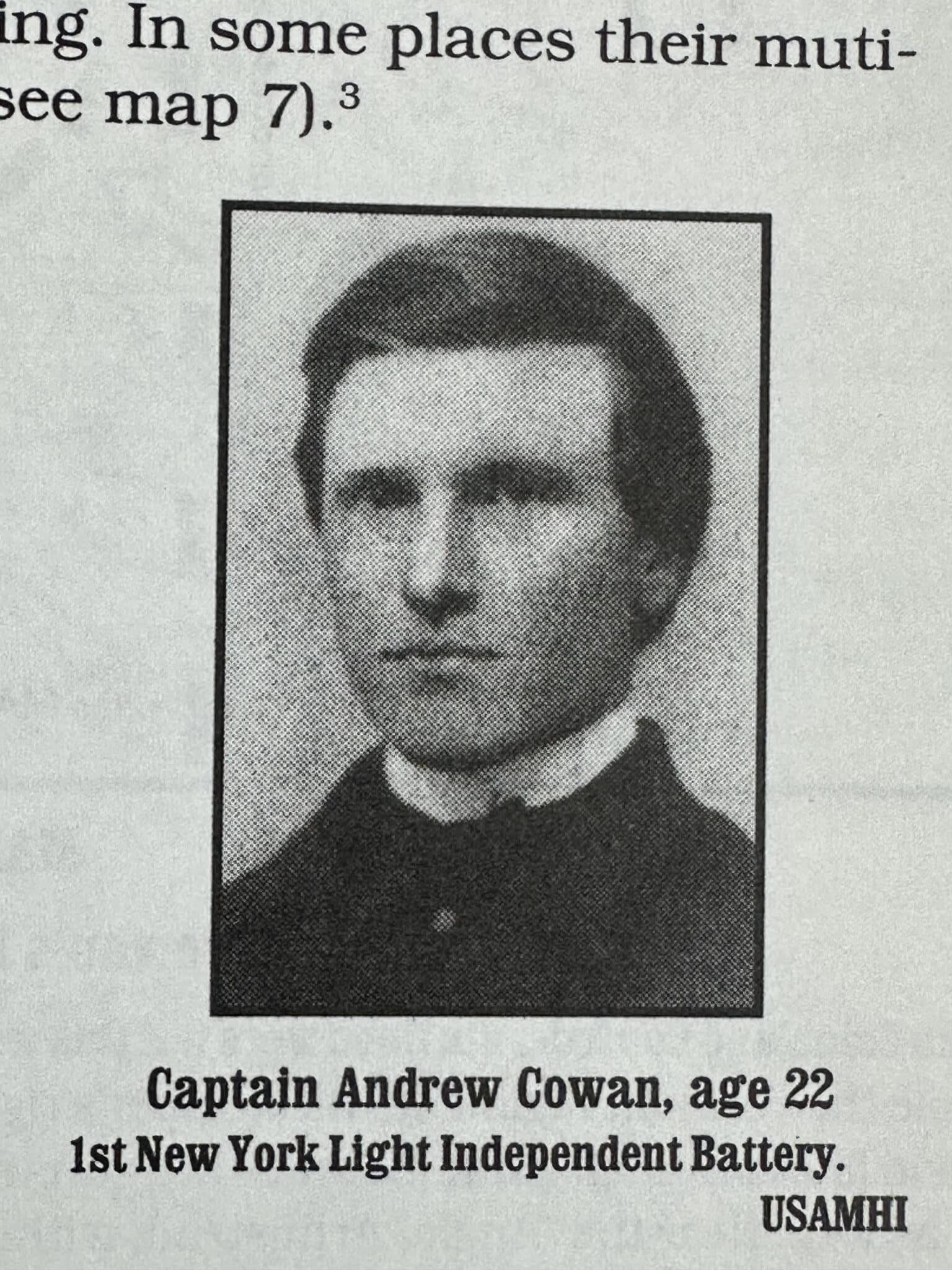
Brigadier General Alexander Webb soon rushed up and drew off the wavering Union infantrymen. He redeployed them in and around the Copse of Trees. Some infantry officers and enlisted, however, made a bee line for the rear and ran through the New York battery. Cowan recalled the chaotic scene. “I saw several officers running away. Cpl. Plunkett struck one man over the head with a coffee pot and it went down over his face, the bottom giving way, and in that plight he ran off with it.”
The artillerymen turned their attention back to the oncoming Confederates. The New York battery had switched to double canister. On the Virginians came, 20-yards, 10-yards … “FIRE!” resounded, and the five guns belched forth with the last of their double-canister. The guns bucked and recoiled. Cowan’s men pulled the cannon back by hand to keep out of reach of the enemy pouring in just to the north of the Copse of Trees.
To Cowan’s immediate front, his guns had done a job. The Confederates never reached his battery. When the smoke cleared, the scene was ghastly. The blast had cut wagon-sized gaps in the Rebels. Their mutilated bodies lay three deep in some places. One major had been cut down within a few feet of the guns. Cowan later buried this enemy officer.
The Confederate casualty list was horrendous. Kemper’s brigade counted 699 killed, wounded, or missing out of 1,634 Virginians. Some of those occurred on the far right when squads of the 11th and 24th Virginia regiments fought the Vermonters. Many others became casualties during the march across the field. Still, others fell in front of the stonewall at the Union line. The field was strewn with dead and dying men and horses.
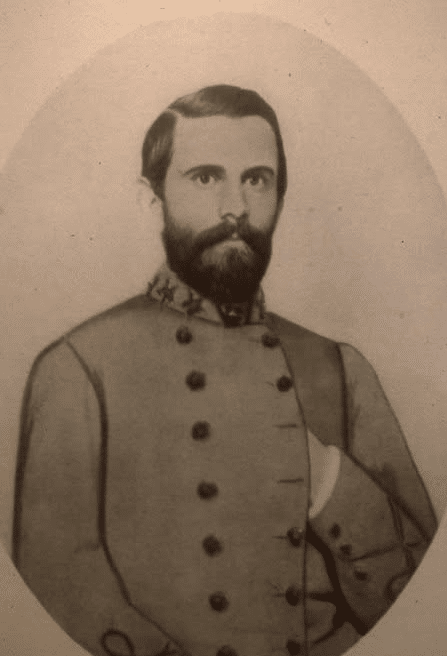
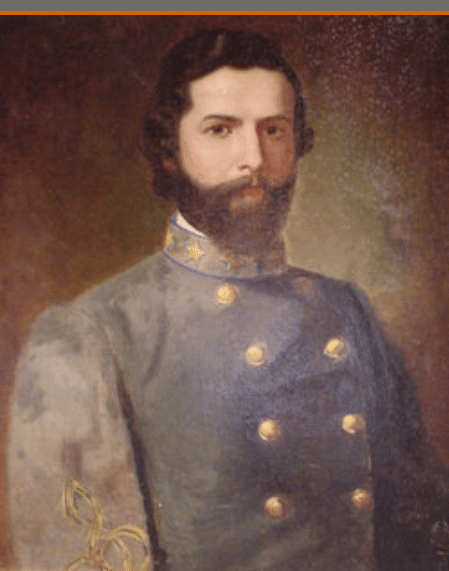
Senior leadership in Kemper’s Virginia regiments was devastated. Colonel Lewis B. Williams had led the 1st Virginia. He died near the Codori house before his men made it to the wall. He was hit in the shoulder. The projectile knocked Williams from his horse, and in the process he fell on his sword. Colonel Joseph Mayo of the 3rd Virginia suffered a concussion and wound to the hand. Colonel Waller Tazewell Patton, commander of the 7th Virginia, collapsed near the Emmitsburg Road with a horrific and mortal wound to the jaw. Major Kirkwood Otey was the senior officer who commanded the 11th Virginia. He was severely wounded, but survived. Colonel William R. Terry was wounded. He led the 24th Virginia and then assumed command of Kemper’s brigade. The 24th Virginia was one of the few regiments able to retain their colors.
Union numbers are more difficult to count in this sector. For one, the infantrymen had sustained heavy casualties on July 2. Secondly, these regiments were pulled out and reformed near the Copse of Trees during Pickett’s Charge. But we can tally some of the artillery losses. Cowan’s 1st New York Independent battery suffered four men killed and fourteen horses killed; eight artillerymen were wounded. It was remarkably light considering the hailstorm of lead the battery had gone through.[1]
Some batteries weren’t so fortunate. Captain James McKay Rorty’s, Battery B, 1st New York Artillery counted ten dead and eight wounded. Rorty was among the killed. He was shot in the head or heart. After the battle subsided, Cowan buried him north of his position in and around the Copse of Trees and Angle.
Next: Cemetery Ridge, Part III
[1] Further reading: JoAnna McDonald, A Walk in Time: Goodbye, Boys! Goodbye! A Walking Guide the High Water Mark, Gettysburg, July 2-3, 1863. Burd Street Press. 1999. James Hessler and Wayne Motts, Pickett’s Charge at Gettysburg: A Guide to the Most Famous Attack in American History. Savas Beatie, 2015. Carol Reardon, Pickett’s Charge in History and Memory. The University of North Carolina Press, 2003. David Shultz, “Double Canister at Ten Yards”: The Federal Artillery and the Repulse of Pickett’s Charge, July 3, 1863. Reprint Savas Beatie, 2017. Photographs: Andrew Cowan, USAHEC; Colonel Patton, Find a Grave; Colonel Lewis, https://peteskillman.com/2013/08/gettysburg-at-hollywood-cemetery-lewis-b-williams/; map American Battlefield Trust. Joseph Mayo’s account can be found several places, Southern Historical Society Papers, Vol. 34, pages 327-335 or Gettysburg Discussion Group, http://www.gdg.org/research/OOB/Confederate/July1-3/shmayo.html.


