“Undisguised Wickedness”: “Fancy Girl” Advertisements in Antebellum Southern Newspapers
In his 1890 memoir, Rev. Calvin Fairbank remembered back almost 50 years to May of 1843, and his efforts to help a young woman named Eliza avoid a life a physical, emotional, and mental misery. The scene was Lexington, Kentucky. Eliza, who Fairbank described as “one of the most beautiful and exquisite young girls one could expect to find in freedom or slavery,” was “the daughter of her master” and was largely “free from African blood . . . being only one sixty-fourth African. She was self-educated, and accomplished in literature and social manners . . . and her heartless, jealous mistress had doomed her to be sold on the block, hating her for her beauty and accomplishments.”[1]
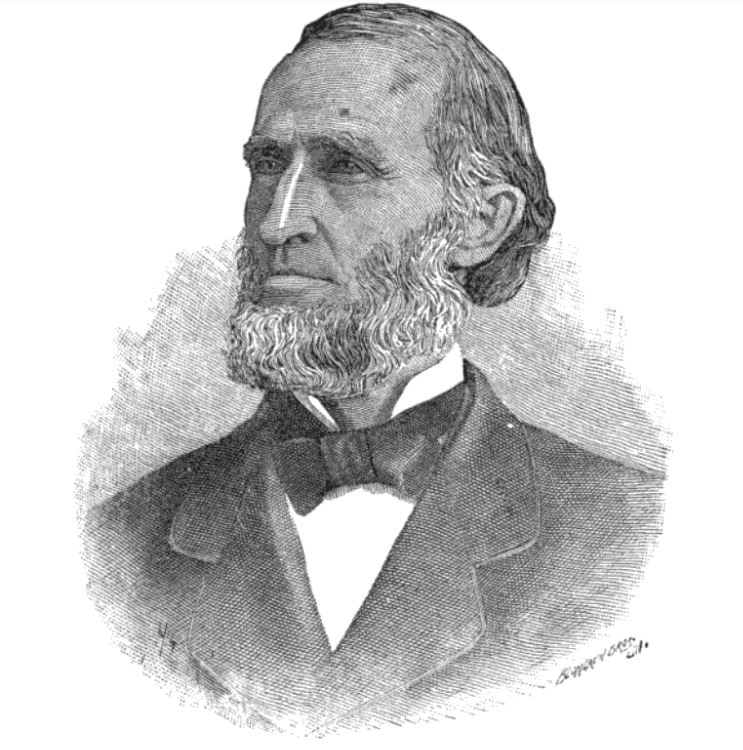
Eliza had apparently become aware of Fairbank’s previous work with helping enslaved people, and as the abolitionist was walking near the jail where she was being confined awaiting sale, Eliza got Fairbank’s attention by tapping on the window. Allowed to visit with her, she told Fairbank her sad tale. A quick trip to Cincinnati and a meeting with like-minded men including famous Underground Railroad conductor Levi Coffin and abolitionist attorney Salmon P. Chase, Fairbank secured $2,275.00 for Eliza’s purchase, as well as papers for additional funds if need be and returned to Lexington.[2]
The day of the auction brought people “representing the wealth and culture of Boston, New York, Philadelphia, Baltimore, Cincinnati, Washington, New Orleans, Louisville, and Frankfort; also the city of Lexington and vicinity. There were ladies and gentlemen, slave-masters and mistresses, and speculators in human chattels—all anxiously waiting.” Many were eager to bid, including a “short, thick-necked, black-eyed Frenchman from New Orleans,” and Fairbank, who stood beside Eliza’s aunt and “two counselors-at-law retained in my service.”[3]
On the auction block stood Eliza and the auctioneer, who “directed attention to the valuable piece of property, using all his cultivated art to enhance its interest, calling particular attention to her exquisite qualities as a mistress for any gentleman.” Bids started at $250.00 and quickly escalated to $1200.00. The New Orleans Frenchman asked Fairbank how high he planned to go. Fairbank replied, “Higher than you do, Monsieur.” On it went, up to $1300.00, and then Fairbank bid $1450.00. The Frenchman stood silent. The auctioneer almost called it at end then, but on second thought and hoping to drive up the bidding, he sat down his gavel and “unbuttoning Eliza’s dress, threw it back, exhibiting . . . her superb neck and breast, shouting in the true professional tone: ‘Look here gentlemen! Who is going to lose such as chance as this? Here is a girl fit to be the mistress of a king!’” The crowd stood aghast.[4]
Fairbank increased his bid to $1475.00. When asked again how high he planned to go, the reverend replied to his competitor, “you cannot command enough money to take this girl.” The auctioneer, still not content to let the bidding stop, “turned his victim’s profile to that excited crowd, and lifting her skirts, laid bare her beautiful symmetrical body, from her feet to her waist, and with his brutal sacrilegious hand smote her white flesh, exclaiming: ‘Ah! gentlemen who is going to be the winner of this prize? Who is the next bid?’” The crowd was embarrassed but the Frenchman bid $1480.00. Again, with the auctioneer about to call it, Fairbank quickly bid $1485.00. “The Frenchman shook his head,” and turned away Fairbank remembered. Eliza fainted. When asked what Fairbank would do with her, he responded “Free her, sir.” To Fairbank, it was “The most remarkable [sale] I ever witnessed.”[5]
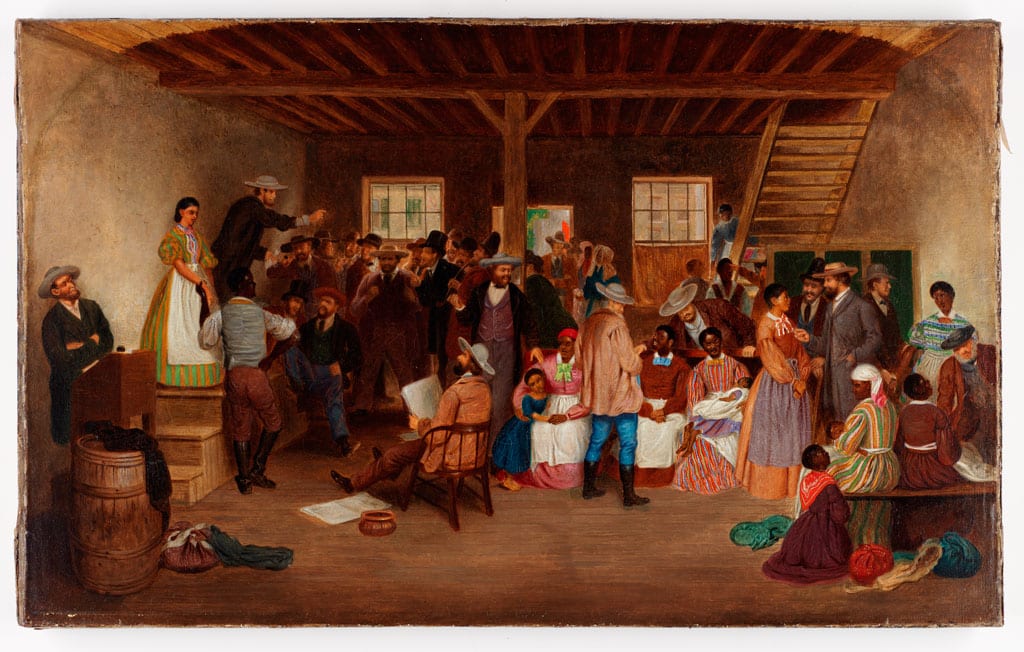
But was it unusual? It appears not. The sale of so-called “Fancy Girls” was not uncommon in the slave trading South as evidenced in many accounts such as Fairbank’s and as supported in advertisements printed in southern newspapers. A quick survey located numerous ads offering “fancy girls” as young as 12 or 13 years old. Today, stories of human sex trafficking abhor us, but during a time and place when owning another human being was not only legal, but also a distinction of a certain level wealth and social standing, and thus power, it was a piece of the nation’s market economy.
According to historian Walter Johnson, “Along with the social distinction, honor, and paternalism that could be wrung from the bodies and souls of the enslaved, slave traders were selling the buyers another fantasy: that other people existed to satisfy their desires.” In describing the term “fancy,” Johnson explains, “The word ‘fancy’ has come down to us as an adjective modifying the word ‘girl,’ an adjective that refers to appearance perhaps, or manner or dress. But the word in its other meaning describes a desire: ‘he fancies . . .’ The slave market usage embarked from this second meaning: ‘fancy’ was a transitive verb made noun, a slaveholders desire made material . . . .” Johnson uses a description by a slave trader named Philip Thomas for a sale he witnessed in Richmond, Virginia, in 1859: “13 years old Girl, Bright Color, nearly a fancy [sold] for $1135.”[6]
Swiss travel writer Fredericka Bremer, after visiting the Richmond slave markets wrote, “In another ‘jail’ were kept the so-called ‘fancy girls’ for fancy purchasers. They were handsome fair mulattoes, some of them almost white girls.”[7]
Surviving slave trader correspondence is replete with references to fancy girls and the liberties that they took with them before selling them on to eager buyers. For example, writing in 1834 to his Richmond contact, Rice Ballard, notorious trader Isaac Franklin wanted Ballard to send him a girl that Ballard had bought in Charlottesville for his own use and then to make a profit in the Natchez or New Orleans markets. Using not so veiled language, Franklin wrote, “Your old one eyed friend is brought up all standing the Fancy Girl from Charlottesville will you send her out or shall I charge you $1100 for her say Quick I wanted to see her I fear the time for the 1100 Dollar prices are over and that I will not git to see the fancy maid.”[8]
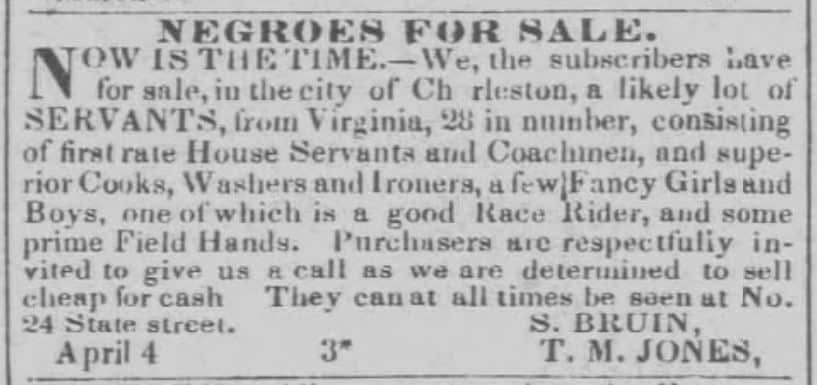
The earliest ad in my limited survey appeared in 1838. Speculators S. Bruin and T. M. Jones placed a notice in the Charleston Mercury offering NEGROES FOR SALE. The ad claimed the traders had a “likely lot” of 28 enslaved people who had arrived from Virginia. Among them were “House Servants and Coachmen, and Superior Cooks, Washers and Ironers, a few Fancy Girls and Boys, one of which is a good [horse] Race Rider, and some prime Field Hands.”[9]
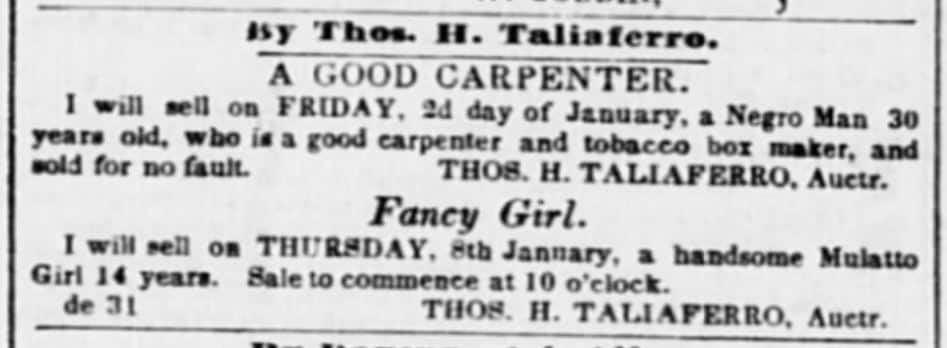
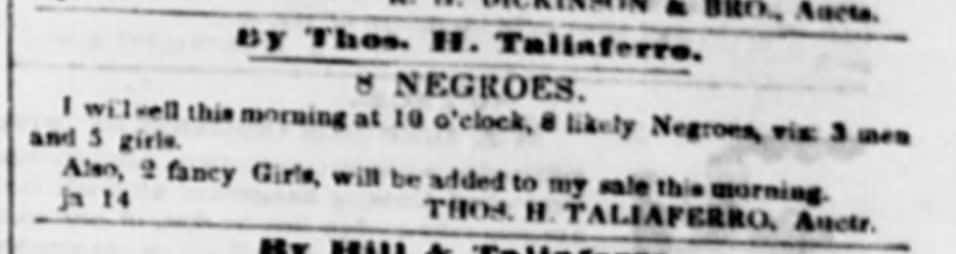
However, most of the advertisements were more specific, as they well knew that fancy girls could bring top dollar prices. Auctioneer Thomas Talifaferro (pronounced Tolliver) placed an ad in the Richmond Daily Whig on New Year’s Day 1846. In it he used a headline of “Fancy Girl,” and went on to describe her as a “handsome Mulatto Girl 14 years,” who was to be sold at 10:00 am on January 8. Two weeks later, Taliaferro ran another ad for a sale that very day, January 14, 1846. After stating that he would sell “three men and five girls”, he noted, “Also 2 fancy Girls, will be added to my sale this morning.”[10]
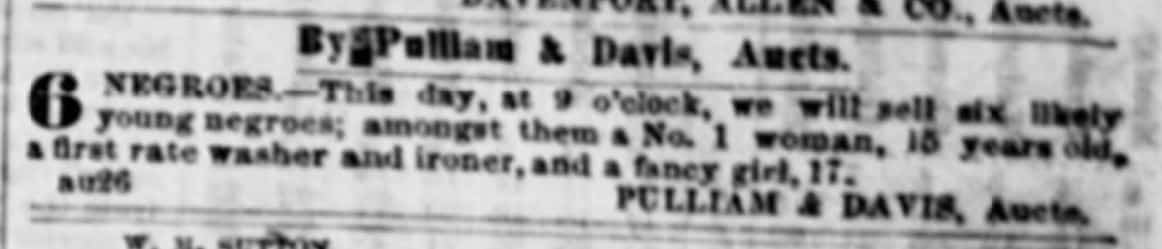
A few years later, in 1853, slave trading partners David Pulliam and Hector Davis advertised a sale for August 26, which included “six likely young negroes.” Traders used the term “likely” to denote individuals (female or male) who were attractive. Among this group offered by Pulliam and Davis were “a No. 1 woman, 15 years old[;] a first rate washer and ironer, and a fancy girl, 17 [years old].”[11]
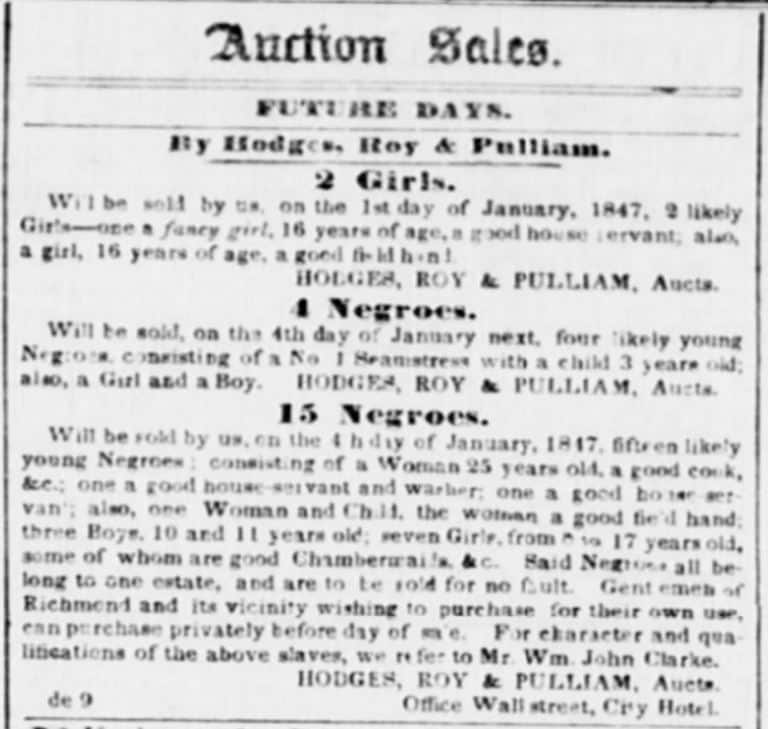
David Pulliam had previously been involved in a three-man trading firm, Hodges, Roy, and Pulliam. These men advertised in December 1846. One ad included the headline, “2 Girls.” The sale, set for New Year’s Day 1847, offered “2 likely girls—one a fancy girl, 16 years of age, a good house servant; also a girl, 16 years of age, a good field hand.” The sellers’ distinction between a fancy girl and a field hand girl, both the same age, is probably purposeful.[12]
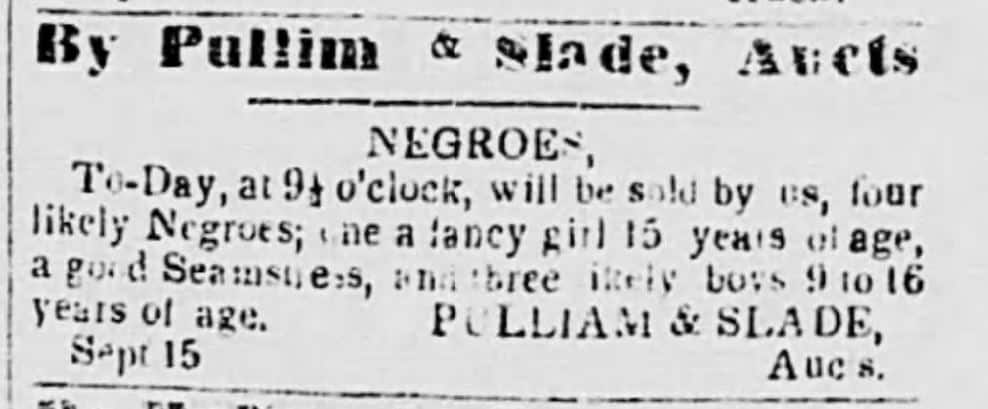
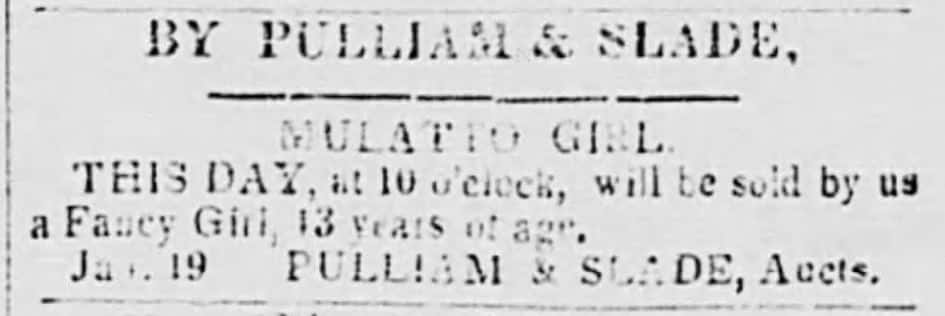
Pulliam again apparently changed partners as in 1848 and 1849, he advertised with a Mr. Slade. In September of 1848, the duo notified potential buyers that they had “four likely Negroes.” Their ad included “one, a fancy girl 15 years of age, a good Seamstress,” and “three likely boys 9 to 16 years of age.” Four months later Pulliam and Slade placed a notice for a “MULATTO GIRL,” informing wishful buyers of their sale on January 19, 1849, of “a Fancy Girl, 13 years of age.”[13]
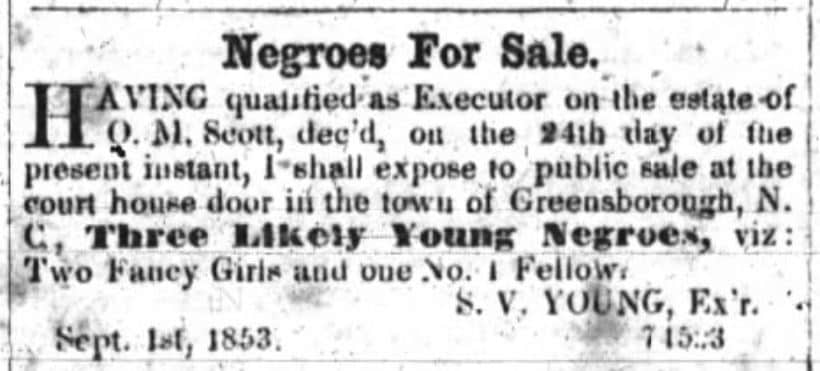
Not only traders, but executors of estates of the deceased advertised fancy girls, too. S. V. Young most probably understood that he could generate more revenue for the estate by the way he worded the enslaved people he offered for sale. Published in the Greensboro, North Carolina Patriot, the ad noted the sale happening at the “court house door,” included Three Likely Young Negroes, viz: Two Fancy Girls and one No. 1 Fellow.”[13]
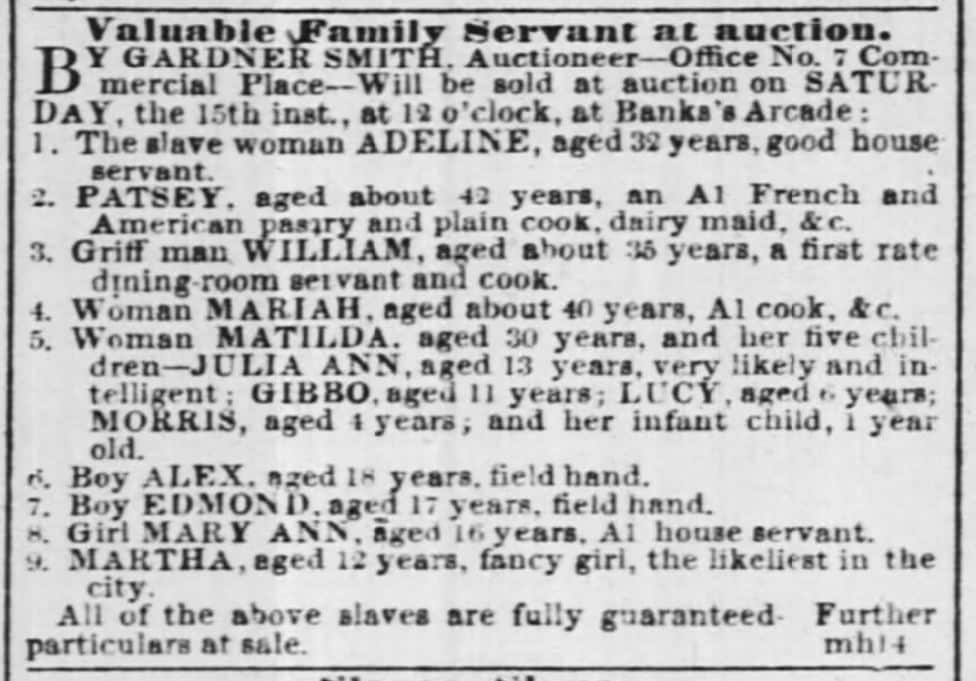
It seems only natural that these ads would largely appear in major slave trading areas of the South like Richmond and Charleston. Another ad, this one from trader Gardner Smith in New Orleans, which was perhaps the largest commercial location for buying, selling, and trading human beings in the United States at the time, offered nine individuals. The last, Martha, was described as “aged 12 years, fancy girl, the likeliest in the city.”[14]
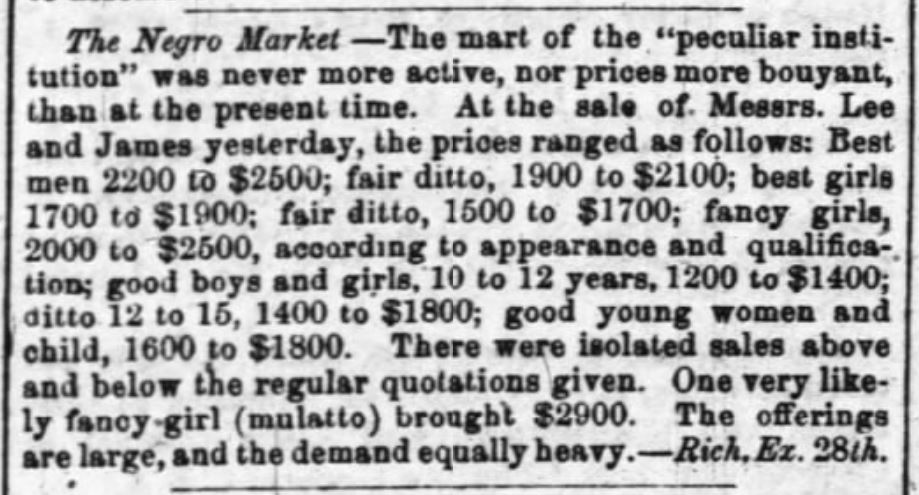
A short article in the March 2, 1863, Fayetteville Semi-Weekly Observer shared prices from “The Negro Market” in Richmond that apparently came from a newspaper in the Confederate capital. It gave the prices for different groups of enslaved people such as “best men,” “best girls,” and “fancy girls.” The prices for fancy girls, listed at $2000 to $2500, rivaled those of the best men, which ran at $2200 to $2500. The brief piece closed noting that “One very likely fancy-girl (mulatto) brought $2900.” While these prices were up due to increased inflation during the war, they still show how much some enslavers were willing to pay for fancy girls and that the slave market was still doing fine business during the war.[15]
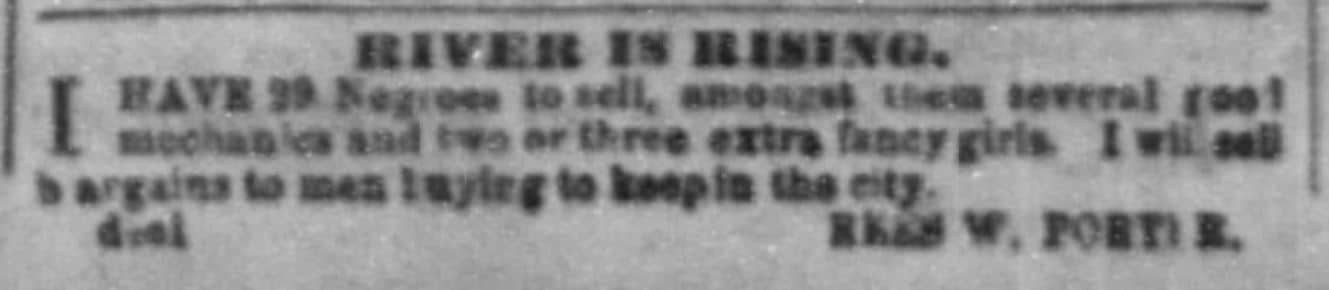
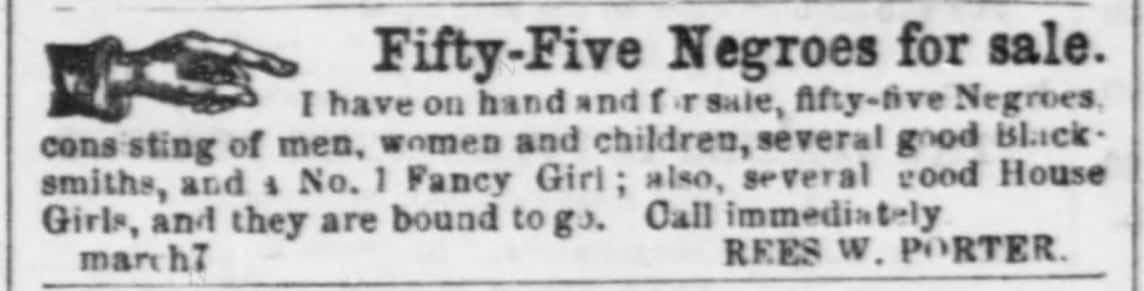
Rees W. Porter, a Nashville trader who advertised in several of that city’s newspapers headlined his ad “River is Rising”. He had “29 negroes to sell.” Among them were “two or three extra fancy girls.” A year earlier, Porter placed an ad for “55 Negroes for Sale.” He mentioned having a “No. 1 Fancy Girl.”[16]
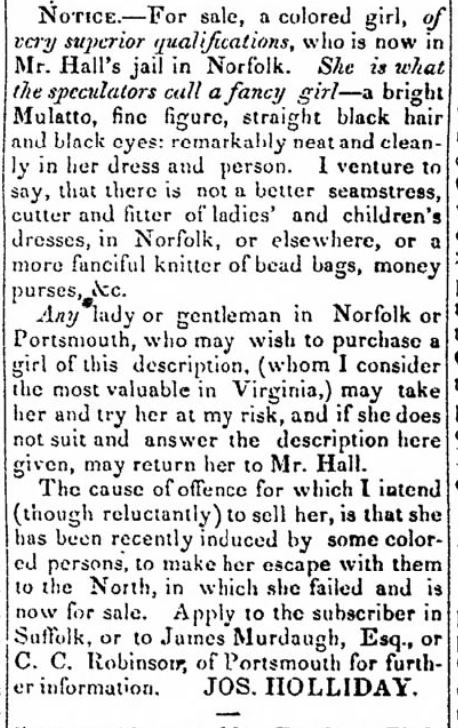
As was the case with many issues involving slavery—including the use of “Negro Dogs,” which was examined in two earlier ECW articles—newspapers in the Free States shared fancy girls ads from Slave State newspapers and often including negative commentary. For example, one ad that received rather heavy circulation came from Norfolk, Virginia. The Norwalk, Ohio, Huron Reflector published it on November 6, 1849, copying it from the Ohio State Journal.
The original ad’s opening, placed by Joseph Holliday, stated, “For sale, a colored girl, of superior qualifications, who is now in Mr. Hall’s jail in Norfolk. She is what speculators call a fancy girl—a bright mulatto, fine figure, straight black hair and black eyes; remarkably neat and clean in her dress and person.” To add to the unnamed girl’s value, the seller claimed she was an excellent seamstress and a “fanciful knitter of bead bags, money purses, &c.” Holliday went on to assert that she was “the most valuable in Virginia.” He even offered potential purchasers to “take her and try her at my risk, and if she does not suit and answer the description here given” she may be returned to Hall’s jail. Holliday honestly included that the reason he was selling her was that she had attempted to run away to the North and “in which she failed and is now for sale.” The Huron Reflector quoted the commentary that the State Journal shared that the ad “speaks more than volumes of argument against the most infamous system of wrong the earth bears us. Mothers, sisters, daughters, read it; then refuse, if you can, to give your influence against a system, which makes merchandize of virtue and the beauty of your sex.”[17]
The Gettysburg Star and Banner, also ran the ad with the commentary that “Presuming that Mr. Holliday has sold the girl, we publish h[i]s advertisement to show how slavery degrades and brutalizes the human mind.” The Weekly Plain Dealer, published in Cleveland, also shared the ad. Calling out Holliday’s hypocrisy, it pointed out, “What can induce her owner to part with her?—She is sighing for liberty! Oh what a crime—for one so intelligent, so ‘bright,’ and keenly sensitive to her degraded position to want to breath the free air of Heaven. Her ‘very superior qualifications,’ are her greatest misfortunes. She has discovered herself a human being, while those around her have not. She pants to be free, and for this crime, her inhuman master locks her up in Norfolk Jail and offers her for sale.”[18]
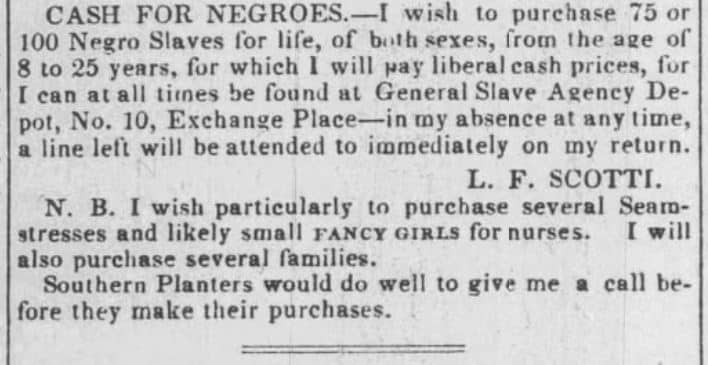
The editors of the National Anti-Slavery Standard, which was published in New York, shared an ad from the Baltimore Clipper placed by L. F. Scotti wishing to buy “75 to 100 Negro Slaves.” Scotti particularly sought “several Seamstresses and likely small fancy girls for nurses.” The Standard commented that “If I am rightly informed for what purpose the class designated as ‘Fancy Girls,’ are wanted, the undisguised wickedness of such an advertisement exceeds all that I had supposed even slave-traders would be guilty of, or community would countenance, pretending to possess that small share of respectability and decency, which is generally found in Southern cities.”[19]
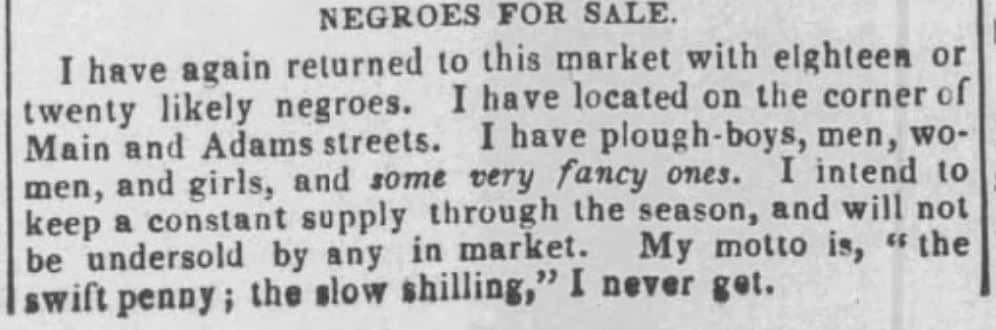
A few years later the Anti-Slavery Standard shared an ad by Memphis-based trader W. H. Bolton. The Standard did not offer commentary on this particular ad, apparently only running it as an example of what regularly appeared in Slave State newspapers. Bolton advised that he had “returned to this market with eighteen or twenty likely negroes.” He provided his address and noted that among his current stock he had “plough-boys, men, women, and girls, and some very fancy ones.” Bolton closed his ad with, “I will also pay the highest cash price for young negroes.” (not shown in above image)[20]
As these accounts and advertisements vividly show, the commodification of young enslaved female bodies was a horrid result when human beings exercising power over them viewed them first as property instead of as individual people worthy of selfhood, dignity, and respect. Greedy slave traders seeking to maximize profit all too often found lecherous buyers who were all too eager to satisfy their fleshly desires in a social system that was then legal. Fortunately, at least some in that era recognized the marketing and selling of so-called fancy girls as yet another morally reprehensible product of the “peculiar institution.” Abolitionists frequently used “fancy girl” accounts and advertisements within their speeches and literature to try to convince others of slavery’s inherent injustice, its damage to the morals of both the enslaved and their enslavers, and the nation.
[1] Calvin Fairbank, Rev. Calvin Fairbank during Slavery Times: How He “Fought the Good Fight” to “Prepare the Way” (Chicago: R. R. McCabe & Co., 1890), 26
[2] Fairbank, 26-27.
[3] Fairbank, 27-28.
[4] Fairbank, 28-29
[5] Fairbank, 29-31, 34.
[6] Walter Johnson, Soul by Soul: Life Inside the Antebellum Slave Market (Cambridge, MA: Harvard University Press, 1999), 113.
[7] Fredericka Bremer, The Homes of the New World: Impressions of America, Vol. 2 (New York: Harper & Brothers, 1864), 535.
[8] Joshua D. Rothman, The Ledger and the Chain: How Domestic Slave Traders Shaped America (New York: Basic Books, 2021), 153-154; for additional discussion see: Alexandra J. Finley, An Intimate Economy: Enslaved Women, Work, and America’s Domestic Slave Trade (Chapel Hill, NC: University of North Carolina Press, 2020), 19-45.
[9] Charleston Mercury, April 4, 1838.
[10] Richmond Daily Whig, January 1, 1846; Richmond Daily Whig, January 14, 1846.
[11] Richmond Daily Whig, August 26, 1853.
[12] Richmond Daily Whig, December 29, 1846.
[13] Richmond Enquirer, September 15, 1848.
[14] Greensboro Patriot, September 17, 1853.
[15] New Orleans Times-Picayune, March 15, 1856.
[16] Fayetteville Semi-Weekly Observer, March 2, 1863.
[17] Nashville Daily Patriot, January 14, 1857.
[18] Norwalk, Ohio, Huron Reflector, November 6, 1849.
[19] Gettysburg, Pennsylvania, The Star and Banner, November 9, 1849; Cleveland Weekly Plain Dealer, October 24, 1849.
[20] National Anti-Slavery Standard, November 14, 1844.
[21] National Anti-Slavery Standard, April 15, 1847.


I have no doubt that slaves were sexually exploited. However, abolitionists also used lurid tales like this to stoke moral and religious outrage against slavery. Should you really take such accounts at face value? It’s like taking a fire eater’s word on the benefits of slavery. Are there any independent sources linking the term “fancy girl/boy” to sex slavery? The ads themselves seem to indicate the term just meant an attractive, “well bred” slave with Caucasian features. I think as historians we have a duty to look at sensational claims like this with a skeptical eye and not at face value.
The connotation of the term “fancy girl” was well understood in the mid-19th century and that was precisely why slave traders used it in their advertising. There is large body of historical scholarship available on this particular aspect of the domestic slave trade. That, in my opinion, is not taking it as “face value.”
I’d be very curious to see the historiography on this subject. I guess I just don’t see the connotation in these ads and need help connecting the dots with primary sources.
I would expect a few Southern preachers and priests would have preached against such a practice. In a time when in white society, it was a major breach of the social rules for a man to speak to woman to whom he had not yet been introduced.
Tom
Read Shannon Eaves’ excellent book “Sexual Violence and American Slavery.”
I always enjoy reading your articles on slavery and appreciate the quality and the information that you provide.
I think this article is one of your best. Well done!
Thank you. Not a whole lot of people know about this aspect of the domestic slave trade.
You’re right. I did not know the level of that depravity. Sure Hollywood movies hint at it, but I had generally taken that as Tarantino style Hollywood movies, but apparently not!
For some suggested scholarly reading on this topic, see the following:
-Michael Tadman, Speculators and Slaves: Masters, Traders, and Slaves in the Old South, The University of Wisconsin Press, 1989, pages 126-127.
-Edward Baptist, The Half Has Never Been Told: Slavery and the Making of American Capitalism, Basic Books, 2014, pages 239-244.
-Edward Baptist, “”Cuffy”, “Fancy Maids”, and “One-Eyed Men”: Rape, Commodification, and the Domestic Slave Trade in the United States,” in Johnson, Walter (ed.). The Chattel Principle: Internal Slave Trades in the Americas, Yale University Press, 2005, pages 165–191.
-Joshua D. Rothman, The Ledger and the Chain: How Domestic Slave Traders Shaped America, Basic Books, 2021, pages 150-155.
-Walter Johnson, Soul by Soul: Life Inside the Antebellum Slave Market, Harvard University Press, 1999, pages 113-115; 154-155.
-Alexandra J. Finley, An Intimate Economy: Enslaved Women, Work, and America’s Domestic Slave Trade, UNC Press, 2020, pages19-45.
-Finley, Alexandra, “‘Cash to Corinna’: Domestic Labor and Sexual Economy in the ‘Fancy Trade,'” The Journal of American History (September 2017), pages 410–430.
-Maurie D. McInnis, Slaves Waiting for Sale: Abolitionist Art and the American Slave Trade, Univ. of Chicago Press, 2011, pages 138-143.
-Catherine Clinton, The Plantation Mistress: Woman’s World in the Old South, Pantheon, 1982, pages 211-214.
-Tiye A. Gordon, “The Fancy Trade and the Commodification of Rape in the Sexual Economy of 19th Century U.S. Slavery” unpublished thesis, 2015, online at: https://scholarcommons.sc.edu/etd/3636/
Are there any such advertisements from the slave trader Nathan Bedford Forrest?
Not that I am aware of. Although I did come across an ad posted by him and his partner Jones in the Memphis Daily Appeal (Feb. 16, 1860) seeking to buy “500 Negroes,” and stating “We will pay more than any other person for No. 1 Negroes, suited to the New Orleans market.”
Were “Eliza” the daughter of her master, and 1/64th black, as the Reverend Fairbank remembers, then her master – the name of whom he somehow cannot remember, though it would not only have been announced at the auction but listed on any bill of sale – would not only have been her father, but also her great-great-great-great-grandfather as well. What a pity we don’t have his name, for he would have been one hell of a physical specimen for scientists to study.
A person who is 1/64 Black means that one of that person’s great-great-great-great grandparents was Black. Since slave law typically passed on the free or enslaved condition of the mother to the child, it is possible that Eliza’s mother (1/32nd Black) was also a very light complexioned enslaved woman.
Are there any letters or anything that shows how these slave owners wives felt when he comes home with a fancy girl? I don’t recall ever hearing about any white female’s reaction to the slave abuse that happened.
The most famous comment on this comes from the diarist Mary Chestnut who wrote,
“I wonder if it be a sin to think slavery a curse to any land. [Senator Charles] Sumner said not one word of this hated institution which is not true. Men and women are punished when their masters and mistresses are brutes and not when they do wrong – and then we live surrounded by prostitutes. . . . God forgive us, but ours is a monstrous system [a] wrong and [an] iniquity. … Like the patriarchs of old our men live all in one house with their wives and their concubines, and the mulattoes one sees in every family exactly resemble the white children – and every lady tells you who is the father of all the mulatto children in everybody’s household, but those in her own.”
I’d be curious to hear other comments as well.
Chestnut’s quote is not specific to “fancy girls.” She could just as easily have been addressing the much more common practice of ad hoc sort of slave concubinage.
Tom
I have not come across any mentions of fancy girls from wives of enslavers, but if they wrote about it, it would probably have been in diaries, as that is something they likely wouldn’t want others to know about. I suspect that many of the men who purchased fancy girls were bachelors.
Numerous enslaver bachelors had relationships with enslaved women, but whether those women were purchased as fancy girls is difficult to determine. Regardless, the power dynamic of owner and property meant that women had little recourse when it came to men’s desires. Martin Van Buren’s vice president, Kentuckian Richard Mentor Johnson, had a relationship with Julia Chinn that produced two daughters, who were so light that they later married white men. Amrita Chakrabati Myers covers Chinn’s story in “The President’s Black Wife: The Untold Life of Julia Chinn.” There are numerous accounts of enslavers who chose relationships with their enslaved women over their white wives. White women usually had few legal choices other than accepting the situation, hoping a divorce would be approved, or moving in with her former family or relatives.
Interestingly, a number of the slave traders made common law wives of fancy girls, enslaved women, and free women of color. Richmond trader Silas Omohundro had a light-complexioned “wife,” named Corina Hinton, and trader Robert Lumpkin had a “wife” in Mary Lumpkin, who was described as “nearly white” and “fair faced.” Mary Lumpkin’s story is well documented in “The Devil’s Half Acre: The Untold Story of How One Woman Liberated the South’s Most Notorious Slave Jail,” by Kristen Green. Richmond trader Bacon Tait, maintained a long-term relationship with a free woman of color named Courtney Fountain that produced several children. Tait and Fountain’s complicated story is covered by Hank Trent in “The Secret Life of Bacon Tait: A White Slave Trader Married to a Woman of Color.”
I just found this article after reading finishing the excellent “Sexual Violence and American Slavery” by Shannon Eaves. She documents the effects of sexual slavery on Southern families (both black and white) quite extensively. The upshot was, their wives obviously didn’t like it, and they frequently took it out on the enslaved women. Some left their husbands and lived permanently with their families, but most were unable to pursue a divorce, unless they were from extremely wealthy families.
And if the female slave had “religion” she went for a higher price. “Religion” being code for knowledge of who was the boss.
Great piece, Tim!
Thank you, Eric!
Thanks, Tim, for the very well researched narrative on this topic. I did not know this kind of trade was so open as evidenced by newspapers, code words, and enabling law officers.