The Battle of the Interior Department, November, 1862
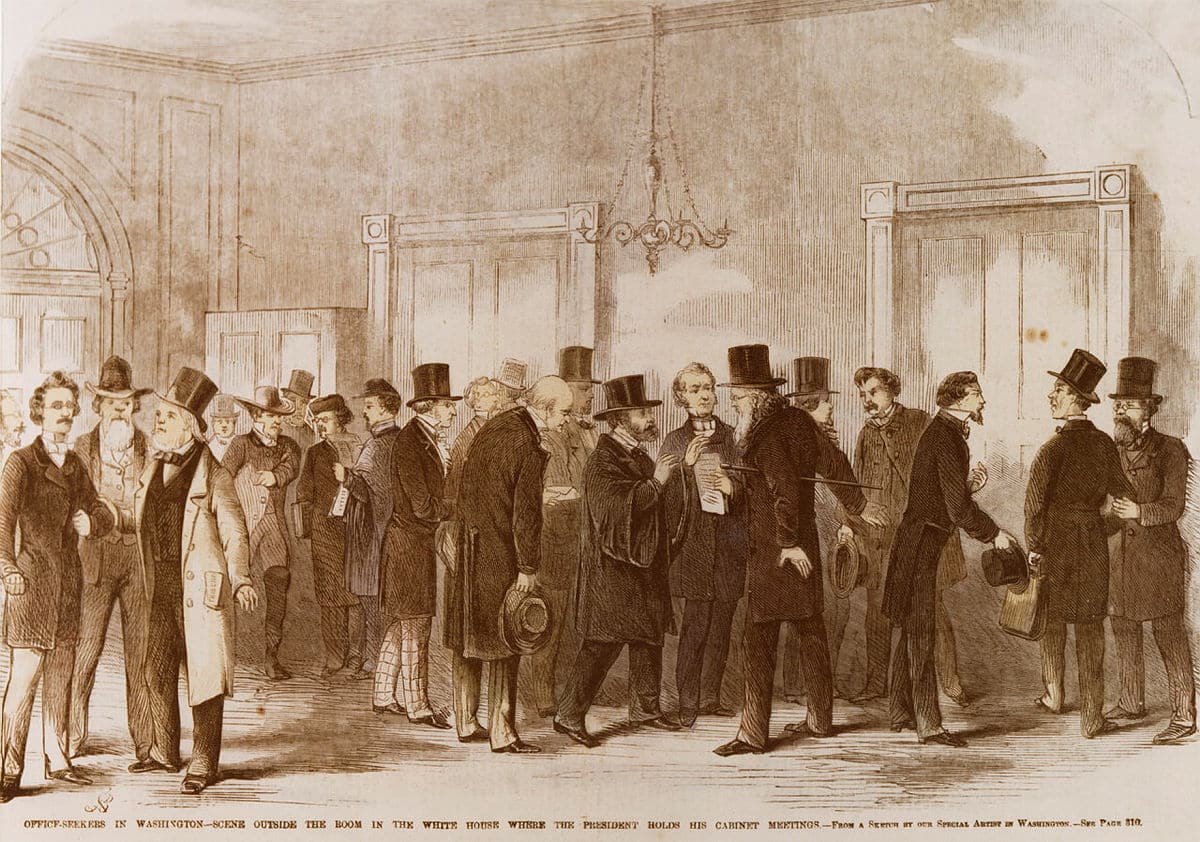
For the 19th century presidency, one of the least glorious but most onerous duties of the office was the assignment of political offices and patronage positions. When Abraham Lincoln served, it would not be an uncommon occurrence for hundreds, even thousands of office-seekers to flood into the Executive Mansion in the hopes of securing a presidential appointment.
These crowds of applicants were often only hoping to receive lower-level bureaucratic positions. For the most prestigious positions, such as the cabinet, whole networks of politicians, party leaders, newspapermen, and other figures of influence could struggle against each other to see that their favored candidate was nominated.
One such occasion occurred in November 1862. Secretary of the Interior Caleb B. Smith, suffering from ill health and disenchanted by Lincoln’s policy of emancipation, informed Lincoln of his intention to resign from the cabinet.[1] As word of this spread, a flurry of jockeying for the office ensued. Not only was a cabinet position available, but one at the head of a patronage-rich department.
Perhaps the leading contender to take the office initially was Representative Schuyler Colfax of Indiana. Colfax was a well-liked and well-connected man of considerable talent and connections. His allies forcefully advocated for the Hoosier’s appointment as Postmaster General when Lincoln was first coming into office. Unfortunately for them, the appointment of Smith as secretary of the interior had essentially foreclosed this possibility, as Smith was fellow Hoosier and tradition dictated that a state should only have one representative in the cabinet.[2]
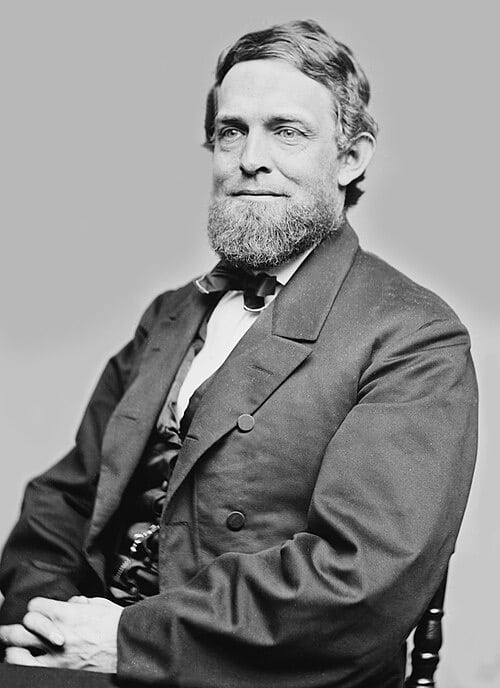
Now that Smith was stepping down, it seemed possible for Colfax to finally enter the cabinet. Despite the 39-year-old’s many allies, however, he also had his share of enemies. One particularly interesting example of the intriguing that surrounded the battle for the nomination is a letter sent by Eliakim P. Walton, a fellow representative, to Lincoln.[3]
Beginning with a humble plea to “allow me one minute of your time on cabinet arrangements,” Walton makes clear that he opposes the nomination of Colfax as secretary of the interior. He adopts a rather unique strategy of argumentation, however. First, he praises Colfax’s character and political abilities, declaring, “you cannot spare him from the 38th Congress: I know of no man in it as yet who cannot be better spared.”
In the next paragraph, he suddenly switches to impugning Colfax’s character and conduct as unfit for a cabinet member. Without a hint of irony, he writes, “In these times you want an adviser in questions of the highest statesmanship – a profound, strong, brave, firm man, wise and self reliant. I do not think Colfax has these qualities.”
For good measure, Walton adds one more argument, claiming that Colfax can not be removed from the House lest his seat fall into the hands of the Democrats. He closes the letter by assuring Lincoln that his advice is solely motivated by “public considerations” and that he truly bears no ill will towards the Hoosier.
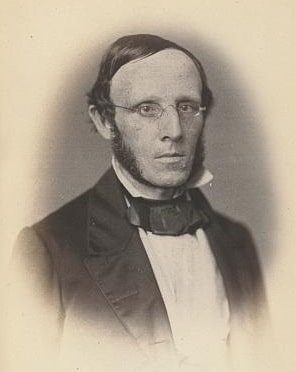
History does not record what effect Walton’s letter had on the president’s decision-making process, but ultimately Walton’s aim was accomplished: Lincoln nominated Assistant Secretary of the Interior John P. Usher to succeed Smith, while Colfax remained in the House of Representatives.
For his part, Colfax claimed the decision was his own. He wrote to his mother on December 7, “I could have gone into the Cabinet if I had desired to, but told Mr. Lincoln I could not surrender my district to the enemy.”[4] Perhaps Gideon Welles most accurately described the reason that Lincoln twice decided against appointing Colfax. As Welles noted in his diary from the time, Lincoln “wants confidence in Colfax, whom he considers a little intriguer, – plausible, aspiring beyond his capacity, and not trustworthy.”[5]
The scuffle over secretary of the interior is just one example of the continual war for office that was waged during Lincoln’s presidency. Even as civil war threatened to tear the country asunder, some national traditions continued unabated.
Endnotes:
[1] David Herbert Donald, Lincoln, (New York: Simon & Schuster, 1995), 379.
[2] Ovando James Hollister, Life of Schuyler Colfax, (New York, Funk, 1886), 174-175.
[3] Eliakim P. Walton to Abraham Lincoln, November 13, 1862, Abraham Lincoln Papers, Library of Congress.
[4] Schuyler Colfax to Hannah Colfax, December 7, 1862. in Life of Schuyler Colfax, Ovando James Hollister (New York, Funk, 1886), 201.
[5] Gideon Welles, Diary of Gideon Welles: Secretary of the Navy under Lincoln and Johnson, ed. Howard K. Beale, vol. 1 (New York: W. W. Norton & Company. Inc, 1960), 481.


Thank-you for this thought provoking article.
It is said “Politics make strange bedfellows.” The attempted introduction of the Wilmot Proviso caused a rift in the Democrat Party in the 1840s that remained unhealed – particularly in Missouri – up until the firing upon Fort Sumter. And the “selection of a replacement for the Lincoln Administration’s Department of the Interior” caused its own curious grumblings in 1862. Why such peculiar interest in the Department of the Interior?
Several months prior to the Presidential Election of 1860 a scheme had been initiated by which Indian Bonds held for safekeeping by the Department of the Interior were removed from a safe without authority and passed to intermediaries who ultimately delivered them to William Hepburn Russell to be used as collateral for MORE loans, in an effort to keep the financially struggling Pony Express afloat. In all, $800 000 worth of bonds were withdrawn from safekeeping; and the Negotiable Bonds were likely held by the brokerage house or merchant bank that provided loans to the Pony Express… until the Pony Express went defunct in October 1861. Those bonds were NEVER returned to the Department of the Interior. “The Case of the Abstracted Indian Bonds” was still alive in the public mind in 1862: one of the key participants in the scheme, Buchanan’s Secretary of War John B. Floyd was a Confederate General who “escaped the closing net at Fort Donelson to avoid capture and ‘retribution for his role in the Indian Bond Affair.’”
Newspapers of the day indicate “Superintendence of Capitol Building renovations was being transferred from the War Department to the Department of the Interior [26 March 1862 Washington ‘Daily National Intelligencer’]” the “Completion of the Washington Aqueduct project required contracts be let by the Department of the Interior [6 August ‘Daily National Intelligencer’]” and one of “the chief clerks of the Interior Department, Robert G. Hedrick, retired in October [6 October ‘Daily National Intelligencer’].” So it appears “sound financial management” combined with “ability to negotiate/superintend completion of contracts” and “LACK of ANY SUGGESTION of being an INTRIGUER” were key elements required by Secretary Smith’s replacement.
And, wouldn’t you know… John Palmer Usher was an Indiana politician prior to accepting the Assistant Secretary of the Department of the Interior role. So it would appear that Usher was “the most suitable man for the job” in November 1862.
Thank you! If the “LACK of ANY SUGGESTION of being an INTRIGUER” was a key consideration for the post of Secretary of the Interior, that provides another possible reason Lincoln passed over Colfax, considering that is exactly what Lincoln considered him.