My Interpretation of McDowell’s Artillery Charge at the Battle of First Manassas
“Victory! Victory! The day is ours! They are running! They are in retreat!” Irvin McDowell yelled near Matthews Hill to his triumphant soldiers on the late morning of July 21.[1] Just a couple of hours later, though, McDowell’s army still faced its Confederate opponents on the very battlefield he claimed to have won. How could he complete the victory? McDowell made a decision that historians have debated for the last 165 years: send artillery to occupy the critical piece of terrain on the Manassas battlefield, Henry Hill.
McDowell’s reasoning has never been clear, and many theories have been proposed since the battle ended. The quick decision McDowell made on the afternoon of July 21 grew out of his prewar background and the battlefield situation as it unfolded—and the very ability of McDowell and his subordinate officers to exert command and control on the field is what doomed the plan. This is my interpretation of how McDowell reached that fateful decision during the Civil War’s first major battle.
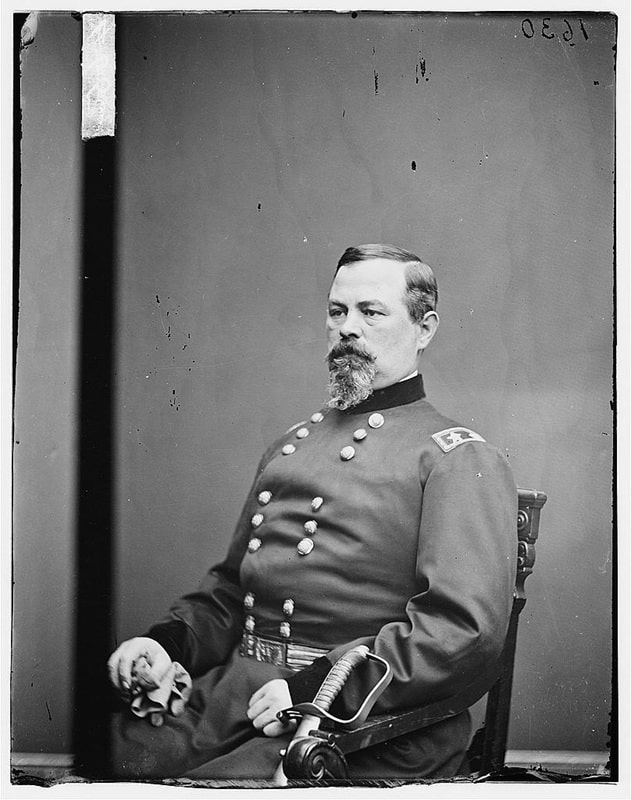
McDowell had good reason to be optimistic and to proclaim victory that morning. After spending two days maneuvering to get his army onto the same side of Bull Run as the Confederates, a sizable portion of his force—roughly 12,000 men—now hovered over the Confederate left flank, having defeated portions of two brigades on Matthews Hill. More troops were on the way. Two of his divisions, David Hunter’s and Samuel Heintzelman’s, remained combat effective; only Ambrose Burnside’s brigade needed rest. All told, McDowell had five infantry brigades available to press the attack.
Two of these brigades were fresher than the other three, which had endured an early-morning march of over half a dozen miles to get around the Confederate left unopposed. These fresher brigades belonged to Brig. Gen. Daniel Tyler’s division and were led by colonels William T. Sherman and Erasmus Keyes.
Sherman’s men marched toward Matthews Hill, where Sherman found Hunter’s division—mostly Burnside’s brigade—had “had a pretty severe fight.” From his vantage point, he believed the enemy “were seemingly retreating.” McDowell soon confirmed this impression, ordering Sherman “to join in the pursuit” and secure Henry Hill.[2]
Dreaming of a pursuit and organizing one, however, were two different things. McDowell struggled mightily to control his army once it engaged in battle, largely because his staff was far too small for the task. As he had observed just thirteen days earlier, though he commanded a large army, “he was only a brigadier” and so “was obliged to be content with a brigadier’s staff”—one far too minuscule to manage an army in the field. Lacking a chief of staff, McDowell had to serve as both commander and chief administrator, building his army from the ground up.[3] “Brigades are scarcely formed; the commanders of brigades do not know their commands, and the soldiers do not know their generals,” observed one civilian close to McDowell before the campaign began.[4]
If the undersized staff hampered McDowell’s infantry, his artillery was in far better shape. McDowell was himself a former artillerist and had organized that branch of the army “almost with his own hands.”[5] He also had a dedicated chief of artillery, Major William Barry, who oversaw all the batteries in the army.
This gap between McDowell’s tight grip on his artillery and his looser hold on the infantry became apparent in the very moment of triumph on the morning of July 21. His assistant adjutant general, Capt. James B. Fry, recalled how McDowell “rushed in person into the conflict, and by the force of circumstances became for the time the commander of the turning column and the force actually engaged, rather than the commander of his whole army.” As a result, McDowell’s “orders were mainly or wholly to the troops under his own observation”—leaving no one to coordinate an army-wide pursuit of the Confederates now regrouping atop Henry Hill, south of the Warrenton Turnpike.[6] Captain William Averell, a staff officer recently promoted on the battlefield to lead a brigade, put it plainly: “There was a want of a headquarters somewhere on the field. All the staff officers who knew anything about the position of the enemy had to act without orders.”[7]
McDowell seemed frustrated by his inability to orchestrate a cohesive pursuit. Just as he had once exhausted himself managing every detail of his army in camp, he now found himself overwhelmed trying to do the same on the battlefield. He watched several local, piecemeal infantry attacks across the valley of Young’s Branch get repulsed before noon by Confederates posted on Henry Hill’s northern shoulder.
Still, more troops were coming, including the rest of Tyler’s division. Having already slotted Sherman’s brigade for the pursuit, McDowell dispatched Capt. Fry to “find and hurry Tyler forward.”[8] Fry found Tyler and “told him that we were victorious, to form line to the left, and advance up the slope in front.”[9]
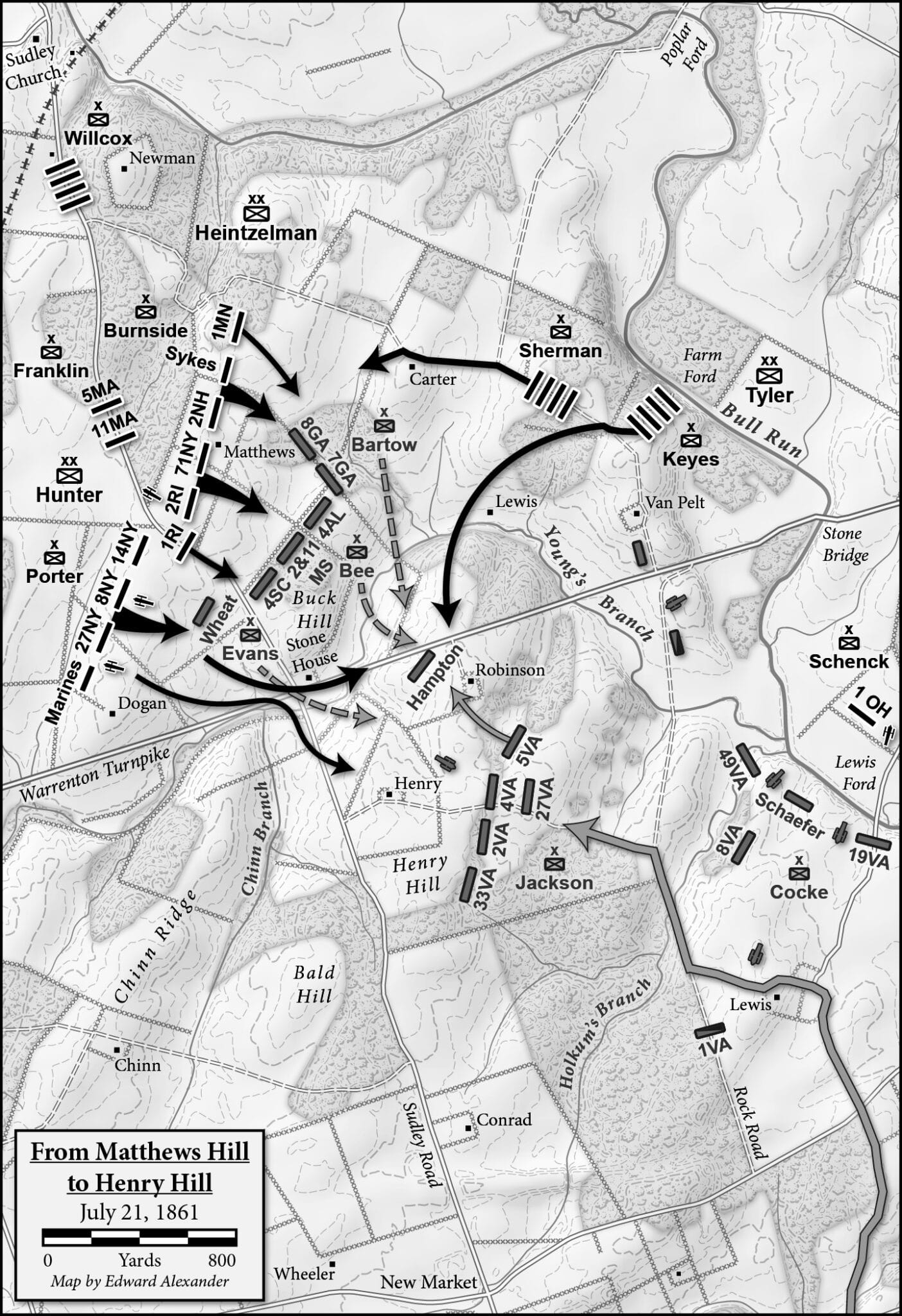
Tyler’s assault, spearheaded by two of Keyes’ regiments, was the most concerted push yet on Henry Hill. It gained some ground on the hilltop but ultimately failed as well. Tyler “sent verbal information” to McDowell of the setback and of his intent to swing his men east of Henry Hill, below the crest, to try to turn the enemy’s position.[10] Even before Tyler’s messenger could reach him, McDowell had likely already seen Keyes’ repulse from his vantage atop Matthews Hill or Dogan Ridge.
By this point, McDowell’s pursuit had stalled. Unsupported infantry attacks from the north were not enough to dislodge the Confederates and seal the victory. He needed something more to drive them from Henry Hill and take the ground for good.
So before 2 p.m., McDowell turned to the branch of his army he knew best and had built himself: the artillery. With Maj. Barry overseeing that arm of the army, McDowell’s orders moved quickly—Barry relayed them to captains James Ricketts and Charles Griffin, whose batteries were ordered to occupy the western side of Henry Hill.
Sending artillery ahead of infantry to secure ground was risky, though not unprecedented; the Confederate guns these batteries would face were themselves posted in front of their own infantry on the hill’s eastern slope. Still, Griffin and Ricketts objected, arguing the infantry should advance first.
The artillery moved out quickly. The infantry was another matter. Relaying orders to infantry regiments—and getting them executed—took far longer than it did for the artillery.
Griffin’s and Ricketts’ batteries reached Henry Hill first, deploying on either side of the Henry house and opening fire on the Confederate guns just 300 yards away.
McDowell likely never intended for his artillery to stand there unsupported for long. Once Barry personally ordered the batteries forward, he scrambled to find nearby infantry to back them up: the 11th New York Fire Zouaves and the 14th Brooklyn, drawn from two entirely different divisions. In the end, twelve regiments from four separate brigades fought for possession of Henry Hill and the guns McDowell had sent there—but they never fought as one cohesive force, instead arriving piecemeal to prop up the artillery.
McDowell’s plan to secure Henry Hill with artillery was not unique, nor was it necessarily a bad one. But it demanded coordination between the batteries and the infantry meant to support them—and that coordination was exactly what McDowell’s army lacked. His artillery was well organized and efficiently commanded; his infantry was not, hobbled by a small and undertrained staff. The decision to send artillery to Henry Hill ahead of infantry belonged to one man, but making it succeed required far more officers than McDowell alone. On July 21, 1861, the Union army fell short in that regard—and paid for it with defeat.
[1] McDonald, We Shall Meet Again, 88.
[2] Simpson and Berlin, eds., Sherman’s Civil War, 123.
[3] Russell, My Diary North and South, 395.
[4] Gurowski, Diary, from March 4, 1861, to November 12, 1862, 61.
[5] Ibid.
[6] Fry, “McDowell’s Advance to Bull Run,” Battles and Leaders of the Civil War, vol. 1, 187.
[7] Report of the Joint Committee on the Conduct of the War, vol. 2, 214.
[8] Fry, “McDowell’s Advance to Bull Run,” Battles and Leaders of the Civil War, vol. 1, 187.
[9] Fry, McDowell and Tyler in the Campaign of Bull Run 1861, 57.
[10] Report of the Joint Committee on the Conduct of the War, vol. 2, 201.


From Alexander’s map it appears as if Sherman failed to take advantage of the exposed Confederate right flank, instead moving off to West perpendicular to it. Anyone know why?
The simple answer is timing and terrain. Sherman doesn’t arrive to that position until after the Confederates have retreated from Matthew Hill and the area is wooded and there is a big hill there so he is unable to observe the location of Confederate position to take advantage of! It’s funny you mention that because the first shots of the battle take place earlier in that location. It’s Wheat’s jumpy Louisiana troops hearing sounds in the woods and opens firing on South Carolina troop coming through there from the Stone Bridge!
It’s was very clear why McDowell sent his artillery forward! Because it was the first major battle of the Civil War he was still using old tactics. Particularly Napoleonic tactics which state in the face of a retreating army, you bring up your artillery to fire at the fleeing soldiers. Exactly what the Confederates will do when the Union troop are retreating and the Confederates get a lucky shot landing in the middle of Cub Run bridge full of troops causing already retreating troops to scurry all the back to Washington DC at the same time President Jefferson Davis arrives to see the retreating Union Army! An interesting item with the first major battle you would think Burnside was in charge on Matthew Hill but actually it was Governor Sprague of RI with the RI troops!
Kevin, your analysis jibes with ours in our book, “Searching for Irvin McDowell.” Another relevant element is that McDowell taught artillery tactics at West Point for some time after his graduation, so he obviously forgot what he had taught his students! Unfortunate, to say the least.