Election Interference Issues Related to Lincoln’s 1864 Reelection
Verbose claims of election interference enacted by both foreign states and internal actors have pervaded American politics for the last decade. From presidential elections to local county votes, it seems that every recent result has been challenged in court in some capacity (though most all have been dismissed for lack of evidence). The question of election interference is nothing new however, and a host of nineteenth century examples exist such as the 1824 and 1876 presidential elections. Among those is the 1864 presidential election, which saw accusation of presidential interference, interference with voting, foreign interference, and questions regarding certification of results.
Abraham Lincoln himself was accused of attempting to rig the 1864 election by bringing in as many potential Republican-voting states as possible. Nevada became a state just a little more than a week before votes were cast, as “Congress hurried forward its admission in order to make sure of three more electoral votes for Lincoln’s second term” and to create legislative votes in Congress that might support an emancipation amendment to the Constitution.[1] When announcing Nevada’s changing status as a state, the Brooklyn Union declared “she will give three electoral votes, and we need not say that she will give them for the Union and Lincoln and Johnson.”[2] Interestingly, anti-Lincoln newspapers proclaimed that the new state would vote solidly for Democratic candidate George McClellan instead.[3]
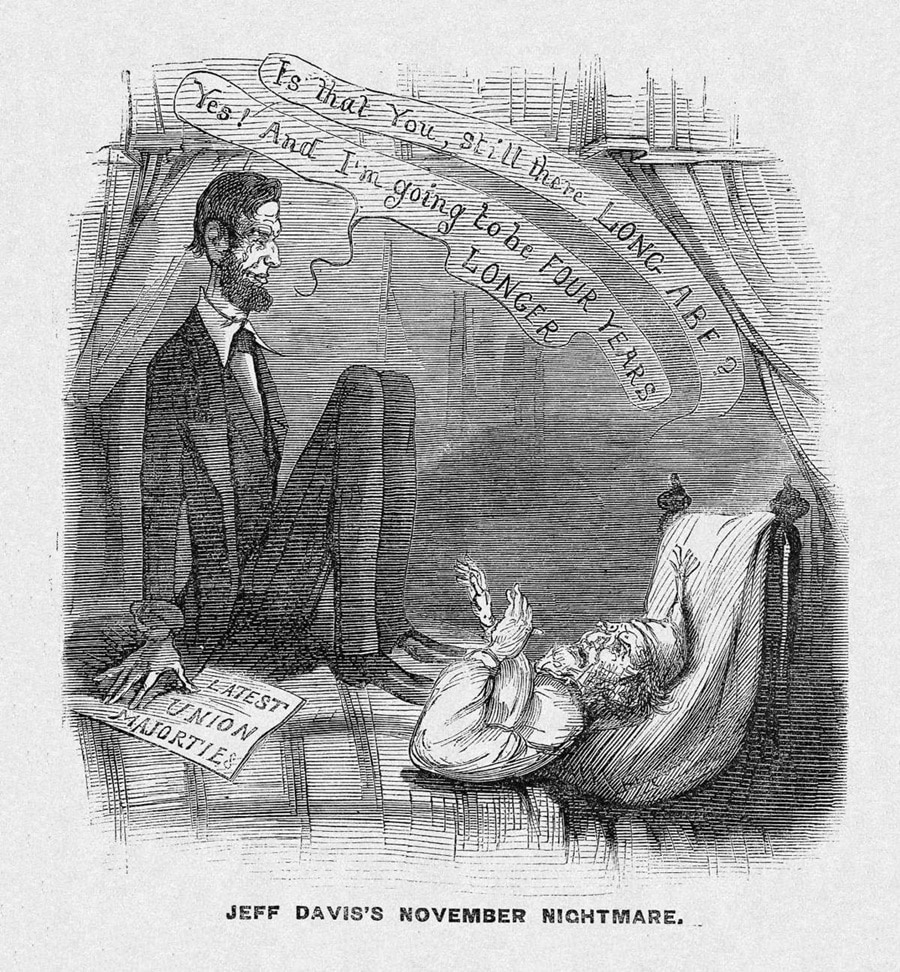
Other states were being organized in attempts to bolster Lincoln’s chances. Republicans pushed for statehood for Colorado in 1864, but that effort collapsed after, what Democrats claimed, was a series of votes in September 1864 that largely resulted in Democrat majorities.[4] Both parties essentially fought for Colorado’s role in the election, hoping to influence the ultimate outcome.
Lincoln also actively sought to create reconstructed Confederate states that might participate in the 1864 election. Federal soldiers advanced into Florida in early 1864 in the hope of potentially establishing a loyal government based on Lincoln’s 10 percent plan, but that effort became a disaster resulting in the battle Olustee. Loyal governments were established in Louisiana, Tennessee, and Arkansas (with varying degrees of success and legitimacy) with both the hopes of proving the 10 percent plan would work and simultaneously provide potential electoral votes from loyal voters in rebelling states.
Both Republicans and Democrats attempted to add more of their own voters, while limiting those of their opponents, in the form of uniformed service members casting absentee votes. This was largely a state matter, as each debated whether soldiers and sailors could vote absentee. Some states allowed this while others did not. Both parties openly declared their side would receive the vast majority of votes from uniformed service members.
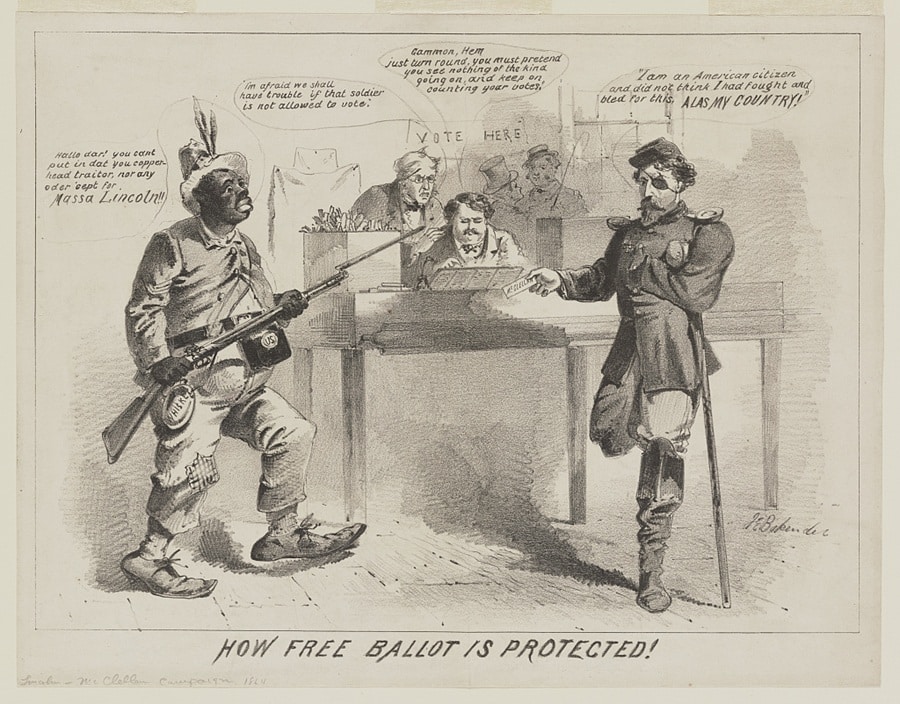
For example, in the navy, some sailors were prevented from voting for McClellan, such as those on USS Roanoke. “Two army officers came on board to-day and managed to get ten votes for Lincoln,” one sailor reported. “When the McClellan men went up to vote they were told to go away; that they might as well vote for Jeff Davis.” They were ultimately told by the ballot collectors that “if the men did not like Lincoln ballots they could not vote at all.”[5] On the Mississippi River, sailors attempting to both vote for Lincoln and McClellan were reportedly turned away in different areas.[6] Similar cases of soldiers emerged, though in general soldiers and sailors who attempted to vote absentee or in the field in accordance with their state laws were allowed to, marking a precedent that the United States has been allowing voting by mail and absentee voting for over 160 years. Meanwhile, talk circulated that pro-Democrat secret societies were conspiring “to disrupt the nation’s war efforts and to interfere with orderly and peaceful elections.”[7]
There were also significant attempts at election interference by a foreign force in the 1864 presidential election–the Confederacy itself. Confederate leaders readily knew that preventing U.S. battlefield victories could sway voters, for Jefferson Davis himself acknowledged that “the real issue to be decided in the Presidential election of that year, was the continuance or cessation of the war.”[8] Thus, Confederate military activity in 1864 actively sought to kill Federal soldiers and thus influence voters. Davis and other Rebel leaders proposed action including enhanced Confederate commerce raiding along New England’s coastline, secret strikes against New York, static defenses designed to bleed Federal armies dry, and counteroffensives designed to make loyal civilians believe they were accomplishing little. Indeed, it was only Federal victories in fall 1864, such as at Atlanta, in the Shenandoah Valley, and at Mobile Bay, that improved “Lincoln’s presidential prospects.”[9]
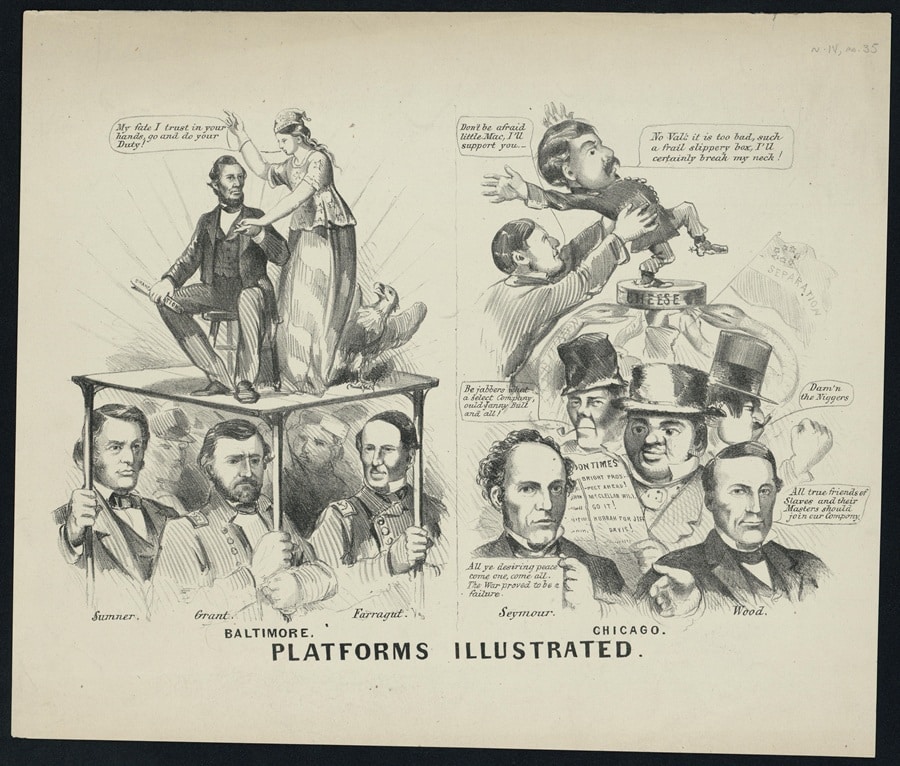
Louisiana, Arkansas, and Tennessee all formed loyal governments before the 1864 election, and both Louisiana and Tennessee sent electors to vote officially for Abraham Lincoln. These votes however, were marked with scandal. Tennessee’s official tally of votes was 30,000 for Lincoln and 5,000 for McClellan, but newspapers reported Confederate guerillas “broke up the ballot boxes in several places” in attempts to halt the proceedings.[10] In loyal parts of Louisiana, no real popular vote was held at all, and state legislators chose electors to represent the state in the electoral college.[11] Compounding issues, rumors abounded that Rebel governments would re-declare themselves as having never seceded to help give McClellan an edge in final vote tallies.[12] Ultimately, both houses of Congress, which each held Republican majorities, refused to certify electors from both Tennessee and Louisiana, which each pledged votes to Lincoln.
The November 1864 election occurred at a pivotal point in the Civil War. The fact that the election occurred at all is a testament to the Constitution itself, and that leaders of the United States thought it crucial to ensure continued regular elections even amid war and strife ripping the country apart. The Union itself, and what that meant for representative government, was at stake. Its result proved a major final nail in the coffin for the Confederacy while simultaneously opening the way for passage of the Thirteenth Amendment and allowing debates about postwar civil rights for those formerly enslaved. Republicans, Democrats, and Confederates all sought to directly interfere with how people voted and the overall election’s results.
Ultimately, the 1864 presidential election demonstrates that perhaps American elections are always being influenced, both by participants and external actors. Then, just as now, what one person considers interference might be instead considered good political maneuvering by another, and I recognize that readers will certainly have different opinions about whether specific actions listed in this article were or were not official attempts to interfere in election results instead of just playing politics. It seems that modern claims of election interference are nothing new at all, with the threats to representative government always pervading by those who desire a specific outcome and will do more than simply vote to get it.
Further Reading:
- Emerging Civil War has discussed the 1864 Presidential Election many times. Here is a link to previous articles and videos about it.
- Larry E. Nelson, Bullets, Ballots, and Rhetoric: Confederate Policy for the United States Contest of 1864 (Tuscaloosa, AL: University of Alabama Press, 1980).
- John C. Waugh, Reelecting Lincoln: The Battle for the 1864 Presidency (New York: Crown Publishers, 1997).
- Jonathan W. White, Emancipation, the Union Army, and the Reelection of Abraham Lincoln (Baton Rouge, LA: LSU Press, 2020).
Endnotes:
[1] F. Lauriston Bullard, “Abraham Lincoln and the Statehood of Nevada,” American Bar Association, Vol. 26, No. 4, 313.
[2] “Thirty-Six Stars on the Flag,” Brooklyn Union, Brookyln, NY, October 31, 1864.
[3] “Democratic Triumph in Nevada Territory – The Shadow of Coming Events,” The York Gazette, York, PA, October 18, 1864.
[4] “Defeat of the Abolitionists in Colorado,” Daily Missouri Republican, St. Louis, MO, October 7, 1864.
[5] “How the Sailor’s Votes Were Taken on the Iron-Clad Roanoke,” Daily Herald, New York, October 28, 1864.
[6] “Democratic Attempts at Fraud on the Sailors’ Votes,” Daily Evening News, Fall River, MA, November 4, 1864; “Frauds in the Sailors’ Votes,” Evening Telegraph, Philadelphia, PA, November 4, 1864.
[7] Larry T. Balsamo, “’We Cannot Have Free Government without Elections’: Abraham Lincoln and the Election of 1864,” Journal of the Illinois State Historical Society, Vol. 94, No. 2, Summer 2001, 193.
[8] Jefferson Davis, The Rise and Fall of the Confederate Government (New York: D. Appleton and Company, 1881), Vol. 2, 611.
[9] “America and the English Markets,” Broadford Observer, Broadford, England, September 22, 1864.
[10] “Tennessee Election,” Chicago Tribune, Chicago, IL, November 18, 1864.
[11] “Louisiana. Election of Presidential Electors,” New York Tribune, November 18, 1864.
[12] “Important if True,” Chicago Tribune, Chicago, IL, November 18, 1864.


You mean all the documented proof of election interference enacted by both foreign states and internal actors.
Don’t you?
Elections today are models of efficiency and security compared to the mid-nineteenth century. What did Boss Tweed say (apocryphally)? “The ballots made no result; the counters made the result.” Also, one of the least understood aspects of the 1864 election was that Lincoln and Johnson were not running under the Republican banner, but under the National Union Party, which was a coalition of Republicans, War Democrats, and other unionists.
An interesting post. Thanks. One thing that cautions against drawing too much similarity to modern conditions is the obvious overarching fact that the 1864 election took place in the midst of a civil war. Tied to that, the vote of soldiers in active military service was at the forefront.