ECW Podcast: Rivalries and Partnerships, An Annotated Supplement
After recording the recent podcast with Chris about the rivalry of Ambrose Burnside and Joseph Hooker, I realized that much of what I said during the interview were direct quotes and sources. Many of these quotes were ones I pulled doing research for what was supposed to be the presentation at this year’s symposium about Partnerships and Rivalries. Family matters derailed that plan, but I still wanted to make use of the quotes, and thought, as people listened, they may be interested in the original sources. Consider this post a cited supplement to the podcast, annotated with a few additional thoughts I’ve had since the podcast’s recording.
1. Beginnings
For biographical overviews of both Ambrose Burnside and Joseph Hooker, see:
- William Marvel, Burnside (University of North Carolina Press, 1991).
- Walter H. Hebert, Fighting Joe Hooker (University of Nebraska Press, 1999 reprint).
- A new biography of Hooker is due out in November 2026, by Daniel Wipperman, and published by Stackpole Books. This will be the first major published treatment of Hooker since Hebert’s publication hit the shelves in 1944.
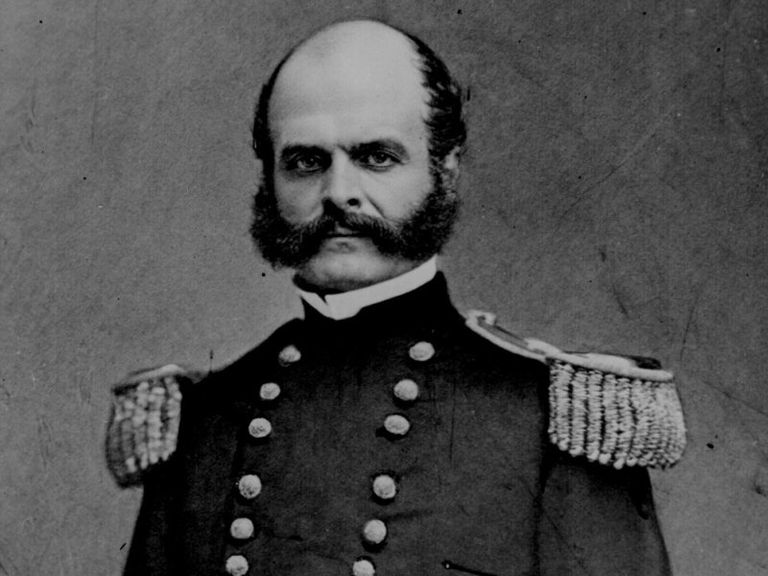
After the First Battle of Bull Run, Joseph Hooker told Abraham Lincoln: “I was at the battle of Bull Run the other day, and it is neither vanity or boasting in me to declare that I am a damned sight better General than you, sir, had on that field.”
- Hooker is quoted in Hebert, 49.
Burnside’s campaign in North Carolina is treated extensively in Marvel’s biography. See also Richard Sauers, The Burnside Campaign in North Carolina: A Succession of Honorable Victories (Morningside Bookshop, 1996).
For Joe Hooker’s service on the Peninsula, especially at the Battle of Williamsburg, see Carol K. Dubbs, Defend This Old Town: Williamsburg During the Civil War (Louisiana State University Press, 2002).
I mentioned that the story of Hooker’s nickname–“Fighting Joe Hooker”–being born out of a newspaper’s misprint is likely apocryphal. See Hebert, 91, and this ECW blog by Edward Alexander tracking down the story.

2. The Maryland Campaign
Burnside and Hooker, who had largely been on divergent paths during the war’s first year, now found themselves in close contact during the September 1862 Maryland Campaign. Because Hooker’s First Corps was folded under Burnside’s wing command, he now answered directly to Burnside. Much of their future disagreements (and Burnside’s burning detestation of Hooker) came about as a result of the Battle of South Mountain, fought on Sept. 14, 1862.
Hooker wrote his official report of the campaign in Washington, D.C., while recuperating from a wound received at Antietam. He dated the report Nov. 7, when he was still very actively lobbying for command of the Army of the Potomac. (Ironically, this was the same date, unknown to Hooker, that Burnside took command of the army.)
As part of his narrative of the fighting at South Mountain, Hooker wrote: “On my way I passed Cox’s corps, withdrawing from the contest. . . Still farther on was Reno’s corps, moving into position to the south of the turnpike. . .”
Burnside took umbrage with the description of the report, and was also quick to point out that Jacob Cox only commanded a division at South Mountain. In his own rebuttal, Burnside laid out his main problems with Hooker’s description of events, and felt he had to jump to the defense of Jesse Reno, killed at South Mountain and thus unable to speak for himself. Keep in mind that Burnside submitted his rebuttal on Jan. 20, 1863, well after the drama of the Battle of Fredericksburg, which only continued to further his animosity to Hooker. Just four days after writing his rebuttal, Burnside, in talking with a reporter, threatened to hang Hooker (more on that later).
From Burnside’s rebuttal: “I at first determined to pass over its inaccuracies as harmless, or rather as harming only their author, but upon reflection I have felt it my duty to notice two gross misstatements made with reference to the commands of Generals Reno and Cox, the former officer having been killed on that day, and the latter now removed with his command to the West. General Hooker says that as he came up to the front, Cox’s corps was retiring from the contest. This is untrue. General Cox did not command a corps, but a division; and that division was in action, fighting most gallantly long before General Hooker came up, and remained in the action all day, never leaving the field for on moment. . . . General Hooker should remember that I had to order him four separate times to move his command into action, and that I had to myself order his leading division (Meade’s) to start before he would go.”

Hooker’s corps was removed from Burnside’s wing before Antietam, and thus they fought on separate parts of the field on Sept. 17. Fighting around the Cornfield, Hooker was shot in the foot, and evacuated to Washington, D.C. to recuperate. It was at this time that Hooker met with several dignitaries, including Secretary of the Treasury Salmon P. Chase, advocating for his own commanding the Army of the Potomac. Much of Hooker’s boasting and self aggrandizement made it back to other army officers.
Samuel Heintzelman, commander of the Third Corps (and thus Hooker’s commanding officer on the Peninsula and Second Bull Run), wrote in his diary on Oct. 18, 1862: “Gen. Hooker has said that he felt that he is the only General in the country competent to lead the armies of the Republic. What vanity.”
- Samuel Heintzelman Diary, Library of Congress Oct. 18, 1862, quoted in Jack Ballard, “General Joseph Hooker: A New Biography,” (unpublished PhD dissertation, Kent State University, 1994), 689.
3. The Fredericksburg Campaign
Ambrose Burnside had turned down command of the Army of the Potomac twice before November 1862. First was in July 1862, following George McClellan’s failure to take Richmond and the conclusion of the Seven Days Battles. Second came in early September 1862, as news hit of the defeat at Second Bull Run and Robert E. Lee’s invasion of Maryland. Both times Burnside insisted he wasn’t qualified and told Lincoln that McClellan remained the best candidate.
That changed late on Nov. 7. Having traveled through a wintry mess, Brig. Gen. Catharinus Buckingham, an envoy from the War Department, arrived at Burnside’s headquarters. Buckingham carried orders relieving McClellan of command putting Burnside in command. For a third time, Burnside refused. But this time, Buckingham flat out told him that another deferral and Lincoln was ready to give command to Joseph Hooker.
A day later, Burnside ran into Darius Couch, commander of the Second Corps. Couch later wrote: “His manner indicated that he did not wish to talk about the change; that he thought it was not good policy to do so, nor the place to do it. He told me afterward that he did not like to take the command, but that he did so to keep it from going to somebody manifestly unfit for it. I assumed that he meant Hooker.”
With no subtlety, Burnside still admitted he was not the right person but so loathed Hooker that he refused to see the army go to him.
Hooker rejoined the Army soon after and reacted with expected arrogance. He sat with one of his division commanders, George Meade, who recounted their conversation in a letter to his wife: “Hooker gave one or two hits at Burnside, and rather hinted it might not be very long yet before he was in command.”
Henry Villard, a correspondent to the New York Tribune, arrived in camp in late November as the Army of the Potomac sat opposite Fredericksburg. Though he had never met Hooker before, it didn’t take long for the general to vent his spleen. “He burst forth into unsparing criticism of the general conduct of the war in the East, of the Government, of Halleck, McClellan, Pope, and, last but not least, of his present immediate superior.”
Hooker’s outburst, with such a person he was unfamiliar with, left Villard hesitant to hang around him for long: “He had even then an unenviable notoriety for a rash tongue, to which he added lamentably in his subsequent career. His language was so severe and, at the same time, so infused with self-assertion as to give rise immediately to a fear on my part that he might be inclined to make use of me for his own glorification and for the detraction of others. This made it prudent for me not to place myself under more personal obligations to him than I could possibly help.”
- Ibid.
While Burnside’s plan to cross the Rappahannock River hinged on the arrival of pontoons, Hooker suggested that he be allowed to take his newly designated Center Grand Division (consisting of the Third and Fifth Corps) upriver and cross near the United States Ford. Burnside denied the request, citing the ford was too far away and not suited for a military crossing. In response, Hooker wrote directly to Secretary of War Edwin Stanton, complaining and gossiping. By so doing, Hooker broke the chain of command by bypassing not just Burnside, but also General-in-Chief of the Army Henry Halleck, whom Hooker had sparred with in the early 1850s. Hooker’s letter to Edwin Stanton, written on Dec. 4, 1862, can be found here, part of Stanton’s papers and digitized by the Library of Congress.
When the Battle of Fredericksburg began, Hooker’s Grand Division was, perhaps intentionally, split between parts of the battlefield. Parts of the Third Corps were sent to the southern end of the battlefield, closer to Maj. Gen. William B. Franklin’s sector, while the Fifth Corps was deployed in the town. Hooker could thus not control parts of his Grand Division simultaneously.
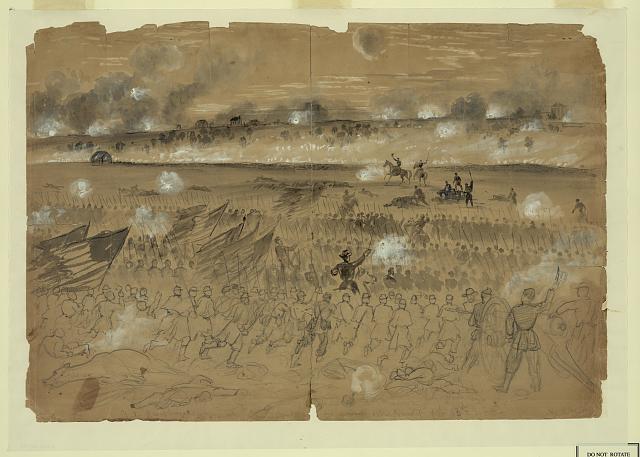
Burnside’s plan of two attacks on both ends of Lee’s line outside of the town necessitated pushing against the daunting Marye’s Heights. Hooker complained, both via courier and in person, of the futility of the attacks. But Burnside persisted, forcing Hooker to deploy towards the end of the day elements of the Fifth Corps, especially Andrew Humphreys’s division of Pennsylvanians and George Sykes’s Regulars. Just one week after the battle, in his Dec. 20, 1862, testimony to the Congressional Joint Committee on the Conduct of the War, Hooker sarcastically intoned: “Finding that I had lost as many men as my orders required me to lose, I suspended the attack.”
4. The Mud March and Burnside’s Replacement
Burnside became aware of generals communicating directly with Lincoln that the army had lost faith in the commanding general after the Battle of Fredericksburg. He was furious and demanded to know the identities, but Lincoln demurred. Burnside had his suspicions, but in the meantime tried one more campaign to get at Lee.
Even before the campaign got underway, Hooker was once again boasting, if he was just in command, how things would be different. Marsena Patrick, the provost marshal of the army, jotted in his diary: “Hooker says he can have command of this Army when he will say the word — He asks but 5 days to whip Lee & 15 is all he will ask to take Richmond — He must be drunk.”
- Marsena Patrick, Inside Lincoln’s Army: The Diary of Marsena Rudolph Patrick, Provost Marshal General, Army of the Potomac, edited by David S. Sparks (A. S. Barnes and Company, 1964), 204
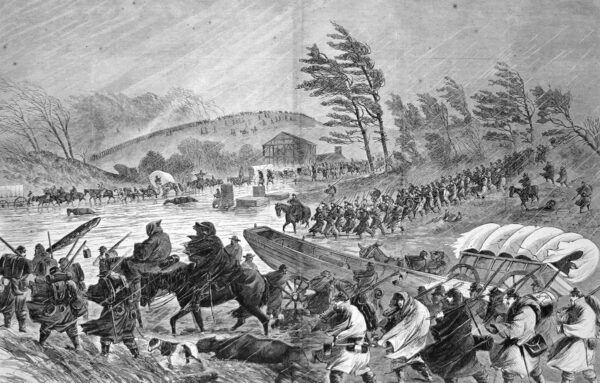
Burnside’s plans for the new offensive started off well-enough but soon constant rain preempted the campaign. The Army retreated back to its camps around Falmouth and the Mud March ended in utter embarrassment to Burnside on Jan. 23, 1863.
As the rain fell and the army got stuck in the mud, Hooker once more talked to the press. William Swinton, a correspondent to The New York Times, told Henry Raymond, editor of the paper, “General Hooker had talked very openly about the absurdity of the movement the day before–that he had denounced the commanding general as incompetent, and the President and Government at Washington as imbecile and ‘played out.’ Nothing would go right, [Hooker] said, until we had a dictator, and the sooner the better. This, Mr. Swinton said, was the general tenor of General Hooker’s conversation, which was perfectly free and unrestrained.”
Burnside had reached his breaking point. He began drafting orders that, if Lincoln approved, would cashier Hooker and others from the army. Henry Raymond asked Burnside, hypothetically, what would happen if Hooker raised troops in mutiny of the order? Burnside answered, “He said he would swing him before sundown, if he attempted such a thing.”
Reporting to Washington, D.C., Burnside gave Lincoln two envelopes. One letter contained the draft of what he called General Orders 8. Making no secrets of where Burnside sat, General Orders 8 began, in one extremely long sentence: “General Joseph Hooker, major-general of volunteers and brigadier-general U.S. Army, having been guilty of unjust and unnecessary criticisms of the actions of his superior officers, and of the authorities, and having, by the general tone of his conversation, endeavored to create distrust in the minds of officers who have associated with him, and having, by omissions and otherwise, made reports and statements which were calculated to create incorrect impressions, and for habitually speaking in disparaging terms of other officers, is hereby dismissed the service of the United States as a man unfit to hold an important commission during a crisis like the present, when so much patience, charity, confidence, consideration, and patriotism are due from every soldier in the field.” In the other envelope Burnside put his resignation. He demanded Lincoln pick one.
Lincoln accepted Burnside’s resignation and finally, after months of lobbying, Hooker had command of the Army of the Potomac. He assumed the mantle on Jan. 26, 1863.
Nine days later, in his own testimony to the Joint Committee, Burnside shot back at Hooker. “I would like to add here that I think a mistake was made in sending General Hooker to report to me. . . after it was well known by the authorities that General Hooker came very near receiving, instead of me, the command of the army. . . It was a mistake to place him junior in command to me.
In one final volley, Hooker couldn’t leave well enough alone. On the eve of his own campaign, what would become the Battle of Chancellorsville, he wrote to Stanton of the recently published General Orders 8, leaked to the press:
“I see that Burnside’s stupid order, Numbers 8, has at last found its way into the newspapers. It causes me no regret, and would no one else if the character of the author was as well understood by them as myself. His moral degradation is unfathomable. My attention was first called to it by his statement under oath that I had expressed to him my approval of his refusal to let me cross the river on the march down from Warrenton in the transfer of our line of operations. I had previously been informed of his cowardice at the first Bull Run, had witnessed his follies at South Mountain, heard of his blundering sacrifice of life at the bridge at Antietam, and felt the madness of the slaughter at Fredericksburg, but during all the time had given him credit for possessing common integrity. . . he speaks of me in terms of unusual praise, as will be remembered by all, and yet behind my back, assassin like, is trying to stab.”
With friends like these. . .


Excellent sources. Thank you for sharing your work, Ryan.
I read a recent quote from a Henry J. Raymond letter to William L. Yancey during the secession crisis which is a most eloquent defense of “sticking to the Constitution” as Raymond put it to Yancey. Henry J. Raymond, as you probably know, served as Lincoln’s campaign chair for the 1864 presidential campaign. He was an active and interesting fellow, and an adjutant of sorts to Horace Greeley for many years.
What was the quote?
I’ve been slowly reading the Burlingame two volume biography on Lincoln at:
https://www.knox.edu/academics/research-and-creative-work/lincoln-studies-center/burlingame-abraham-lincoln-a-life
Volume Two, Chapter 33 has a lot of Henry J. Raymond in it, which prompted me to read up on him. That led me to an 1861 published collection of letters between Raymond and Yancey here:
https://archive.org/details/disunionslaverys00raym/page/36/mode/2up
Full quote of Raymond to Yancey from the last paragraph on page 36 – “We shall stand then, as now, upon the Constitution which our Fathers made. We shall not make a new one, nor shall we permit any human power to destroy the old one. Long before that day shall come the People of the Northern States will stand together as one man — forgetful of all past differences and party divisions — to preserve the American Union and crush any revolution which may menace it with destruction. We seek no war, — we shall wage no war except in defence of the Constitution and against its foes. But we have a country and a Constitutional Government. We know its worth to us and to mankind, and in case of necessity we are ready to test its strength”.