“As Sensitive About the Flanks as a Virgin”: Best Gibes & Insults of the Civil War
Lady Astor: “If I were married to you, Winston, I’d put poison in your tea.”
Winston Churchill: “Madam, if I were married to you, I’d drink it.”
This legendary—possibly apocryphal—Lady Astor-Winston Churchill repartee is an example of how a quick-witted gibe can deliciously amplify an insult. The Civil War offered many an opportunity both for prompt gibes and considered insults. Here are some of the best.
J.E.B. Stuart’s Complaint
[To] Quartermaster-General Meigs, United States Army
Quality of the mules lately furnished me very poor. Interferes seriously with movement of captured wagons.
/s/ J.E.B. Stuart
During his “Christmas” or “Dumfries” Raid of 1862, Stuart’s men captured a federal telegraph post. Stuart used the opportunity to send this taunting message to Meigs.[1]
Meigs no doubt did not find the gibe amusing.
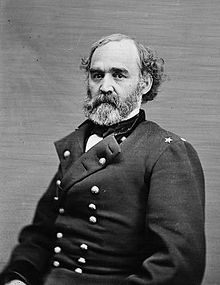
Abraham Lincoln’s Barb
While Stuart humorously complained of the quality of the equine transport furnished him by the federal government, only weeks earlier a frustrated Abraham Lincoln had been in no mood to hear a similar complaint by his own top field commander.
In response to an October 25, 1862 report from Maj. Gen. George B. McClellan that one of his cavalry commanders claimed that his mounts were “absolutely broken down from fatigue and want of flesh,” Lincoln promptly retorted:
“I have just read your dispatch about sore-tongued and fatigued horses. Will you pardon me for asking what the horses of your army have done since the battle of Antietam that fatigues anything?”[2]
No doubt, that one stung.[3]
Longstreet Compares Green Troops to Blushing Virgins
While later expressing regret for employing such earthy language in “official correspondence” during the May 31, 1862 battle of Seven Pines, then-Maj. Gen. James Longstreet perfectly captured the fear of green troops facing attacks on their flanks by using a sexual reference.
With the battle still raging, Longstreet reported to his superior, Maj. Gen. G. W. Smith, that:
‘[I]n going forward we encountered a flanking fire from the enemy … which was exceedingly annoying, particularly with fresh troops, who were always “as sensitive about the flanks as a virgin.’”[4]
The fact that Longstreet had the presence of mind to employ such a vivid metaphor amid a battle not only is amusing but reveals an ability to maintain composure under fire.
If it walks like a duck…
In contrast to Longstreet, U.S. Maj. Gen. William Rosecrans supposedly was “unnerved” by his army’s devastating defeat at Chickamauga (September 18-20, 1863). Driven back into Chattanooga and placed under siege by Confederate Gen. Braxton Bragg’s forces, Rosecrans was reported to be utterly unable to respond to the crisis. It even was feared that he might surrender his army.[5]
Lincoln, losing confidence in his reportedly mentally paralyzed commander, concluded that Rosecrans was:
“…confused and stunned like a duck hit on the head.”[6]
Whether or not his was a fair assessment, Lincoln’s colorful metaphor earns a place among the Civil War’s better gibes/insults.

What is the Value of a General?
Perhaps not surprisingly, Old Abe is the source of multiple memorable war-time quips. When informed that a daring raid upon Fairfax Court House, Virginia in March 1863 by the partisan John S. Mosby had nabbed Brig. Gen. Edwin Stoughton along with 58 horses, Lincoln reportedly bemoaned the loss of quality horseflesh more than his general, explaining:
“I can make a much better General in five minutes, but the horses cost one hundred and twenty-five dollars apiece.” [7]
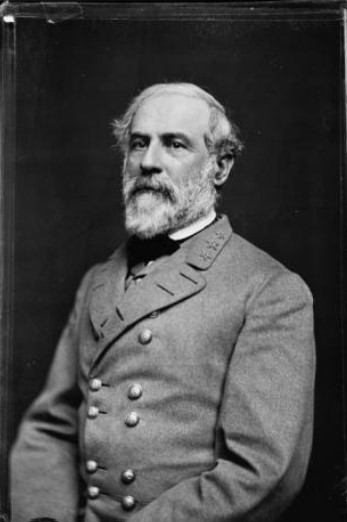
Even On the Eve of Surrender, Lee Kept His Sense of Humor
A man nicknamed the “Marble Model”[8] is not one usually associated with expressions of levity. Yet Robert E. Lee clearly had a sense of humor, as evidenced by various examples throughout his life.[9]
Even during the stress of his final campaign, Lee’s humor persisted. CSA Brig. Gen. A.L. Long recounted the following incident involving Lee and Brig. Gen. Henry A. Wise that took place on April 8, 1865.
‘The general [Wise] had made his morning ablutions, in the absence of the requisites of a civilized toilet, in a mud-hole in the road, the water of which was deeply tinged with the prevailing red clay of that country. Towels were as scarce as basins, and in the lack of any better method he permitted the water to dry upon his face. The consequence was that his countenance displayed a very decided coating of red clay.
Unaware of the appearance which he presented, mirrors having been left behind with the other impedimenta of civilization, Wise, with his blanket thrown around him and presenting a not inapt resemblance to an Indian chief, walked up to where General Lee was standing in the midst of a group of officers. Despite the gravity of the situation, Lee’s face broke into a humorous smile on perceiving the ludicrous appearance of the unconscious officer.
“Good morning, General Wise,” he remarked in a tone of merry pleasantry. “I perceive that you, at any rate, have not given up the contest, as you are in your war-paint this morning.”’ [10]
Not every gibe need be insulting; some simply are humorous.
“La Patience Est Amere, Mais Son Fruit Est Doux”
Then again, some gibes are both humorous and insulting.
The embarrassment caused the Lincoln administration by the November 1863 escape of CSA raider Brig. Gen. John Hunt Morgan and several of his officers from the Ohio State Penitentiary was exacerbated by a taunting note left behind by one of the escapees. That note, addressed to the prison warden, read:
“Hon. (!!) N. Merion, the watchful, the vigilant.
CASTLE MERION, CELL No. 20.
Commenced work November 4; number of hours worked per day, three; completed work November 20; tools, two small knives.
“La patience est amère, mais son fruit est doux” [“Patience is bitter, but its fruit is sweet.”]
By order of my six confederates:
- HENRY HINES,
Captain, C.S. Army.” [11]
Now, there is an insult with style.
A Misplaced “Arse”
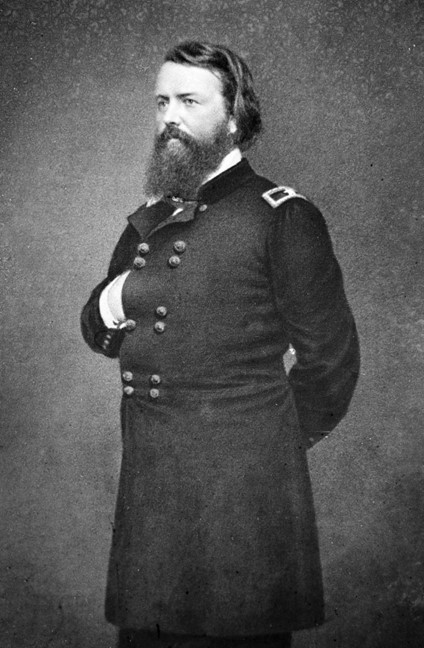
Lincoln’s insulting gibes directed towards McClellan and Stoughton were not the only instances coupling a general with horses. Perhaps the most famous such quip was supposedly uttered by Lee. Upon hearing that Maj. Gen. John Pope had issued an order from his “Headquarters in the Saddle,” Lee allegedly retorted that:
“If so his headquarters are where his hindquarters ought to be.”[12]
While repeated many times, the “Headquarters in the Saddle” heading it is of dubious providence.[13] Pope himself denied that he ever made the statement.[14] But it makes for a good, purported jab by Lee.
A Pinch of Owl Dung
A final wonderfully colorful quip that does stand historical scrutiny also involved Pope.
During the 1862 Second Manassas Campaign Col. Herman Haupt, in charge of military railroads, was tasked with untangling the chaos that was snarling efforts to forward reinforcements to Pope. In the course of his efforts, Haupt confronted Brig. Gen. Samuel Sturgis, who had unilaterally hijacked several trains that should have been used in Pope’s behalf. In response to Haupt’s admonishment that Sturgis was interfering with efforts to support Pope, Sturgis (perhaps emboldened by liquor courage) retorted,
“I don’t care for John Pope a pinch of owl dung!” [15]
Whether characterized as an insult, gibe, or simply a drunken outburst, Sturgis’s exclamation provides a fitting concluding example of some of the best of the Civil War’s humorous disparaging quips.
[1] Burke Davis, Jeb Stuart: The Last Cavalier (The Fairfax Press, New York, NY, 1988), 262 & 433, n. 2; H.B. McClellan, The Campaigns of Stuart’s Cavalry (The Blue & Gray Press, Secaucus, NJ, 1993), 201.
[2] The War of the Rebellion: A Compilation of The Official Records of The Union and Confederate Armies, Series I, Vol. 19, part 2 (U.S. Government Printing Office, Washington, D.C., 1880 – 1901) (“OR”), 484-485; Stephen W. Sears, Landscape Turned Red: The Battle of Antietam (Book-of-the-Month Club, New York, NY, 1994), 330-331.
[3] It did. See McClellan’s response at OR, Series I, Vol. 2, part 2, 331.
[4] Douglas Southall Freeman, Lee’s Lieutenants: Manassas to Malvern Hill (Vol. 1) (Charles Schnbner’s Sons, New York, NY, 1942), 237 & n. 53; Mark M. Boatner, Civil War Dictionary (David McKay Company, Inc., New York, NY, 1988), 490.
[5] James M. McPherson, Battle Cry of Freedom: The Civil War Era (Oxford University Press, New York, NY, 1988), 672-675; David A. Powell, Battle Above the Clouds: Lifting the Siege of Chattanooga and the Battle of Lookout Mountain, October 16-Novmber 24, 1863 (Savas Beatie, Eldorado Hills, CA, 2017), xix-xxi; Frank P. Varney, General Grant and the Rewriting of History (Savas Beatie, Eldorado Hills, CA, 2018), 207-239. Varney discusses the reports and charges against Rosecrans in the course of arguing that all such were false.
[6] McPherson, 675.
[7] Jeffry D. Wert, Mosby’s Rangers: The True Adventures of the Most Famous Command of the Civil War (Touchstone, New York, NY, 1990), 45, 48; Freeman E. Jones, Major, USA, Mosby’s Rangers and Partisan Warfare (Unpublished Master’s Thesis, The Johns Hopkins University, Fort Leavenworth, KS, 1993), 28-31, https://www.scribd.com/document/178522486/Mosbys-Rangers.
[8] Lee earned this stoic moniker while serving as Superintendent of the U.S. Military Academy at West Point. James I. Robertson, Jr., Robert E. Lee: A Reference Guide to His Life and Works (Rowman & Littlefield, Lanham, MD, 2019), 145. In his poem “Army of Northern Virginia,” Stephen Vincent Benet referred to Lee as “as the rigid image in marble” and “the marble man.” https://internetpoem.com/stephen-vincent-ben-eacute-t/army-of-northern-virginia-poem/#google_vignette.
[9] E.g., James I. Robertson, Jr., Robert E. Lee: Virginia Soldier, American Citizen (Atheneum Books for Young Readers, New York, NY, 2005), 14, 84, 115; Charles Bracelen Flood, Lee: The Last Years (Houghton Mifflin Company, Boston, MA, 1981), 135, 145-146. Flood recounts Lee’s humorous advice to two students involved in an apparent assassination attempt upon a Washington College professor.
[10] A.L. Long, Memoirs of Robert E. Lee (The Blue and Grey Press, Secaucus, NJ, 1983), 416.
[11] OR, Series II, Vol. 6, p. 729; A. C. Quisenberry, “History of Morgan’s Men,” Register of Kentucky State Historical Society (Vol. 15, No. 45, September, 1917), 21, 41, https://www.jstor.org/stable/pdf/23368404.pdf?refreqid=fastly-default%3A0d164d60781c6f2fe72541708dfd5258&ab_segments=&initiator=&acceptTC=1.
[12] Donald R. McClarey, “Did John Pope Claim that His Headquarters Was in the Saddle?,” The American Catholic, August 30, 2012, https://the-american-catholic.com/2012/08/30/did-john-pope-claim-that-his-headquarters-was-in-the-saddle/.
[13] E.g., Edward Porter Alexander, edited by Gary W. Gallagher, Fighting for the Confederacy: The Personal Recollections of General Edward Porter Alexander (The University of North Carolina Press, Chapel Hill, NC, 1989), 123; Peter Cozzens, “John Pope (1822–1892),” Encyclopedia Virginia (Dec. 7, 2020),https://encyclopediavirginia.org/entries/pope-john-1822-1892.
[14] John Pope, “The Second Battle of Bull Run,” from Robert Underwood Johnson, Clarence Clough Buel, Editors, Battles & Leaders of the Civil War, Vol. II (Thomas Yoseloff, London, 1956), 449, 493-494; Gary W. Gallagher, “Should Pope be a Punchline?,” HistoryNet (Oct. 6, 2021), https://historynet.com/should-pope-be-a-punchline/.
[15] Herman Haupt, Reminiscences of General Herman Haupt (Wright & Joys Co., Milwaukee, WS, 1901), 80, 83, https://archive.org/details/reminiscencesofg00hauprich/page/n9/mode/2up; Peter Cozzens, General John Pope: A Life for the Nation (University of Illinois Press, Urbana & Chicago, IL, 2000), 42, 102.


Unnamed Confederate at Dispatch Station the morning of June 28, 1862, who became the first hacker in world history. The post fell to Jeb Stuart’s cavalry, who found it abandoned, and this young man warmed up the telegraph key and sent a message to the Federals at White House Landing, 12 miles to the northeast: “Go to Hell you damned Yankees – we’ll be there in 20 minutes.”
I love the way people talked back then. Such a way with words.
More of a witticism than a gibe, but one of the war’s best lines came during the surrender at Appomattox Court House. When Lee noticed that Lieutenant Colonel Ely S. Parker, a Seneca Indian, was present at the proceedings, he commented, “I am glad to see one real American here.” Parker quickly retorted, “we are all Americans.”
Awesome post. May favorite gibe is this one where a young Maryland young woman was giving some Confederates stick as they passed through Frederick or somewhere around there, while she was wearing a U.S. flag upon her chest, and apparently some Confederate piped up and said –
“Look h’yar, miss, better take that flag down; we’re awful fond of charging breast-works!”.
In Camp and Battle with the Washington Artillery of New Orleans (1885), Page 133 – https://antietaminstitute.org/hrc/files/original/7380aac013e5cea80f96cc7dfc0e29500a84e8f9.pdf
Hilarious.
Great post, Kevin.
Brian, thank you. It was fun to write. As shown by Lyle’s post, I am sure that our readers can contribute many other examples.
They are all great! Especially the quote left by L. Smith. Wonder if that Southern Solider made it home to his wife?!
thanks Kevin … another great post … i was hoping to see that Lincoln-McClellan exchange about horses — and sure enough there it was! Years ago, i was at the Lincoln Library for some event and i got hold the original telegram (in a plastic sleeve) in my hand — pretty cool! thanks again.
Mark, thank you. And the fact that you were able to hold that very document in your hands, that is chilling.
Although Longstreet’s quote has great “Wow!” factor – one must consider he wrote it in 1883, as opposed to G.W. Smith’s recall of the note as it originally appeared in his report written on June 23, 1862. Smith’s description of Longstreet’s note – which he struck the following portion Joseph E. Johnston’s request – reads: “between 4 and 5 o’clock a note was received from General Longstreet stating that : “he had attacked and beaten the enemy after several hours severe fighting; that he had been disappointed in not receiving assistance upon his left, and, although it was now nearly too late, that an attack by the Nine-miles road upon the right flank and rear of the enemy would probably yet enable him to drive them into the Chickahominy before dark.”
[Smith’s excerpted portions of his report are available in Smith’s Battle of Seven Pines book, pages 20-22.]
I’m generally dubious of anything Longstreet wrote after the war – especially when he claims to have written much more than is normally scribbled on a battlefield note.
Although D.H. Hill’s command was responsible for all the Confederate success at Seven Pines; Longstreet’s note fails to even mention Hill’s name. However, Longstreet had the time to list the capture of Casey’s division camp, driving the enemy back, Huger’s alleged failure and his receiving flanking fire from G.W. Smith’s front – in addition to the alleged virgin comment. Longstreet’s alleged recall blends well with his false claim of directing victorious action at Seven Pines while assigning blame to Huger and Smith for the lack of greater success.
Longstreet’s actual May 31, 1862, note went to Johnston and has not been found.
Although Smith’s recall of the note also seems somewhat lengthy – Smith’s recall is written in 1862 instead of Longstreet’s 1883 account. Call me skeptical as I seriously doubt Longstreet’s May 31, 1862, note gave the recap he claims it did in 1883. However, it does make for great Civil War conversation.
Mr. Vignola,
Thank you for your comments. I greatly enjoyed reading your wonderfully insightful book, “Contrasts in Command: The Battle of Fair Oaks, May 31-June 1, 1862.”
As an aside, you may be amused to learn that I won your book in June 2025 as first prize in a raffle conducted in London by the American Civil War Round Table of the United Kingdom. Your fame is international.
Kevin
Kevin – Thank you for another “Wow!”
I’m happy you won the book and enjoyed reading it.
… and yes, I find my name and “international fame” in the same context as very amusing. 🙂
Onward!
Mr. Vignola,
Like Kevin I also thoroughly enjoyed reading your book “Contrasts in Command: The Battle of Fair Oaks, May 31-June 1, 1862.” Thanks to you, I feel like I have some understanding of that battle like never before. Your time and research are very much appreciated. Reading your book inspired me to pick a copy of Gustavus W. Smith’s memoir of his time in the Mexican War, while visiting the Palo Alto battlefield near Brownsville, Texas. It reads fair-minded and honest even if written years after the events.
Not sure how true. When Sherman was beginning his march to the sea. Jefferson Davis called for the people of Georgia to rise up like the Russians who destroyed napoleon’s army. Sherman retorted “he neglected to say who was going to supply the snow”
I remember one that I read a long time ago (maybe in North and South Magazine?). Lincoln and his cabinet were having a meeting and someone asked how many troops the Confederate Army had and Lincoln immediately responded with 1 million (or something like that). When asked how he came upon that number, Lincoln stated that the Confederates only had 100,000, but Pinkerton inflated the numbers to 300,000 when reporting to McClellan, and then McClellen doubled or tripled the numbers he received from Pinkerton. I have no idea if this is true and have never been able to find the reference again. If anyone knows where this came from, please let me know.