Which One Would You Choose?
After the firing on Fort Sumter and President Abraham Lincoln’s call for volunteers from the governors of the Northern states, Republican Governor Richard Yates of Illinois called for 6,000 volunteers on April 15, 1861. Yates was busy organizing his state’s regiments and their camps for the impending conflict.[1]
But Yates soon had a problem. He had two regiments in turmoil. The men of the 19th and 21st Illinois Infantry regiments wanted new colonels.
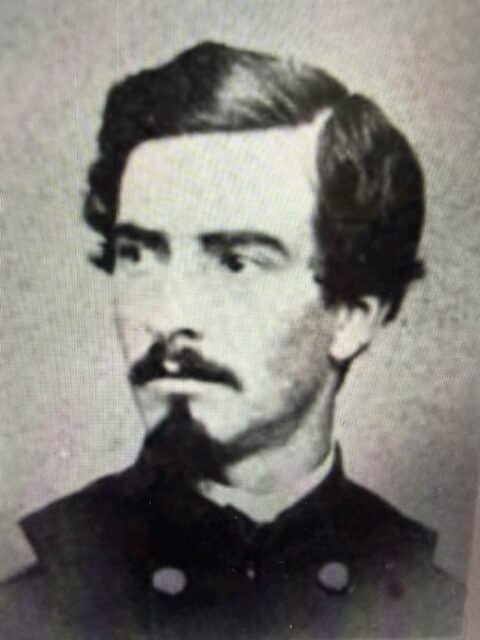
Canadian-born, Col. Joseph R. Scott of the 19th Illinois was only 22 years old, making him one of the youngest colonels in the Union army. He had been a part of Col. Elmer Ellsworth’s Chicago Zouave Cadets before the war along with three of the regiment’s companies. While recognizing that Scott was a good man, the majority of the 37 officers and 916 men thought he was too young to command. A soldier in the Nineteenth wrote:
“The 19th wished to have an older and more experienced officer for colonel and keep their first-elected as lieutenant colonel . . . he [Joseph Scott] was a splendid soldier, only 22 years of age.”[2]
Apparently, Governor Yates agreed with them. To Scott’s credit, he did decide to step aside and remain as the lieutenant colonel.[3]
Yates heard that the 21st Illinois Regiment was in a near-mutiny. Colonel Simon S. Goode was the regiment’s colonel. Born in Kentucky, he moved to Decatur, Illinois. where he practiced law. He secured the colonelcy by claiming extensive prior military experience. Goode claimed he fought in the Mexican-American war as well as joining the filibustering expeditions with Walker to Nicaragua in 1856 and with Narcisco Lopez to Cuba in 1851. In 1850 on his way to California, he killed a man in Salt Lake City and was tried and acquitted. He traveled to Australia and China. It is impossible to verify many of his claims.[4]
In camp at Mattoon, Illinois, Col. Goode “was tall, booted to the hips, shirted in handsome gray, and obsessed with Napoleon to the point that he quoted him constantly. He wore a wide-brimmed hat, three revolvers and one bowie knife.” He was flamboyant, blustery, prone to bombastic speeches, and a drunk. “At night he would wander the camp in a cloak like Napoleon’s telling the camp guards, ‘I never sleep.’” Too drunk to instill discipline, his men left camp at will, roaming the countryside, and frequenting saloons. The locals referred to them as “Yates Hellions.” His men complained of the filthy camp and the poor food. One private said, “we had too much self-respect to serve under a drunken, incompetent colonel.”[5]
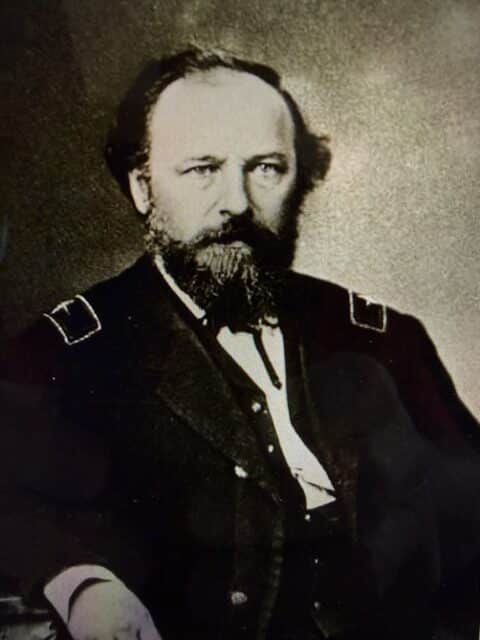
As replacements, Governor Yates had two men available for these regiments. The first was a Russian- émigré now living in Chicago. He was working as a topographical engineer for the Illinois Central Railroad, was a Republican, and had been a colonel in the Russian Imperial Guards after attending the Military Academy in St. Petersburg before immigrating to the United States. His name was John Basil Turchin, and he offered his services to the State of Illinois.[6]
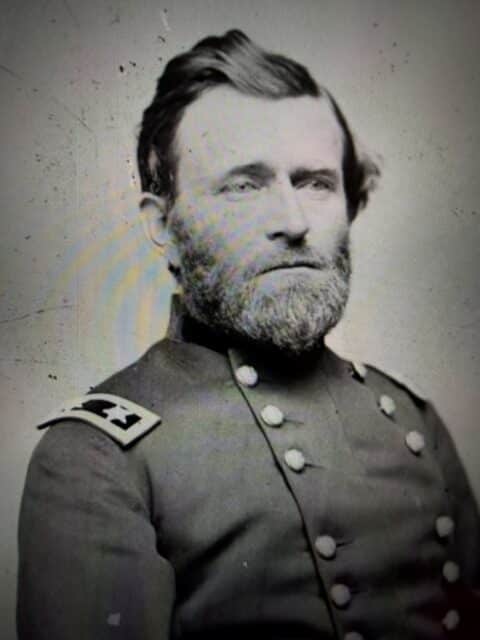
The second man was a West Point graduate and a Mexican-American War veteran. He attained the rank of captain in the regular army before resigning his commission to avoid a court-martial for drunkenness. Impoverished, a Democrat, and clerking in a leather store in Galena, he was temporarily mustering in Illinois regiments. His name was Ulysses S. Grant.[7]
On June 15, Yates relieved Goode. According to one account, Yates offered the 19th first choice of the two candidates for their colonel. “One man was Captain Grant, who had been in the regular army, and the other was John B. Turchin, a Russian officer who came highly recommended by General McClellan. . . When the election for our colonel took place, our officers did not know Captain Grant from a side of sole leather and elected Turchin as colonel,” one member of the regiment wrote, adding, “I do not know that we were ever sorry.”[8]
In fact, some members of the 19th Illinois had had a run-in with Grant earlier in May while camped in Springfield. James Fenton of Company B recalled that “They were mostly young men from 18 to 21 years of age . . .. But a more mischievous crowd was never gathered together in all of war. . .. They learned to forage very early and a rooster was not safe to come within a mile of the camp at night.”[9]
While temporarily clerking in the adjutant’s office, Grant was told by the adjutant general of a complaint that members of the 19th Illinois had stolen a pig and roasted it. The adjutant sent Grant to read a general order to the regiment threatening punishment if such activity continued.[10]
Fenton recalled the response in the ranks to Grant’s order: “Someone in the rear rank began to grunt like a pig, and soon there was more big and little pigs squealing. The man [Grant] kept his nerve under all this and calmly looked the company in their faces, folded the paper, placed it in his breast pocket, and, with a decided military movement, wheeled about and walked away.”[11]
Turchin was appointed colonel on June 17, 1861, and he and Scott, his lieutenant colonel, would become close friends.
On June 16, 1861, Grant received a telegram from Governor Yates appointing him colonel of the 21st Illinois – a regiment that he had helped muster into service. In a gentle, but firm manner, Grant earned the regiment’s respect. “We knew we had the best commander, boasted one soldier, “and the best regiment in the State.”[12]
Both regiments were satisfied with their colonels and both colonels were successful. Turchin became a brigadier general and a hero at Chickamauga earning the nicknames “The Russian Thunderbolt” and “The Mad Cossack.” Grant rose to be lieutenant general and commanded all the Union armies while earning the nickname “Unconditional Surrender” Grant, and later president of the United States.
————
[1] Report of the Adjutant General of the State of Illinois, 8 volumes, rev. Brig. Gen. J. W. Vance, Springfield, ILL: 1886, pp. 1, 5-7. Quoted in Victor Hicken, Illinois in the Civil War, Urbana ILL: University of Illinois Press, 1996, p. 1.
[2] Fenton, James, “Civil War Diary,” James Fenton Papers, Manuscript Collection of Illinois State Historical Library in The Abraham Lincoln Presidential Library, Springfield, Illinois, p. 17.
[3] Haynie, Henry J., The Nineteenth Illinois: A Memoir of a Regiment of Volunteer Infantry Famous in the Civil War of Fifty Years Ago for Its Drills, Bravery, and Distinguished Service, Chicago, ILL: M. A. Donohue & Co., 1912, pp. 47-48, 53, 135. The Nineteenth Illinois; a memoir of a regiment of volunteer infantry famous in the Civil War of fifty years ago for its drill, bravery, and distinguished services : Haynie, Henry i. e. James Henry, 1841-1912 : Free Download, Borrow, and Streaming : Internet Archive Hunt, Roger D., Colonels in Blue, Illinois, Iowa, Minnesota, and Wisconsin: A Civil War Biographical Dictionary, Jefferson, N.C.: McFarland & Company, Inc., Publishers, 2017, p. 124. Treichel, James A., Union Cossack: General John B. Turchin’s Career in the American Civil War, Master’s Thesis, Marquette University, Milwaukee, Wisconsin, 1962, p. 17. Joseph R. Scott would become colonel of the 19th Illinois when Turchin was promoted to brigadier general. He would be wounded in the left thigh and groin at the Battle of Stone’s River and die of his wounds in Chicago on July 8, 1863.
[4] Shiloh National Military Park Facebook Page, June 14, 2015. Ulysses S. Grant Receives… – Shiloh National Military Park | Facebook
[5] Chernow, Ron, Grant, New York, NY: Penguin Press, 2017, p.136. Mattoon History Center, “21st Illinois Infantry Regiment. 21st_Illinois_Infantry.pdf Norris, Bob, “21st Illinois Infantry Regiment’s History and Monument in Pike County, Illinois,” Illinois History (Yesterday & Today), February 16, 2021. ILLINOIS History (yesterday & today) | 21st Illinois Monument | Facebook Shiloh National Military Park, Facebook Page, June 14, 2015, Ulysses S. Grant Receives… – Shiloh National Military Park | Facebook New York Tribune, September 27, 1885, “Grants Only War Speech.” fn. Chernow, Grant, p. 974. Quote attributed to Pvt. Joseph H. Wham. Simon S. Goode would leave the army never to serve again. After traveling overseas, be returned to Mexico, Missouri where he operated a grocery. In February 1868, he was accused and arrested for illegally selling government barrels with the United States label branded on the barrel. The charges were brought against him by W. D. Campbell, U.S. Assessor for the city. He was acquitted as the judge ruled he wasn’t trying to make a profit. Campbell, however would not let the issue go and threatened to have Goode re-arrested. On February 11, Goode assaulted Campbell with a hickory walking stick. Campbell retailiated by drawing his pistol and firing two shots into Goode, one in the left breast and one in his ear. Goode died of his wounds shortly after.
[6] Haynie, Nineteenth Illinois, pp. 131-135. Warner, Ezra, Generals in Blue: Lives of the Union Commanders, Baton Rouge, Louisiana State University Press, 1964, pp. 511-512.
[7] Warner, Generals in Blue, pp. 183-186. Chernow, Grant.
[8] Treichel, Union Cossack, pp. 17-18. Fenton, James, Manuscript Records of James Fenton, “How Some Regiments Refused Officers Appointed Over Them,” Pt. E, pp. 1-4, Palmer Collection, Western Reserve Historical Society, Cleveland, Ohio. Chicoine, Stephen, John Basil Turchin and the Fight to Free the Slaves, Westport, CONN: Praeger Publishers, 2003, p.17.
[9] Fenton, “Civil War Diary,” p. 13.
[10] Chicoine, John Basil Turchin and the Fight to Free the Slaves, pp. 17-18.
[11] Fenton, “Civil War Diary,” p. 14.
[12] Chernow, Grant, p. 138. Smith, Jean Edward, Grant, New York, NY: Simon & Shuster Paperbacks, 2001, p. 111.


What a pair of diametrically different soldiers; Turchin and Grant. I suppose it was for the best that both regiments were happy with their selection, but I have to imagine there were at least a couple privates in the 19th kicking themselves for not going with Grant.
It’s interesting how the wheat was separated from the chaff early on in the war.
Love the pig grunt story.
thanks Brian — neat story … Governor Yates had an eye for talent in Turchin and Grant, and also in Scott who stayed on as the #2 … he was also a darn good wartime governor.