Book Review: Fighting With the Past: How Seventeenth-Century History Shaped the American Civil War

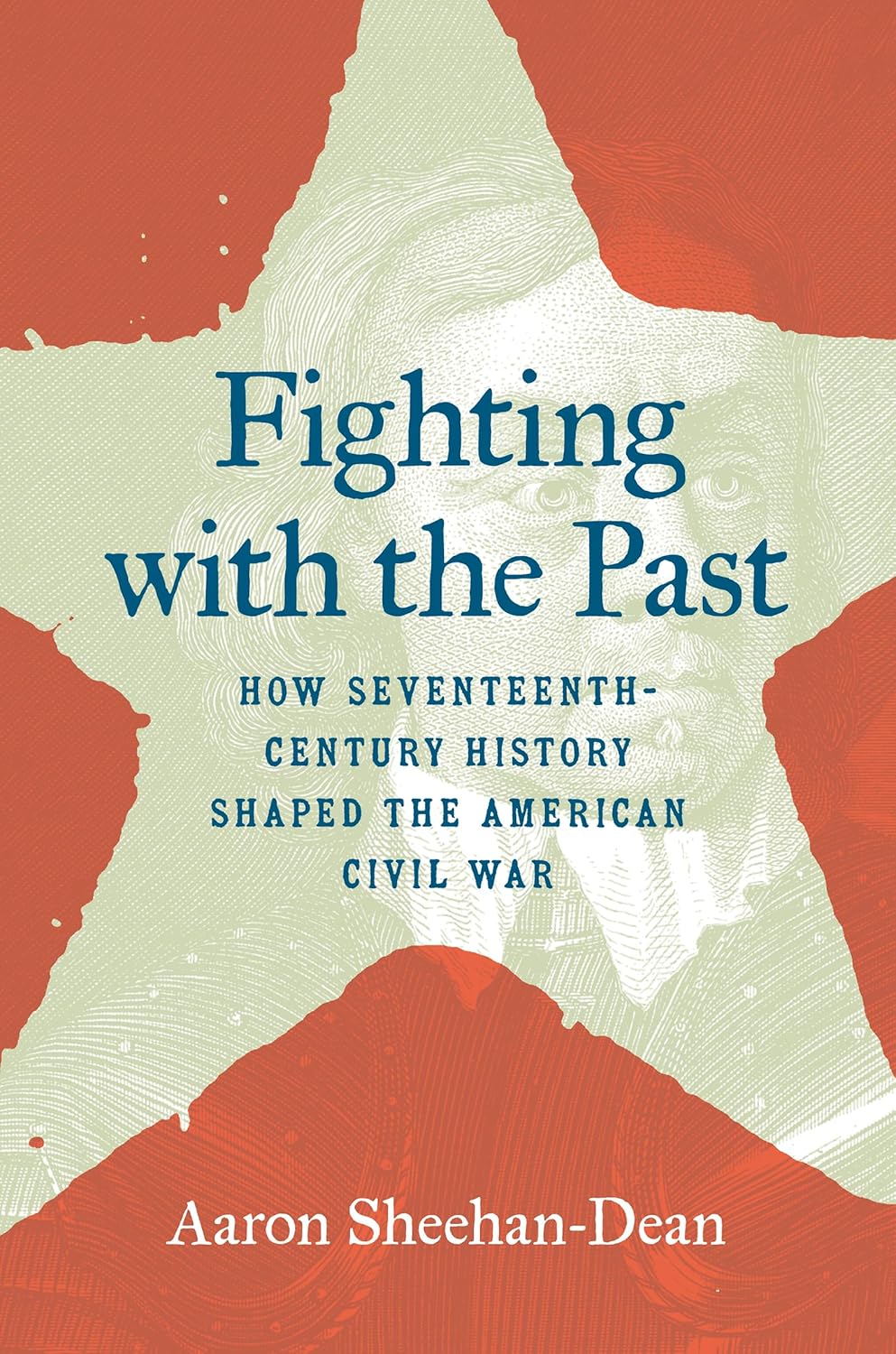 Fighting With the Past: How Seventeenth-Century English History Shaped the American Civil War. By Aaron Sheehan-Dean. Chapel Hill: University of North Carolina Press, 2025. Paperback, 210 pp. $27.95.
Of all the speeches at the dedication of the Gettysburg battlefield in November 1863, Abraham Lincon’s became the most famous – indeed, it is among the most famous speeches ever given. It wasn’t planned that way. Lincoln was supposed to be the warm-up act to conservative Unionist Edward Everett. Everett’s long speech invoked a prior Civil War – the one in England, Scotland and Ireland in the 1640s – plus the aftermath of those wars (Anglocentric folks describe these events as the English Civil War). Everett was one of many people during the American Civil War who drew lessons from the prior Civil War. Aaron Sheehan-Dean examines the various newspapers, politicians, and other figures, North and South, who drew these comparisons, and analyzes the viewpoints these different people took.
“Civil War memory” is by now a well-established genre. Authors in this genre look at how succeeding generations looked at the Civil War, and how their perceptions were influenced by, and contributed to, the social and political events of succeeding eras. Aaron Sheehan-Dean looks at “Civil War memory” of the English Civil War, as manifested during its American counterpart. Here, too, historical memory was shaped by the needs of the people invoking that memory.
The English Civil War was a war between King Charles I on one side (“Cavaliers”) and the armies of Parliament (“Roundheads”). Oliver Cromwell led the Roundhead armies to victory and the victors killed the King. Then Cromwell turned against Parliament and made himself dictator (“Lord Protector”). On Cromwell’s death, the English brought back the monarchy.
Sheehan-Dean examines the various differing, and creative, interpretations of these seventeenth-century events by the Confederates and by different factions in the North. Conservatives such as Everett drew lessons about the need for national reconciliation between the warring sides. Antislavery Northerners compared the Northern cause to the cause of the freedom-loving “Roundheads.” Confederates and Northern peaceniks said that the “Roundheads” – portrayed as ancestors of the hated New England Puritans – were evil revolutionaries seeking to tear up cherished traditions and bathe the land in blood.
The Confederates compared themselves to the “Cavaliers,” or royalists. This is curious because Charles lost. That was no deterrent to Southerners who fancied themselves as medieval knights imbued with the ideals of chivalry and of Lost Causes. Another strange thing about the comparison is that the real Cavaliers saw themselves as defending an established government against wicked rebels. But in the Confederate frame, the Cavaliers were defending tradition against revolutionary usurpers and innovators. Which brings us back to Oliver Cromwell.
The Confederates and Copperheads were on solid ground in portraying Cromwell as an evil tyrant. Cromwell replaced constitutional government with a military dictatorship. For bonus evil points, Cromwell waged a bloody war of conquest against Ireland, massacring Irishmen and seizing the land of Irish Catholics for distribution among English Protestants. The effects of this policy were felt by the Irish Catholic peasants into the nineteenth century. Confederates tried to win over Irish-Americans by saying that the Northern campaign against the south was like Cromwell’s campaign against Ireland.
This being so, one would think that all Northerners would have rejected comparisons between their cause and Cromwell’s, and that they would have tried to reassure Irish-Americans that the Northern cause was one of liberation, not conquest and oppression. However – and I was saddened to learn this fact from Sheehan-Dean’s account – many radical antislavery Northerners actually embraced the Cromwell comparison, citing Cromwell as a hero and a model for themselves and their crusade.
Even Cromwell’s conquest of Ireland was sanitized into a civilizing project – a model for what the radicals wanted to do in the South. The radicals had read contemporaneous histories which glorified Cromwell as a basically a modern liberal and champion of human rights. Also, I strongly suspect that the radicals’ admiration for Cromwell stemmed from their self-consciously Puritan heritage and anti-Catholic nativism, making them deaf to the suggestion that Cromwell might possibly have been the bad guy. The Northern antislavery radicals already had enough problems winning the Irish over to their cause, but adopting the Cromwell comparison probably killed off any remaining sympathy.
Building on Sheehan-Davis’ analysis, allow me to venture a comment. If the “radical” antislavery Northerners wanted role-models from the English Civil War era, they ought to have embraced the group known as the Levelers. The Levelers were soldiers who fought against King Charles. They believed that the King’s defeat should pave the way for a society which guaranteed equal rights for the humbler classes. Cromwell suppressed the Levelers. Imagine if the radical Northerners had revived the memory of the anti-Cromwellian Levelers when championing the elevation of enslaved Southerners. Could the Irish have seen a parallel to what was needed in their own island, and developed sympathy with landless Southern laborers rather than with the Southern version of the Protestant Ascendancy?


A generally interesting post. One major qualification: for those who want an excellent example of “curated” history, nothing is better than the reviewer’s reduction of Cromwell to a cardboard villain, just foaming at the mouth to massacre “innocent” Irish peasants and priests. Anyone who has seriously studied the Parliamentary concern of Irish involvement/interference with English domestic politics, from Wentworth onward, know this to be a hopelessly shallow fabrication. There are many incomplete “Lost Cause” narratives out there.
What a fascinating speech Lincoln made at Gettysburg. He stated that Federal soldiers, who already had their own government, were fighting for self-determination, when in fact they were fighting to deny self-determination to 5 million people. I wonder if he ever pondered the irony of that…
I’ll let Lincoln explain the true meaning of democratic self-government to you: “Plainly the central idea of secession is the essence of anarchy. A majority held in restraint by constitutional checks and limitations, and always changing easily with deliberate changes of popular opinions and sentiments, is the only true sovereign of a free people. Whoever rejects it does of necessity fly to anarchy or to despotism. Unanimity is impossible. The rule of a minority, as a permanent arrangement, is wholly inadmissible; so that, rejecting the majority principle, anarchy or despotism in some form is all that is left.” – A. Lincoln, 1861
That’s our old pard EP Schaffer for sure! Welcome back lad!