Lincoln wouldn’t have liked Illinois Nazis, either
Some readers may remember the dispute which erupted in the 1970s when avowed Illinois Nazis sought to demonstrate in the Chicago suburb of Skokie, Illinois, a village inhabited by many Holocaust survivors. Other readers may remember that Illinois Nazis (based on the real ones) were the villains in the 1980 movie The Blues Brothers.
“I hate Illinois Nazis,” pronounces Blues Brothers protagonist “Joliet Jake” Blues (John Belushi) when he encounters the totalitarian apologists demonstrating on a bridge where a court – defending their First Amendment rights – has allowed them to demonstrate. Belushi shows what he thinks of the Illinois Nazis – and their rights – when he drives them off the bridge and into the river below, to the applause of anti-Nazi bystanders.
Would Abraham Lincoln have had a similar reaction (and you were wondering what relevance this essay has to the Civil War! This will soon be made clear.)
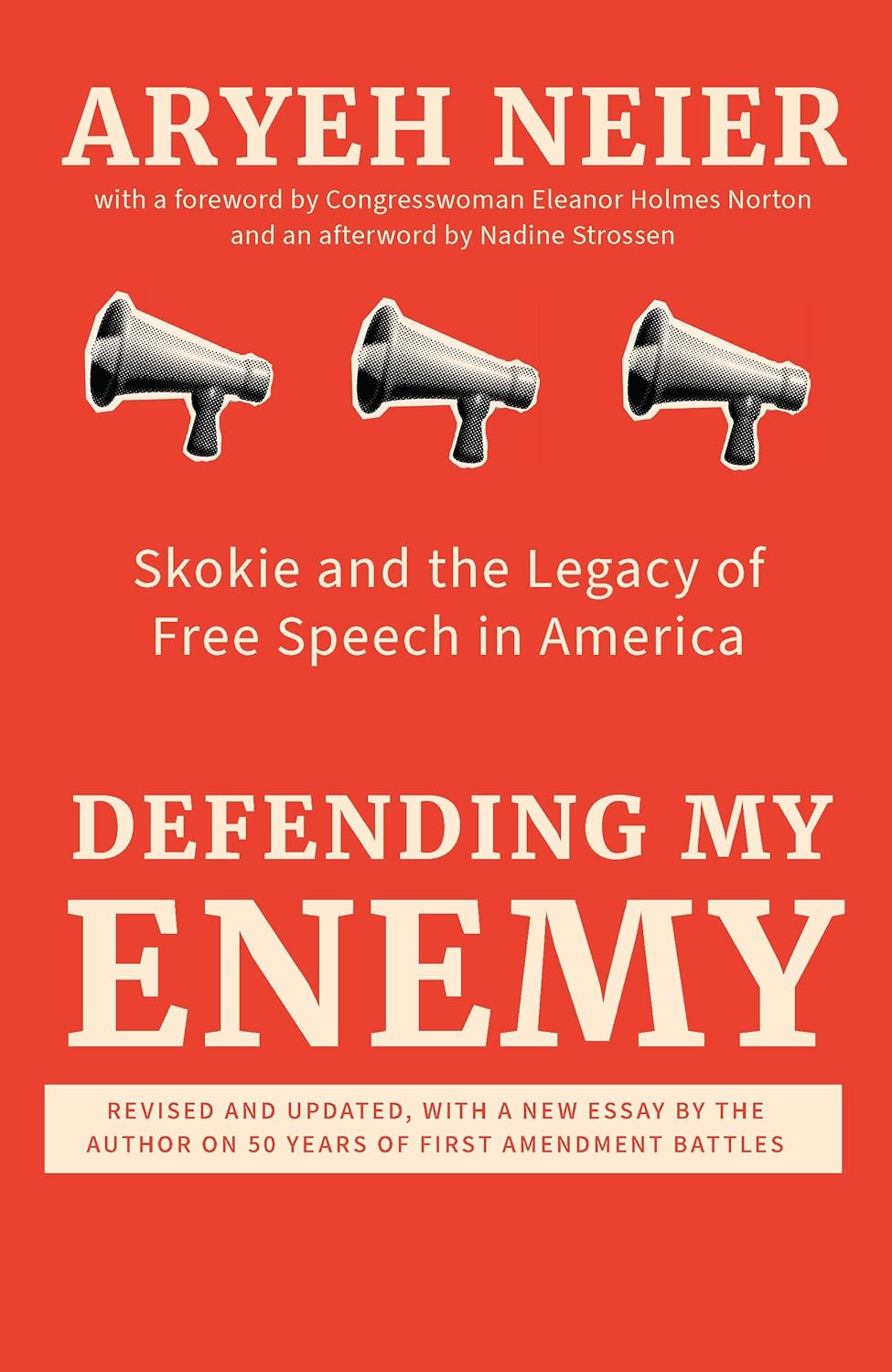 Aryeh Neier was the executive director of the ACLU during the Skokie controversy, and on Neier’s watch the ACLU was responsible for winning multiple court victories affirming the First Amendment right of the Illinois Nazis to demonstrate in Skokie: uniforms, swastikas, and all (the Nazis ultimately agreed to demonstrate in Marquette Park in Chicago, rather than in Skokie). In 1979, Neier published his book Defending My Enemy: Skokie and the Legacy of Free Speech in America to vindicate his stance in the Skokie case. Neier himself escaped the Nazis as a child before coming to America. Despite this – or, he would argue, because of this – he defended the rights of extremists such as Illinois Nazis to exercise their First Amendment rights in the most offensive contexts. As a person to whom the Nazis would have been among the first to single out for murder, Neier is all the more enamored of the virtues of a free country like the U. S. A., where civil liberties protect the people against Nazi-like oppressive governments.
The book was first published by E. P. Dutton in 1979, but in 2025 it was reissued in a 186-page edition by The New Press. The main impetus for re-releasing the book was Nadine Strossen, herself a former ACLU president (but not a current ACLU spokesperson). The 2025 edition has an afterword by Strossen, a foreword by Eleanore Holmes Norton, and an extra chapter from Neier about Skokie’s legacy and modern threats to the First Amendment.
Neier defends a robust vision of free speech (with a few narrow exceptions), even going to the extent of protecting people (such as Illinois Nazis) who oppose the foundations of the republic itself. Punish such adversaries for any political violence, says Neier, but leave them free to advocate even the most intolerant doctrines. Otherwise, the government would be in the position of saying which doctrines were intolerant, often resulting in the censorship of good speech which the regime happens to describe as intolerant – meaning, in reality, speech which is inconvenient to the regime. Furthermore, the legitimacy of a democratic government is based on full public debate. If the government excludes certain viewpoints from discussion, then when the voters decide which candidates and policies to support, the voters will be acting on incomplete information. The consent of the governed would be lacking if citizens didn’t have the full information on which to make decisions about government policy. Thus, the First Amendment is essential to upholding a democratic government’s very legitimacy.
The reason for discussing Neier’s book in a Civil War blog is that Abraham Lincoln also faced issues involving the First Amendment rights of dissenters. Lincoln faced opponents who said that the Northern war-effort was wrong, and that the North should negotiate a compromise peace with the Confederacy. In a modern “hate speech” angle, there were also critics who opposed Lincoln because the president was fighting a war to free the slaves. Some of these opponents believed that the war should be fought solely on grounds of preserving “the Union as it was.” Other opponents believed that, due to the war’s antislavery nature, it should not be fought at all. These critics, needless to say, were not pacifists, but racists who simply did not believe that freedom for Black people was worth the cost in White lives. The advocates of a compromise peace – whom we know as “Copperheads” – wanted the compromise to be at the expense of Black people.
Other critics (or sometimes the same ones) denounced the Lincoln administration as corrupt, motivated by the desire to enrich its capitalist allies rather than promoting Union or humanitarianism.
Lincoln did not prosecute most of his critics, but he certainly prosecuted a lot of them. He suppressed antiwar newspapers, banished the antiwar politician Clement Vallandigham to the Confederacy, and locked up numerous opponents of the war (often without trial). Nor was Lincoln shy about defending this repression. To him, with the country facing the existential threat of a civil war, peacetime rights of free expression did not apply. Criticizing the war effort could undermine the war effort, and criticism could be particularly insidious while a draft was going on. How does one tell the difference between honest criticism of the war and attempts to obstruct the draft, since to draft-age men in the audience, the messages could sound similar? There is no way to improve on Lincoln’s eloquence: “Must I shoot a simple-minded soldier boy who deserts, while I must not touch a hair of a wiley agitator who induces him to desert?”
Neier would defend modern Supreme Court doctrine, that even if a speaker seems to be inciting violation of the law (including the draft law), the government shouldn’t censor him unless there’s no opportunity for “counterspeech” by supporters of the government position. So if someone like Vallandigham is arguing against the war to an audience including potential draftees, the solution is not to arrest Vallandigham, but to have a prowar speaker make the case for waging a war for Union and liberty (and for drafting young men to serve in that war).
Neier’s point about the First Amendment as a guarantor of the legitimacy of government policies seems to apply here (assuming we accept Neier’s argument). Lincoln and his supporters were arguing a position which was, shall we say, not universal. Before there can be any legitimacy to a war for the restoring the Union and freeing the slaves, the public needs to have the chance to hear the argument against such a war. Then, having heard both sides, the public would hopefully support Lincoln’s war aims.
These elevated free-speech arguments sound very bracing and optimistic. As a cynic, I wonder whether, had Neier lived during the Civil War, Lincoln would have taken the risk of making Neier the attorney general. Such an experiment (a hostile interpretation would be “co-opation”) would be similar to FDR appointing Francis Biddle, a lawyer who used to write briefs for the ACLU, as attorney general during the Second World War. Here is what I consider to be a very optimistic and positive-minded summary of Biddle’s career as attorney general. Even the article, though, admits that Biddle prosecuted some dissenters.
Looking at the issue from Lincoln’s viewpoint, he might think the case of the Illinois Nazis was an easy one. By the 1970s, the Americans had defeated the Nazis on the battlefield, and the swastika-wearing hoodlums would be about as persuasive to the general public in the 1970s as an unapologetic pro-British Tory would be in the world of the 1860s (if politicians paid attention to Toryism in the Civil War, it was to bend over backwards to avoid being accused of it themselves).
Lincoln’s concern about his opponents was that, unlike Illinois Nazis, they actually had a chance of prevailing, through a combination of First Amendment activity and more conspiratorial paramilitary activity.
What would a hypothetical Attorney General Neier think of that?


“Nazis! I hate these guys!” (Indiana Jones)…
https://youtu.be/5sp3dIyNA2A?si=s7Ct2grV1P5EAv6o
Wasn’t snakes that Indiana Jones hated?
I think it’s pretty clear that free speech was a notional concept during the Civil War. There are so many examples of newspapers being shut down, critics jailed, harassed, etc. I’m more familiar with the Northern homefront but I’m sure it happened in the South too.
During the Cold War we were trying to clearly delineate the absence of freedoms in the Communist bloc compared to our own. American Nazis were an easy group to permit the exercising of those rights as they were a ulta minority fringe group. As the writer noted, they weren’t backed by an army elsewhere in the nation. Contrast that with the heavy handed treatment of West Coast Japanese American citizens in the aftermath of Pearl Harbor. Lincoln and Stanton were MUCH closer to the latter viewpoint.
Sheesh. Something about that place. Now you’ve got the real National Socialists – the Nazis were, of course, Left Wing Socialists – attacking ICE agents for arresting illegal alien murderers, rapists, pedophiles, drug dealers, etc., claiming “they are vital to our community!” What the hell kind of community is that? As for modern skinhead types walking around yelling Sieg Heil and that they hate anyone different from them, they have no true understanding or grasp of any kind of political ideology – they’re just seeking negative attention. If you explained to them that Hitler and Mussolini and their cronies and followers were Socialists they might hate them, might not – but for sure, they wouldn’t understand what they were about. There’s a difference between highly-organized purveyors of societal and world destruction and unorganized thugs. Lincoln the Real Man probably wouldn’t have liked either; Lincoln the 20th Century-anointed Saint we’ll probably be told was fighting National Socialism as soon as Mussolini invented it toward the end of World War I. He had that much reach, you know…
Lincoln would be in very good company suppressing free speech during wartime … John Adam’s administration passed the Alien and Sedition Acts in 1798 during the Quasi War with France … and Woodrow Wilson passed the Espionage Act (1917) and Sedition Act (1918) during WWI … both muzzled and jailed private citizens for “false and malicious” speech against the government.
Adams tossed a few people in the klink, including a congressman … and Eugene Debs – the famous socialist – got 10 years for mouthing off about the draft … the WWI acts even survived a SCOTUS challenge (9-0) in Schenck v. United States … this is where we get the familiar — “you can’t (falsely) shout fire in a crowded theater” … so, the nation has a solid record of doing dumb things when it comes to free speech … and it is informative that we have never done it since.
To your question about a hypothetical Attorney General Neier, he would absolutely come down on the side of the first amendment – no matter what the circumstances … and I am not sure about your argument that the Nazis could not have won … anyway, thank goodness we have a first amendment – pretty smart guys those framers.
Excellent points.
Well, once again here comes the trump-worshiping, right-wing Mr. Schafer with more historically incorrect information. The German National Socialist party in the 1920s and 1930s was of course an extreme RIGHT wing organization. The driving premise of that party was their abhorrence of LEFT parties, especially the KPD(German Communist Party). Mr. Schafer should engage in reading some genuine historians of the period; a good start would be Richard Evans trilogy on the Third Reich or even Ian Kershaw’s duology on Hitler. It’s astounding how every single issue of the American Civil War can somehow turn into a far right-wing drumbeat for Mr. Schafer. So, take some time ff from your daily worship of trump and do a bit of reading.
Please – no more comments from non-readers. Socialism is, always has been, always will be, Left Wing. Pure fact: Benito Mussolini’s father was a leading Socialist in Italy. So was Benito, who, seeing the difficulties of enforcing Socialism on the disparate society in Italy, invented National Socialism, which he called “Fasces” (bound together), or, in English, Fascism – which Adolf Hitler and his cronies blue-printed for Germany. Hitler, whenever he was interviewed, asserted the truth – that he hated Capitalism, and that he indeed was a Socialist. What’s more, Hitler and Mussolini did what every Socialist/Communist government has always done: total control of the media, suppression of opposition political parties, suppression of free speech, total economic control (socialism: directs the economy; communism: owns the economy; national socialism: partners with industrialists to control the economy), and collections – concentration camps – for political opponents, re-education, labor, and murder. This behavior is not Right Wing, it is Left Wing. Lenin and Stalin did it; Mao did it; Kim did it; Pol Pot did it; Castro did it; the Vietnamese behind Ho Chi Minh did it.
If one wants graphic evidence of this, I refer you to study the tenets of Hitler’s National Socialist German Workers Party – NASDAP, or Nazi – and to view the logo of the Nazi’s largest trade union, the NSBO, the “National Socialist Factory Cell Organization.” It is an upraised arm clenching a hammer emblazoned with a swastika, crossing the arc of a machine cog, substituting for the curve of a sickle. The hammer and sickle – the classic emblem of Socialists and Communists.
Please stop with your ridiculous attempts to propagandize over the truth. Clearly, it is the attempt of someone on the extreme Left to paint the Right with the horrors of Left Wing Nazism and the Holocaust. You could not declare more clearly and loudly that you are a Nazi than doing this. This is not a matter of opinion, but fact. The facts of history prove you not just to be wrong, but to be lying.
For those who like your facts simple and easy to find, simply check Wikipedia at the link below. It displays the clearly Socialist logo of the NSBO and states, “…the NSBO had an ideology similar to National Bolshevism.” Good Lord – even Wiki gets it correct!
https://en.wikipedia.org/wiki/National_Socialist_Factory_Cell_Organization
“You can fool all the people some of the time and some of the people all the time, but you cannot fool all the people all of the time.” Attributed to Lincoln in the Lincoln-Douglas debates.