ECW Podcast: Civil War Memories in a Polarized America (with Jen Murray and John Kinder)
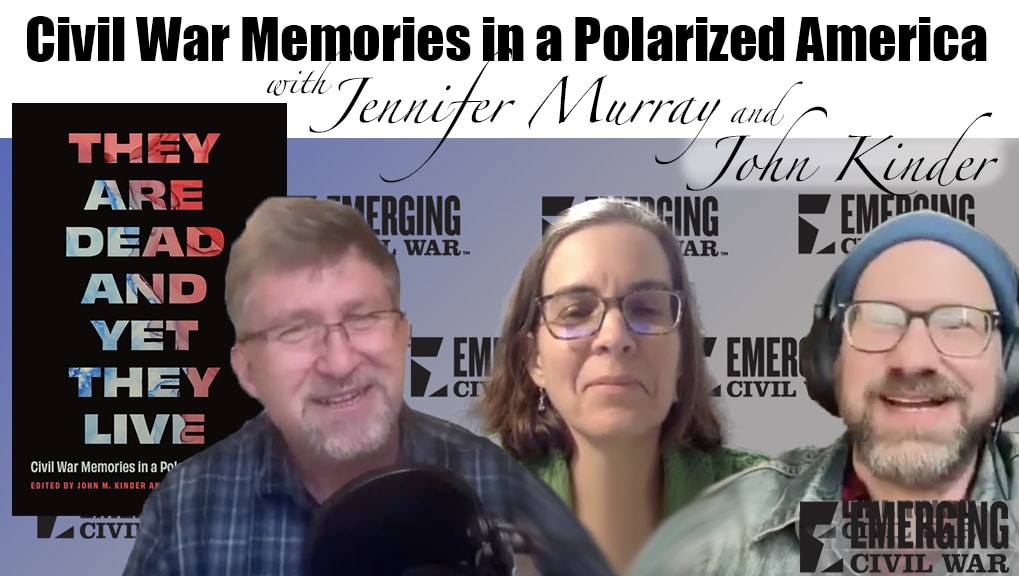
Today’s political polarization has had an impact on how we remember the Civil War—and how we remember the Civil War impacts how we view today’s politics. In this episode of the Emerging Civil War Podcast, host Chris Mackowski speaks with historians Jennifer Murray and John Kinder about the new collection of essays they’ve edited, They Are Dead and Yet They Live: Civil War Memories in a Polarized America.
This episode of the Emerging Civil War Podcast is brought to you by Civil War Trails, the world’s largest open-air museum, offering more than 1,500 sites across six states. Request a brochure at civilwartrails.org to start planning your trip today.
The Emerging Civil War Podcast taps into ECW’s award-winning line-up of historians and great special guests—all of whom come from a wide variety of backgrounds with a wide variety of interests on a wide variety of topics.
You can listen on Spotify here:
You can listen on Apple Podcasts here:
You can also listen through the ECW Patreon page. A subscription to our Patreon page—which helps pay our podcast costs—also entitles you to exclusive free content. Sign up for as little as $1.99/month: https://www.patreon.com/emergingcivilwar.
Be sure to also catch the video version of each podcast on Emerging Civil War’s YouTube Channel. Videos drop Friday evenings at 6:30 p.m. Eastern.


Great conversation! Thank you for highlighting this new book and discussing relevance honestly.
The docent at the South Carolina museum who stated that Lincoln was killed by his doctors and not the bullet probably conflated Lincoln with Garfield, who pretty clearly was killed by his doctor. That is a significant misstatement, but I’m betting that conflating Lincoln with Garfield was the basis for it.
That might be true (and, yes, Garfield was certainly the victim of his doctors!). However, I’ve also experienced first-hand people who intentionally “misremember” the northern side of the war in various ways. Sometimes it’s an honest mistake; sometimes, it happens in a way that tends to intentionally make the North look bad or the South look less-bad. That might not even be the fault of the person sharing the memory but, instead, the way the story was passed on to them. If the doctors killed Lincoln, for instance, does that somehow absolve Booth, a Southern sympathizer, of some of the blame?
I’ll take felony murder for 200, Alex. It wouldn’t absolve Booth, Guiteau or anyone else.