Whitewashing Lee’s Army: Gettysburg and the Erasure of Black History
Director Ron Maxwell’s Gettysburg (1993), one of my all-time favorite films, is the definitive cinematic depiction of the famous battle. The movie chronicles the epic three-day struggle between the Union Army of the Potomac and the Confederate Army of Northern Virginia for the fate of the nation. Based on Michael Shaara’s novel The Killer Angels (1974), the film features an epic soundtrack and top-notch performances from its cast.
The more I study the battle, however, the more apparent the film’s historical inaccuracies become. Race is one area in which Gettysburg falls short. Although the movie’s 271-minute runtime includes multiple discussions about slavery, it features only a single African American character—a runaway slave whose sole purpose is to spark a conversation between Colonel Joshua Lawrence Chamberlain and (the fictional) Sergeant ‘Buster’ Kilrain.
Despite the historical reality that thousands of black slaves accompanied the Confederate Army into Pennsylvania, the force shown in Gettysburg is monochromatic. The film devotes plenty of screen time to Confederate encampments and units on the march. Where are all the black Southerners who served in numerous non-combat roles?
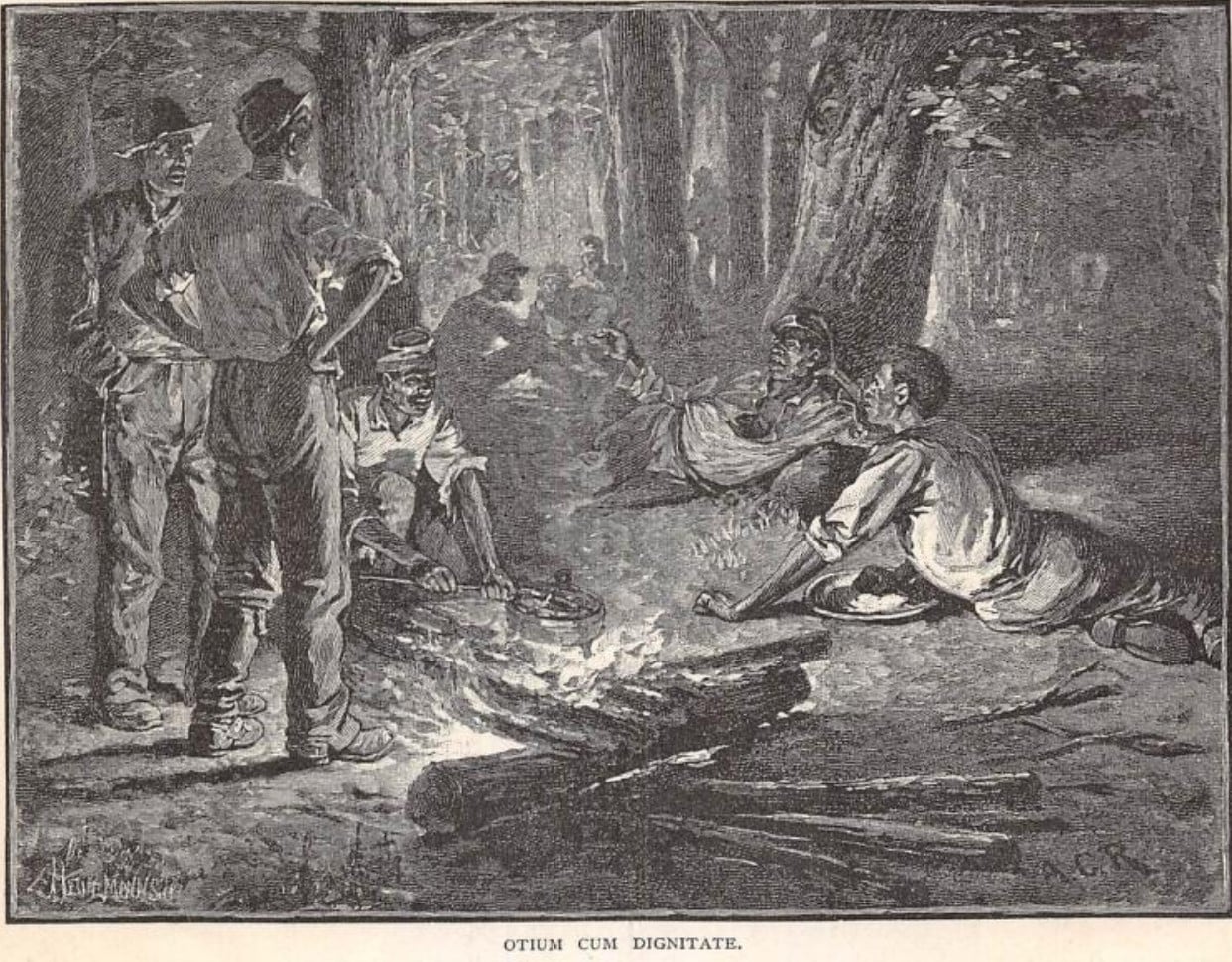
In the Confederate army, black Southerners (mostly enslaved, but some freemen) performed tasks such as cooking, washing, foraging, tending horses, blacksmithing, and digging graves. They served as teamsters, musicians, and even hospital orderlies.[1] If the filmmakers were genuinely striving for historical accuracy, how could they overlook such an obvious fact?
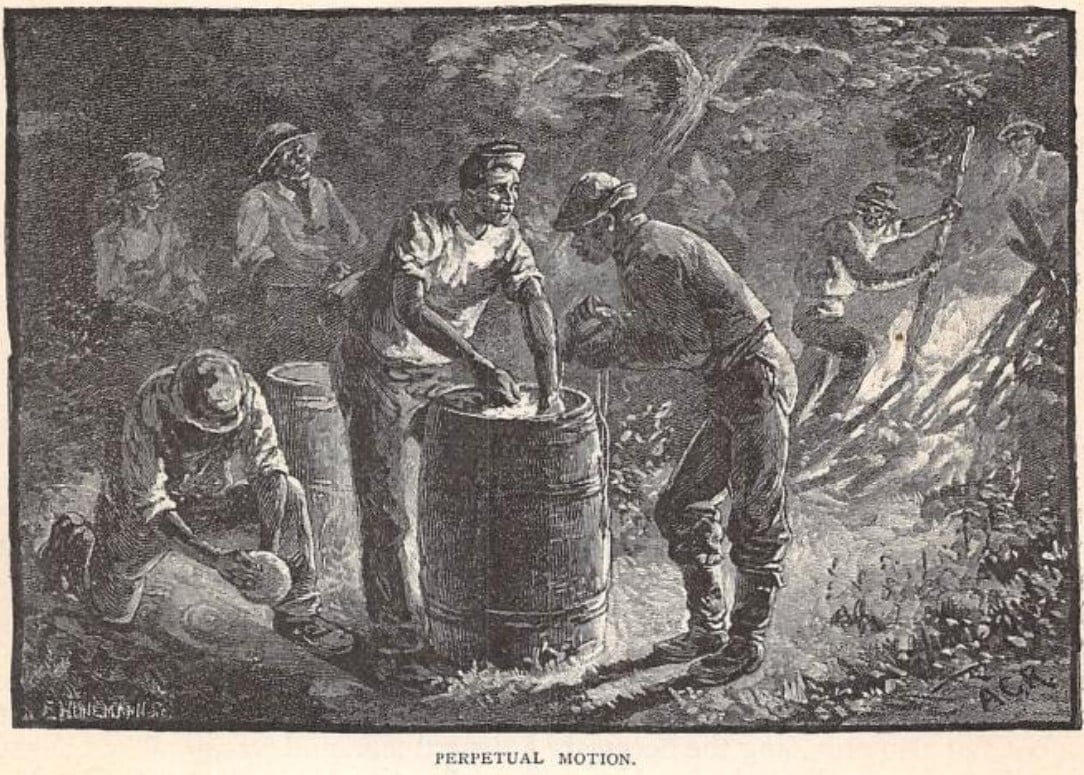
We know from contemporary sources that black Southerners played an active part in the Army of Northern Virginia. For instance, Major Johann August Heinrich Heros von Borcke, a Prussian cavalry officer on Maj. Gen. J.E.B. Stuart’s staff, recalled Stuart being alerted to the fighting that began the battle of Brandy Station on June 9, 1863, at the opening of the Gettysburg campaign:
“Stuart was now promptly awakened, the entire headquarters alerted, the nearby horses saddled by the Negro servants, and everything placed in readiness for the impending engagement.”[2]
Likewise, Capt. Justus Scheibert, a Prussian military attaché, observed:
“Here I must remark that the southern cavalry (also the artillery and staff), as soon as they arrived at the camp, immediately unsaddled the horses and either sent them to the fenced pasture or assigned some Negroes to watch over them. The officers’ servants, some wagon drivers, and supply-train soldiers were in fact Negroes, while not a single Negro bore weapons at that time.”[3]
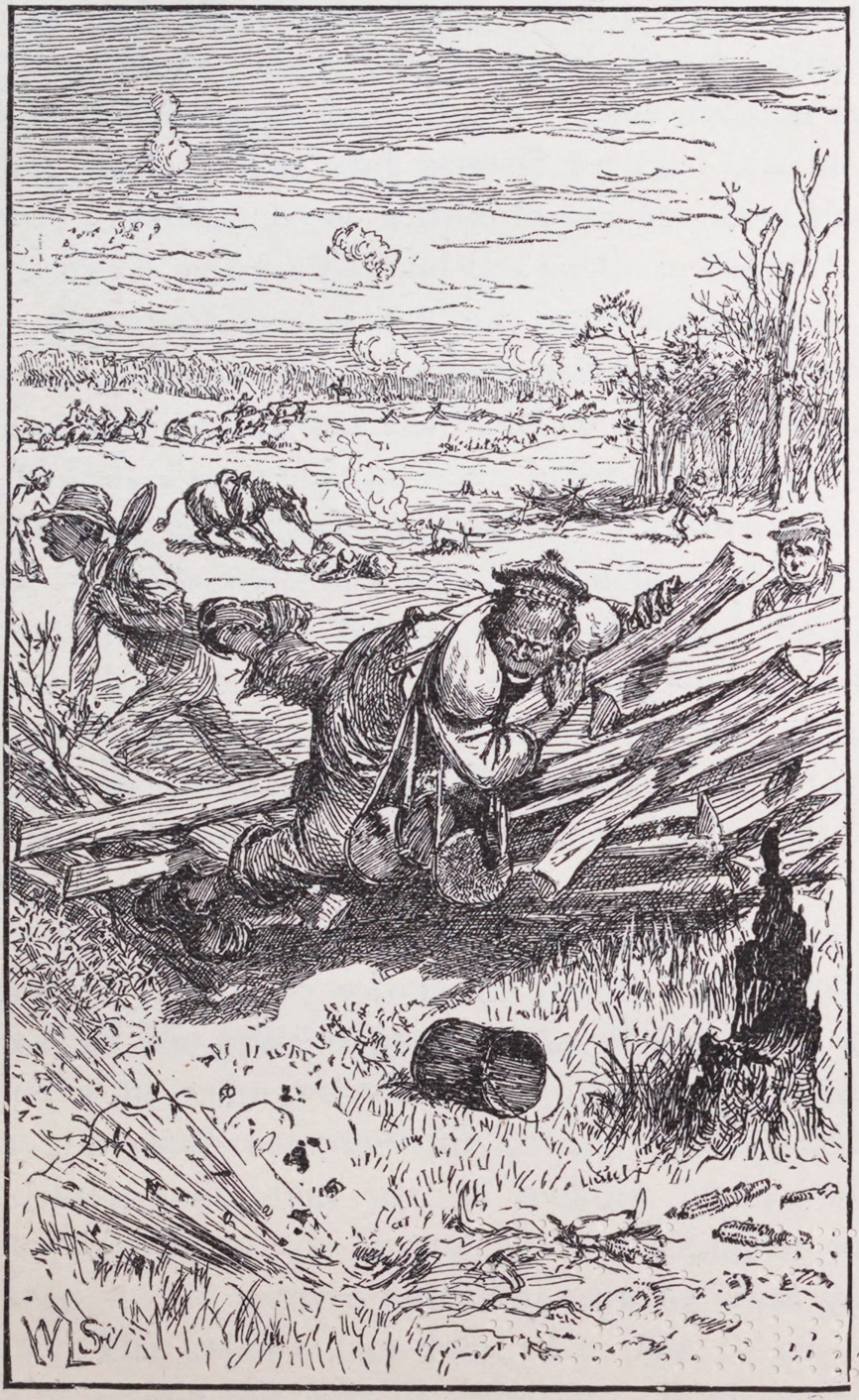
While they did not bear arms on the battlefield, that does not mean they never handled weapons. On July 6, 1863, as the Army of Northern Virginia retreated from Gettysburg, British observer Lt. Col. Arthur Fremantle (portrayed by James Lancaster in the film) “saw a most laughable spectacle”:
“a negro dressed in full Yankee uniform, with a rifle at full cock, leading along a barefooted white man, with whom he had evidently changed clothes. General Longstreet stopped the pair, and asked the black man what it meant. He replied, ‘The two soldiers in charge of this here Yank have got drunk, so for fear he should escape I have took care of him, and brought him through that little town.’ The consequential manner of the negro, and the supreme contempt with which he spoke to his prisoner, were most amusing.”[4]
Fremantle did not say what became of the pair, but the sight of an armed slave passing a Confederate corps commander and his staff evidently was not alarming. Others, like Lewis H. Steiner, an inspector for the U.S. Sanitary Commission, observed slaves carrying weapons while on the march.
During Lee’s 1862 invasion of Maryland, Steiner kept a diary documenting the Confederate occupation of Frederick, Maryland. In his forty-page report, he estimated the strength of Lee’s army and observed the following:
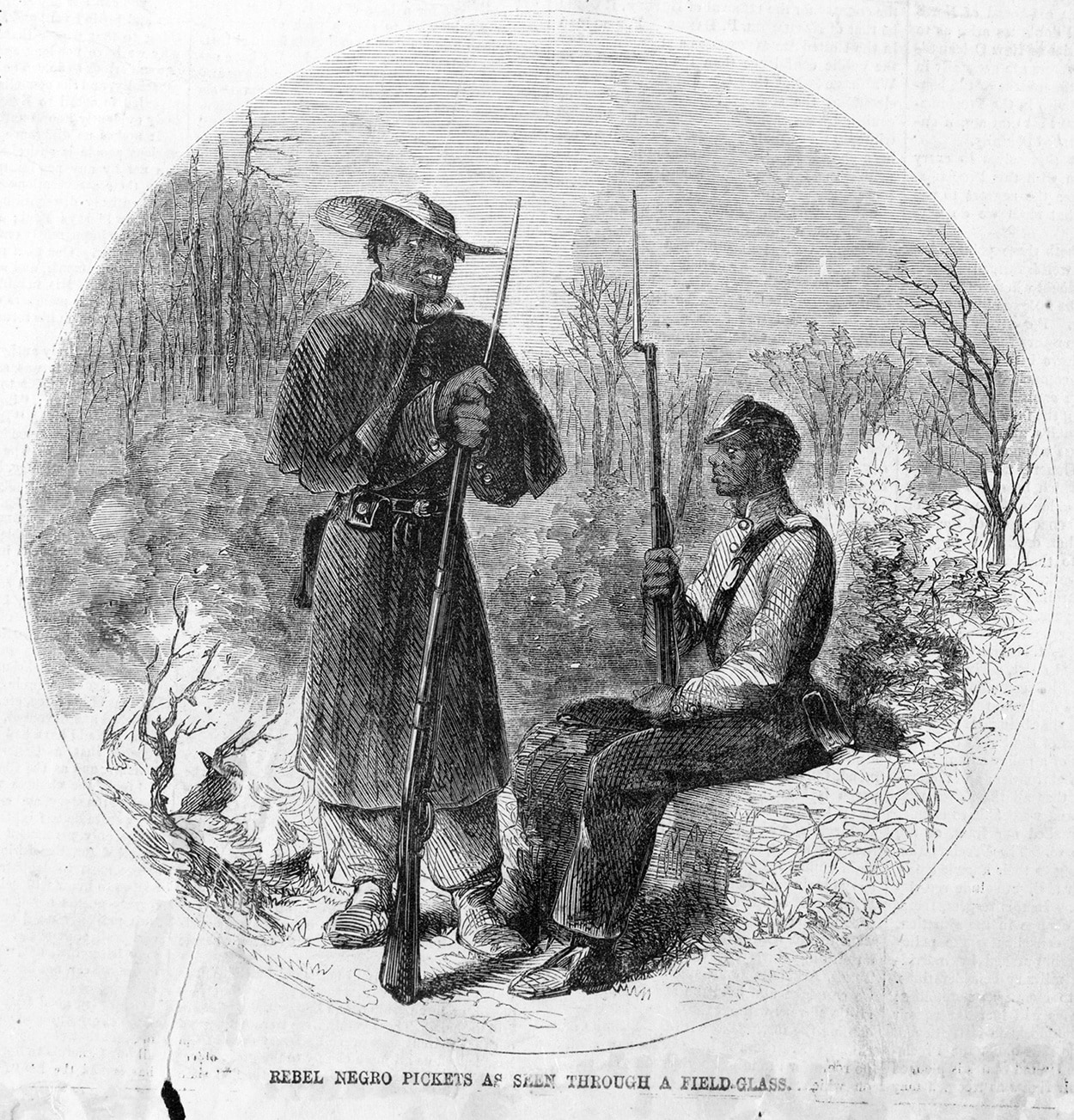
“Over 3,000 negroes must be included in this number. These were clad in all kinds of uniforms, not only in cast-off or captured United States uniforms, but in coats with Southern buttons, State buttons, etc. These were shabby, but not shabbier or seedier than those worn by white men in the rebel ranks. Most of the negroes had arms, rifles, muskets, sabres, bowie-knives, dirks, etc. They were supplied, in many instances, with knapsacks, haversacks, canteens, etc., and were manifestly an integral portion of the Southern Confederacy Army. They were seen riding on horses and mules, driving wagons, riding on caissons, in ambulances, with the staff of Generals, and promiscuously mixed up with all the rebel horde.”[5]
Later, he added, “The only real music in their column to-day was from a bugle blown by a negro. Drummers and fifers of the same color abounded in their ranks.”[6]
Just how many black Southerners (enslaved or otherwise) accompanied the Army of Northern Virginia is difficult to say. They were not considered soldiers and did not appear on official muster rolls, so traditional troop estimates reflect only white men formally serving in the Confederate army. Historian Kevin M. Levin has estimated that Lee’s army brought as many as 10,000 slaves, sometimes called “body servants,” on its 1863 invasion of Pennsylvania.[7]
As McLaws’ Division marched north in June 1863, Fremantle noted, “In rear of each regiment were from twenty to thirty negro slaves, and a certain number of unarmed men carrying stretchers and wearing in their hats the red badges of the ambulance corps.”[8]
During the Gettysburg campaign, Semmes’ and Barksdale’s Brigades each consisted of four regiments, which means between 80 and 120 slaves accompanied each brigade (if Freemantle’s observation was accurate). For Barksdale’s Brigade, that’s roughly a ratio of 1:20 or 1:13. In Semmes’ Brigade, the ratio was more like 1:17 or 1:11.
Historian Allen C. Guelzo estimated that Lee’s army included anywhere from 10,000 to 30,000 slaves prior to the Gettysburg Campaign.[9] Guelzo’s highest figure came from Lt. Thomas Caffey, an Englishman serving in the Army of Northern Virginia who published an anonymous and often error-filled account of his service aimed at persuading overseas readers of the righteousness of the Southern cause. The work devotes an entire chapter to Southern slavery, with particular attention to slaves serving in the Confederate army. Caffey quoted a soldier as saying:
“In our whole army there must be at least thirty thousand colored servants who do nothing but cook and wash. . . They are roaming in and out of the lines at all times, tramping over every acre of country daily, and I have not heard of more than six instances of runaways in our whole brigade, which has a cooking and washing corps of negroes at least one hundred and fifty strong!”[10]
Thirty thousand is undoubtedly exaggerated. Lee had enough problems feeding his own men, let alone an entire corps of camp followers. If Caffey’s claim of 150 slaves per brigade is taken as representative, it suggests a figure only slightly higher than Fremantle’s.
Given the best information we have available, it’s not unreasonable to conclude at least 4,500 to 5,000 slaves accompanied the 75,000-man Army of Northern Virginia into Pennsylvania in June 1863. They even rounded up several hundred free blacks and escaped slaves in Maryland and Pennsylvania, so these must be added to the total.[11]
Depicting the Army of Northern Virginia as mono-racial is not merely inaccurate; it deliberately glosses over the extent to which slavery, and black Southerners more broadly, shaped the Confederacy. Black slaves were a constant presence in Confederate camps, cooking meals, tending horses, and performing a wide range of labor. The all-white army portrayed in films like Gettysburg would have been unrecognizable to actual Southern veterans of the Civil War.
[1] Colin Edward Woodward, Marching Masters: Slavery, Race, and the Confederate Army During the Civil War (Richmond: University of Virginia Press, 2014), 82-83; Allen C. Redwood, “The Cook of the Confederate Army,” Scribners Monthly 18 (May-Oct. 1879): 560-68.
[2] Heros von Borcke and Justus Scheibert, Die grosse Reiterschlacht bei Brandy Station 9 Juni 1863, trans. M.A. Kleen (Berlin: Paul Kittel, 1893), 79-80.
[3] Justus Scheibert, Sieben Monate in den Rebellen-Staaten während des nordamerikanischen krieges 1863, trans. M.A. Kleen (Stettin: Th. von der Nahmer, 1868), 100.
[4] Arthur Lyon Fremantle, Three Months in the Southern States: April-June, 1863 (Edinburgh: William Blackwood and Sons, 1863), 288.
[5] Lewis H. Steiner, Report of Lewis H. Steiner, inspector of the Sanitary Commission, Containing a Diary Kept During the Rebel Occupation of Frederick, MD (New York: Anson D. F. Randolph, 1862), 19-20.
[6] Steiner, Report of Lewis H. Steiner, 21.
[7] Kevin M. Levin, Searching for Black Confederates: The Civil War’s Most Persistent Myth (Chapel Hill: University of North Carolina Press, 2019), 48.
[8] Fremantle, Three Months in the Southern States, 238.
[9] Allen C. Guelzo, Gettysburg: The Last Invasion (New York: Vintage Books, 2014), 161.
[10] [Thomas Caffey], Battle-Fields of the South, from Bull Run to Fredericksburg, Vol. II (London: Smith, Elder and Co., 1863), 58-59.
[11] Robert J. Wynstra, At the Forefront of Lee’s Invasion: Retribution, Plunder, and Clashing Cultures on Richard S. Ewell’s Road to Gettysburg (Kent: The Kent State University Press, 2018), 81-82.


Point taken. I am sure that there is much Maxwell missed about the Gettysburg experience. But there’s only so much you can put in one movie. Gettysburg was four hours long—it required an intermission.
Gettysburg also downplayed the female experience in the battle. I guess Jennie Wade’s death fell on the cutting room floor? According to the website for her museum, she “became Gettysburg’s heroine.” Should we fault Maxwell for ignoring her, and the other women of Gettysburg, as well?
Perhaps you’re being a wee bit picky here.
While including Jennie Wade’s story would have required lengthening the run time, it wouldn’t have required any special effort to include African Americans in the background in the numerous camp scenes and marching scenes. There were a lot of opportunities to show them. They did have women in some scenes as the armies marched along. I do fault the movie for ignoring other aspects of the battle too. But like you said, it could only be so long.
Well, sure but the subtitle is “Erasure of Black History.” There is some difference between just not having enough run time and actually erasing black history.
Tom
Thank you for detailing the true source of Southern wealth. Without free labor there would have been no oligarchs to demand the right to enslave men and women.
The sources are good enough that we could have a new film, with true and accurate characters!
“with true and accurate characters”
What is “untrue” about how the main characters were portrayed? What was “untrue” and “inaccurate” about Maxwell’s portrayal of Lee, Longstreet, Armistead and the other Confederate characters? (I’m presuming that you’re unhappy with how the leading Confederate characters were portrayed).
I’ve always found the character acting in this film to be the best part. I’m not sure what Mark is talking about. The actors practically disappeared into their roles.
The tagline for the movie is “Same Land. Same God. Different Dreams.” What does that even mean? Hollywoodese. You know right off that the movie won’t be presenting a good historical accounting of what the Civil War was all about.
Criticizing the movie for a lack of black representation is unreasonable. First it is a movie, not a documentary. The role of support troops on either side is not the point of the movie, the command decisions and battles are. I don’t remember a signal war movie that covers rear troops in any detail. The criticism can be applied to any WWII movie that doesn’t for instance include the roll of the Red Ball Express.
The role of blacks, slaves or free, is certainly an area of scholarship that should be looked at. But it is hardly a new or ignored subject.
Maxwell’s prequel, “Gods and Generals” did have a scene involving black camp servants in the Confederate camp. One freed servant’s former master had been killed and the servant was planning to take the body home to his family. The scene was cut but appears in a deleted scenes collection on the DVD.
Neat, I haven’t seen that deleted scene yet
Thanks to Michael for this helpful overview of the role of enslaved labor in Lee’s army. I don’t place much weight on the focus of Maxwell’s movie since it is based on a work of historical fiction. The questions that I am grappling with, as I continue work on a book-length study of role of enslaved labor in Lee’s army during the Gettysburg Campaign, is how this group helps us understand how the Confederate army functioned in camp, on the march and even in battle. How does their presence help us to better understand the importance of the campaign? After all, in the summer of 1863, the institution of slavery had entered a free state. The presence of the Army of Northern Virginia sent shock waves through Black communities and as Michael mentions hundreds of men, women, and children were kidnapped and brought back into slavery–most of these people were likely not born into slavery. Finally, I believe that focusing on the thousands of enslaved laborers who marched with Lee’s army can shed light on some of the most tired debates about Confederate soldiers. How many times have you been told that because a soldier didn’t own slaves that he had no stake in its existence. Well, if we acknowledge the sheer numbers of slaves and the key roles they played throughout the army we can begin to shift our focus from whether a soldier ‘fought for slavery’ to whether a soldier understood the importance of slavery to the army and its chance of success on the battlefield. The latter question is much more important. These are just a few of the things I am thinking about.
It’s probably impossible, but it would be interesting to find out what happened to the people taken in Pennsylvania. Did any escape during the battle or retreat? Were they sold in Virginia? Did they stay with the army? I hope ypur research uncovers some of these answers.
I do know that at least one Confederate camp slave, who ran off during the battle, eventually married a local Gettysburg Black woman. This really is a fascinating and largely untapped history.
“How many times have you been told that because a soldier didn’t own slaves that he had no stake in its existence.”
About as many times as I’ve been told that Confederate soldiers fought FOR slavery.
The “extras” were mostly members of reenactment units. In a recent battle reenactment I attended, several Blacks showed up on “chains” attempting to join any Confederate unit in what I assumed was a protest of the irony of the Confederate soldiers fighting for their rights but also to deny those same rights to others. Those Blacks were booed by members of the Confederate reenactment units they approached and threatened with police action if they did not leave. Putting “slaves” in the background of “Gettysburg” scenes of Confederate camplife would not quite fit some reenactors’ perferred historical image and may have adversely impacted the use of some of the Confederate “extras” if Maxwell would have tried to do so.
I think the problem was the intrusive nature of what happened. They weren’t making a genuine effort to add to the historical realism of the reenactment. They were trying to crash it to make a political point, and if it’s the same incident I saw, post it for views online. I think if the intention going into it was a good fath effort to more accurately portray camp life in the Confederate army, the reaction would have been different.
Thanks for this piece, you make a great point … the director could have easily fixed it by dropping a few black faces in the background during camp scenes — too easy … but this movie has lots of other things that make it historically “unrecognizable to actual southern veterans” — Confederates who are too old and way too fat, uniforms that looked like they were fresh from the dry cleaners, and wooden dialogue that make the movie almost unwatchable … getting little things right is important when making a historically faithful film … and Gettysburg doesn’t do that. thanks again.
While we expect that Confederates had Black servants, both free and enslaved, by the battle of Gettysburg large numbers of freed Blacks known as Contraband also accompanied Union troops. My study of surgeons who served at Gettysburg revealed that both sides had African American servants taking care of horses and cooking meals.
Yes! I’m thinking of writing about black teamsters, etc on the Union side of the battle at a later date. Winslow Homer had some famous illustrations of them.
Michael Kleen: There is some information on the fate of the black folks captured in Pennsylvania. There was one young man, from York, I think, who was being held in Castle Thunder later in 1863. This is detailed in Jacob Hoke’s “other” book, “Reminiscences . . .” There is substantial documentation involving Amos Barnes, a free black from Mechanicsburg, I think. He was eventually freed through the efforts of Rev. Thomas Creigh. A group of about 30–40 women and children who were captured by Jenkins’s brigade in Chambersburg were freed on their way south by a and of citizens from Greencastle.
I was aware of this topic from Kevin Levin, who has commented above. I appreciate Kleen’s added perspective.