“A Promissory Note:” Abraham Lincoln and the Civil Rights Era
There are few, if any, other figures in the history of the United States who loom as large in public memory and imagination as Abraham Lincoln. Even now, 217 years after his birth, Lincoln lives in the thousands of volumes dedicated to him. Around the world, his words, quotations, famous speeches, and anecdotes echo through generations. His humble beginning, tumultuous personal and professional life, constant desire for growth and knowledge, and his rise to power and prominence feel so uniquely American. To be sure, Lincoln’s ascent to the presidency at the moment of the nation’s greatest need and his determination to save the Union, end slavery, and preserve the Constitution secured his place in history, and his untimely death enshrined him in the public imagination. Indeed, Robert Penn Warren included Lincoln among the “mythic figures” of the war. Novels, and later films, dramatized his life. Authors, politicians, and commentators quoted his speeches. His likeness appeared on propaganda materials during both the First and Second World War. In his death, Lincoln left his dreams and vision for Reconstruction and a post-Civil War nation to speculation.[1]
As the centennial of the American Civil War approached, the nation found itself at another pivotal crossroads in the long struggle for racial equality. The “cup of liberty,” which Lincoln spoke of in his final public address, had been dashed from those freed from the bonds of slavery and from their descendants throughout Reconstruction and the subsequent Jim Crow Era. To them, the promise of the Thirteenth, Fourteenth, and Fifteenth Amendments to the Constitution of the United States had been left to the “vague and undefined when, where, and how.”[2]
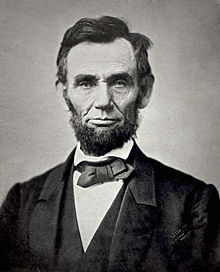
In the final pages of Lincoln and the Politics of Slavery, Daniel Crofts reflected on Emancipation and the Civil Rights Era. “The parallels to the Freedom Movement of the 1960s are substantial,” wrote Crofts. “Few African Americans in the mid-twentieth century Deep South,” he continued, “could register to vote, and the humiliations of racial segregation were strongly entrenched behind a bulwark of state and local laws, coupled with repressive violence.” This, in a nation, “conceived in liberty and dedicated to the proposition that all men are created equal.”[3]
Indeed, the same United States that was “so conceived and so dedicated” grappled with the reality of its meaning then, as it had at the dawn of the Civil War. Lincoln observed that struggle firsthand. On August 24, 1855, he wrote to his friend Joshua Speed, “As a nation,” he wrote, “we began by declaring that ‘all men are created equal.’” “We now practically read it, ‘all men are created equal, except negroes,’” he continued. Outraged by the betrayal of the Founders’ promise, Lincoln continued his searing criticism. “When the Know-Nothings get control,” he claimed, “it will read ‘all men are created equal, except negroes, and foreigners, and catholics’…When it comes to this, I should prefer emigrating to some country where they make no pretence of loving liberty-to Russia, for instance, where despotism can be taken pure, and without the base alloy of hypocracy [sic].”[4]
By the 1960s, the nation still had not fully grasped that seemingly elusive self-evident truth. On May 17, 1962, the head of the Southern Christian Leadership Conference, Dr. Martin Luther King Jr., wrote an open letter to Kennedy. In an appeal to the president, King urged him, on the eve of the centennial of the Emancipation Proclamation, to reconstitute Lincoln’s January 1, 1863 order. “The wellsprings of equality lie deep within our past,” wrote King. Seizing the opportunity to frame the Civil Rights Movement in the context of history, and of the 100th anniversary of the Civil War, King’s letter stated, “We believe the Centennial of the Emancipation Proclamation is a peculiarly appropriate time for all our citizens to rededicate themselves to those early precepts and principles of equality before the law.” King quoted the great Civil War historian Bruce Catton, referenced the battles of 1862, and then turned his attention swiftly to Lincoln, slavery, and emancipation. “The conscience of America,” King contended, “looks now, again, some one hundred years after the abolition of chattel slavery, to the President of the United States.”[5]
King’s Second Emancipation Proclamation, however, failed to move Kennedy to action. “Although he might have privately agreed with King’s historical point,” concluded David Blight, “Kennedy was unwilling to alienate Southern Democrats before the congressional elections of 1962, and he ignored this and other demands for a new Emancipation Proclamation.”[6]
A year later and a month after racial violence in Birmingham, Alabama, hours after National Guardsmen escorted two Black students, Vivian Malone and James Hood, onto the University of Alabama’s campus, Kennedy spoke to the nation. On June 11, 1963, Kennedy spoke of “a moral issue…as old as the scriptures and…as clear as the American Constitution.” “One hundred years of delay have passed since President Lincoln freed the slaves,” remarked Kennedy, “yet their heirs, their grandsons, are not fully free… And this Nation, for all its hopes and all its boasts, will not be fully free until all its citizens are free.”[7]
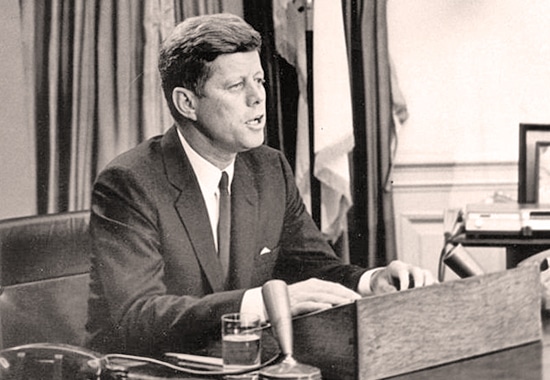
“We preach freedom around the world, and we mean it…but are we to say to the world, and much more importantly, to each other that this is the land of the free except for the Negroes,” asked the president. He piercingly questioned if the nation could boast “no second-class citizens except Negroes…no master race except with respect to Negroes?” “Now the time has come for this Nation to fulfill its promise,” Kennedy concluded. The “promise” of the nation, first uttered in July 1776, declared the “self-evident” truth that “all men are created equal.” Kennedy did not survive to see the second “new birth of freedom” and the realization of that promise.[8]
On August 28, 1963, four days and 108 years after Lincoln’s letter to Speed, King spoke to the nation from the steps of the memorial dedicated to the “Great Emancipator.” He opened his speech emulating Lincoln’s Gettysburg Address. “Five score years ago,” King announced, “a great American in whose symbolic shadow we stand today signed the Emancipation Proclamation.” That document, King testified, was a “great beacon light of hope to millions of Negro slaves who had been seared in the flames of withering injustice. It came as a joyous daybreak to end the long night of their captivity.” “But,” he confessed, “100 years later the Negro still is not free…the life of the Negro is still badly crippled by the manacles of segregation and the chains of discrimination…”[9]
As Lincoln viewed the Declaration of Independence as his “ancient faith,” so too did this African American, Southern Baptist preacher revere the document’s “magnificent words” and its role as a “promissory note to which every American was to fall heir.” The challenge for the nation was only to take up the task. For seventeen minutes, King spoke of the plight of African Americans before he illustrated his dream of America.[10]
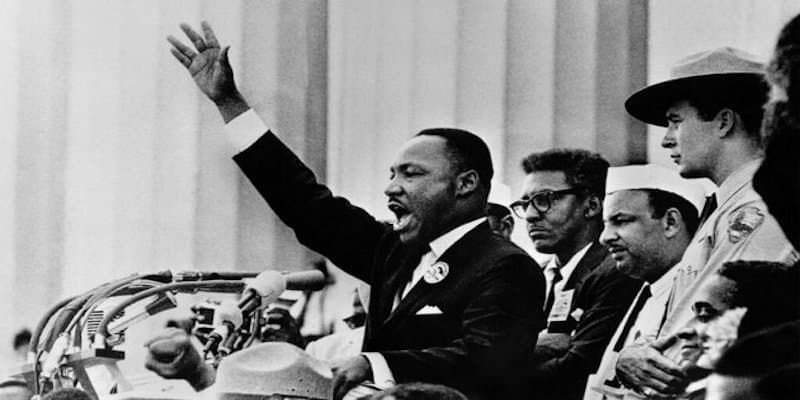
Over the next five years, King led a non-violent crusade for civil rights and equality. In 1964 and again in 1965, he rejoiced with the passing of the Civil Rights Act and Voting Rights Act. His work continued and took on new aims, but all his efforts focused, like so many before him, on forming “a more perfect union.” He had “made it a moral imperative that the constitutional transformation of the Civil War era be heeded.” In 1968, King, like Kennedy five years earlier, fell victim to an assassin’s bullet. In humble tribute to his dedication to what Lincoln called the “great task remaining before us,” a monument to him stands on the National Mall in Washington, D.C.[11]
In August 2023, as part of their trip to the United States, historians Dominic Sandbrook and Tom Holland, hosts of The Rest is History podcast, visited the Lincoln Memorial and reflected on King’s speech. In their opening remarks, Sandbrook and Holland spoke about the power of the place. “People come to the Lincoln Memorial and come to the spot where King gave his speech,” said Sandbrook, “they’re visiting not just Lincoln, but they’re visiting King…for people in America…these are two great saints.” In the general view of American history, the two have emerged like Warren’s “mythic figures” in our collective memory.[12]
Returning to Crofts, “we are bound to reflect back and wonder how much really changed and how much remained the same.” “The constitutional amendments of the 1860s failed to overcome the malign legacy of African slavery,” argues Crofts, “and the breakthrough legislation of the 1960s could not rectify all accumulated injustices.” He concluded:
Racial inequality was and is a national scandal, not just a Southern shortcoming. Nevertheless, the promise of equality lives and the struggles continue.[13]
The work to craft Lincoln’s ideal “government of the people, by the people, for the people,” for all, must still go on.
[1] Robert Penn Warren, The Legacy of the Civil War, (Lincoln, NE: University of Nebraska Press, 1998), 17.
[2] Abraham Lincoln, ed. Roy P. Basler, “Last Public Address” (1865), in The Collected Works of Abraham Lincoln, Volume VIII, (New Brunswick, NJ: Rutgers University Press, 1953), 404.
[3] Daniel W. Crofts, Lincoln and the Politics of Slavery: The Other Thirteenth Amendment and the Struggle to Save the Union, (Chapel Hill, NC: The University of North Carolina Press, 2016), 268-269; Lincoln, ed. Roy P. Basler, “The Gettysburg Address,” The Collected Works of Abraham Lincoln, Volume VII, (New Brunswick, NJ: Rutgers University Press, 1953), 21.
[4] Lincoln, “The Gettysburg Address,” Collected Works, 21; Lincoln, ed. Roy P. Basler, The Collected Works of Abraham Lincoln, Vol. II, “Letter from Abraham Lincoln to Joshua Speed,” August 24, 1855, 323.
[5] Berl I. Bernhard Personal Papers. Commission on Civil Rights, 1958-1963. Emancipation Proclamation centennial: Martin Luther King appeal to President Kennedy re: civil rights, 17 May 1962. BIBPP-005-004-p0003-0004. John F. Kennedy Presidential Library and Museum.
[6] David Blight, American Oracle: The Civil War in the Civil Rights Era, (Cambridge, MA: Belknap Press of Harvard University Press, 2011), 17-18.
[7] John F. Kennedy, “Address to the Nation on Civil Rights” (speech, Washington, D.C., June 11, 1963), https://www.jfklibrary.org/learn/about-jfk/historic-speeches/televised-address-to-the-nation-on-civil-rights.
[8] Kennedy, “Address to the Nation on Civil Rights.”
[9] Martin Luther King Jr., “I Have a Dream Speech,” August 28, 1963, The Words of Martin Luther King Jr., (NY: Newmarket Press, 2008), 95-97.
[10] King Jr., “I Have a Dream Speech,” 97.
[11] Abraham Lincoln, “The Gettysburg Address,” 21.
[12] Dominick Sandbrook and Tom Holland, “359: Martin Luther King’s Dream,” August 13, 2023, in The Rest is History, produced by Goalhanger Podcasts, podcast, MP3 audio, 00:2:54-00:3:09, https://open.spotify.com/episode/3nDmmHtoIs6y9fI4GNVvOR?si=43aee62183a049ee
[13] Crofts, Lincoln and the Politics of Slavery, 270.


Grace makes the promise, Providence makes the payment!!!
Lincoln is a fascinating character by any measure, and as noted, thousands of books have been published about him. He is due, however, for an accurate, fair revision of his history, because equally fascinating to the man is the myth that writers and historians have built up around him, especially since the Civil Rights Movement of the 1950s. In contrast to the overblown hyperbole that has adoringly canonized him as a saint, Lincoln was not that shining example of Americaness, the Founding Father type finally made perfect by wiping the stain of “original sin” of slavery from America. A wise, intelligent, politically adept, humane, patriotic American to be sure. Also, a political animal who failed as often as he succeeded, was completely inept in military matters, and always gave in to the demands of political party to appoint incompetent men to positions of high command – which cost tens of thousands of Federal soldiers their lives. But he didn’t end slavery, nor did he intend to, at least not until late in the war; the Emancipation Proclamation not only did not free anyone, but guaranteed the continuation of slavery in any state or territory that was not in rebellion against the Federal Government – this is proved by the existence of slavery throughout the war, or much of it, in Delaware, Maryland, Missouri, Kentucky, New Jersey and, as of five months after the issuance of the Proclamation, West Virginia; Congress did not even vote to end slavery until January 1865, and it did not cease in America until December 6, 1865 – in the North.
The list can go on and on but does not need to here, and the purpose is not to denigrate Lincoln, because he never claimed to do most of the things ascribed to him. Rather, historians in retrospect, seeking to shape, rationalize or outright invent a warm fuzzy explanation for the Civil War, what occurred during and after it, and to cover its ugliness, turned Lincoln into a “marble man.” The endless reinterpretation – with plenty of fantasy thrown in – of the Constitution as filtered through Lincoln’s statements and actions comes off as ridiculous and cringeworthy to anyone who knows the history of the Constitution and the war. What’s worse, it has seeped into a largely-uninformed populace who now believe the war was a shining crusade by altruistic, disinterested knights in shining armor to wipe out the scourge of not just slavery (which Americans did not instigate in America) and hatred and racism thrown in. Somehow – must have been something in the water – all 20 million white Americans in the North were angels who hated slavery and racism…and all 5 million Americans in the South were evil sons of Satan with blood dripping from their fangs as they whipped blacks to death and raped children. In light of the current divisive political climate in America, where the uninformed tell the well-informed, “You will agree with me or you are a racist white supremacist Nazi – and I’m going to kill you,” people are getting into violent arguments over the causes of the Civil War – with death threats included – because of the distorted view of the conflict that has come from historians’ fantasies that Lincoln was a saint leading Christian soldiers to a perfect, shining America against the minions of Darkness.
It’s a terrible shame, this lie. Lincoln was good enough, and interesting enough, to survive any scrutiny that reveals the real man – which I’m sure is what he would want if he could talk with us today. Furthermore, by reducing the war to a simple Zero-Sum Game, it ploughs over the truly fascinating history of 19th century American culture, law, economics, politics and military action that makes the Civil War and its era so wonderful – and so educative – to study. Not least, it furthers the sort of divisiveness that, apparently, still exists in us 160 years on. I wager that telling the truth about Mr. Lincoln – and there is nothing shameful in it – would help us join rather than divide, learn rather than pontificate, talk rather than scream, and give so many more Americans the truth about this utterly fascinating period of our history.
We need fewer, not more, books about Lincoln, and they need to be written in reality, not fantasy. That would leave room for more books about other important people in the war – and leave room for huge doses of truth.