Encountering John C. Frémont Repeatedly in My Research and Recent Travels, Part II: Examining His Time in Missouri as Commander of the Department of the West
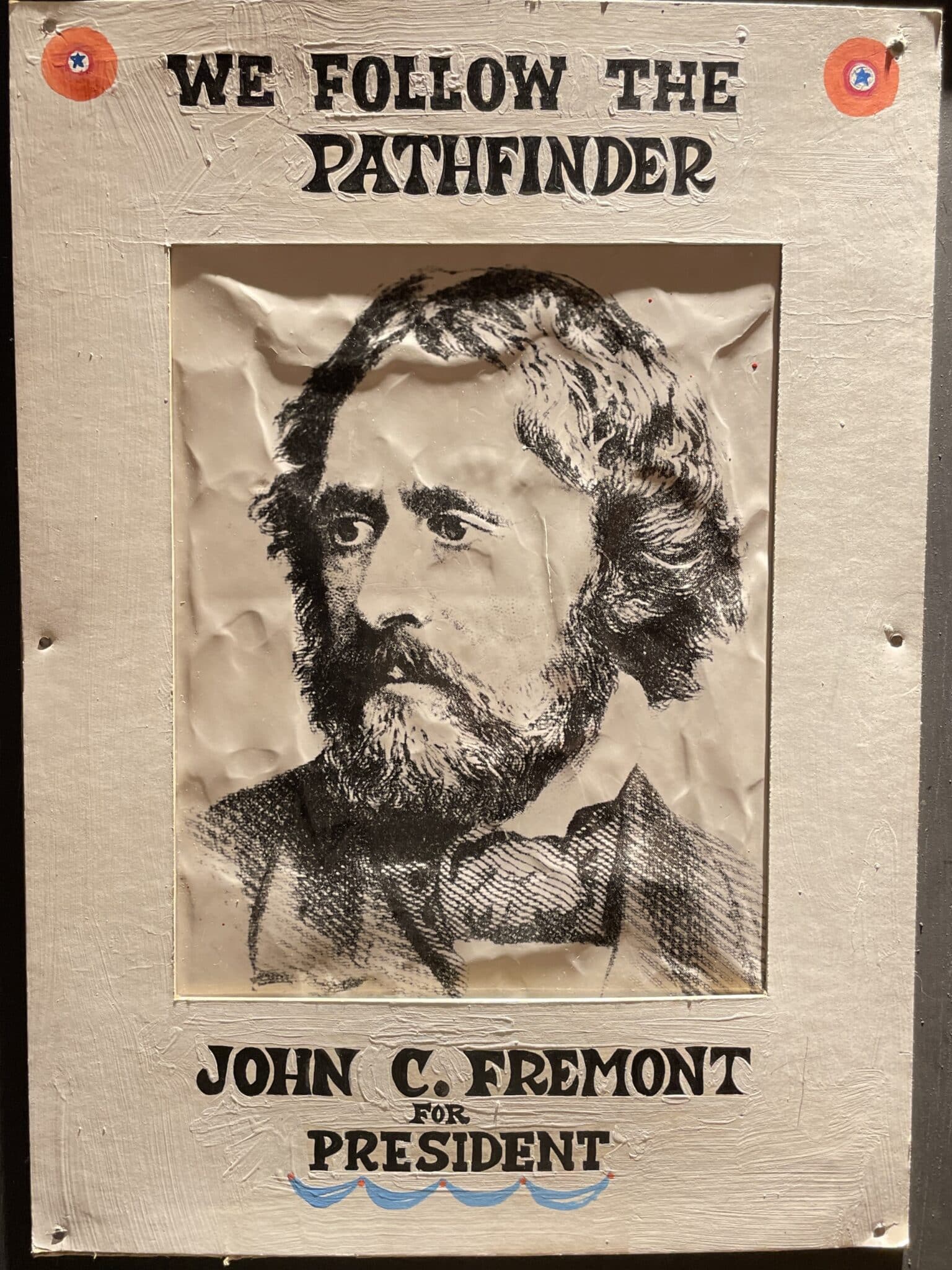
As I mentioned in Part I of this post, it’s often easy to feel disconnected from Civil War history out here in the West, with few Civil War monuments, memorials, statues, or historic sites. There is one Civil War general, though, whose name appears frequently: John C. Frémont. However, those references typically relate to his many exploratory treks, his detailed topography maps, his role in early California history, and his gold mining successes. Growing up, I did not learn about his candidacies for president or his Civil War contributions – at least not that I remember.
However, as I began researching Missouri’s Civil War history a couple years ago for my book A State Divided: The Civil War Letters of James Calaway Hale and Benjamin Petree of Andrew County, Missouri, his name came up repeatedly. And once I confirmed this was indeed the same John Frémont who had played such a significant role in California’s history, I found myself feeling much more personally connected to his actions. Even though he was not born in California, nor is he buried here, he felt “Californian” somehow.
Frémont first appears in A State Divided in chapter 1, when I discuss early events in and around Missouri that contributed to the start to the Civil War. One of those key events was the signing of the Kansas-Nebraska Act into law by President Franklin Pierce in 1854. The Act created the Kansas and Nebraska territories and established “popular sovereignty” as a means of deciding whether each territory would be slave or free.
As I explain in A State Divided: “It was Illinois’s Democratic Senator Stephen A. Douglas who authored the Kansas-Nebraska Act and argued that popular sovereignty was the most democratic way to resolve the slavery question. He and others hoped the Act would help resolve the ongoing sectional debate between the North and South over slavery’s extension into the territories. Douglas went on a speaking tour in Illinois to rally support for the Act. Instead, it inflamed tensions and sparked a political realignment, splitting the Democratic Party and prompting antislavery Americans to form the new Republican Party. This new party presented its first candidate for president in 1856: John C. Frémont, an American explorer, military officer, and politician whose anti-slavery leanings would later come into play in Missouri in 1861.” [1]
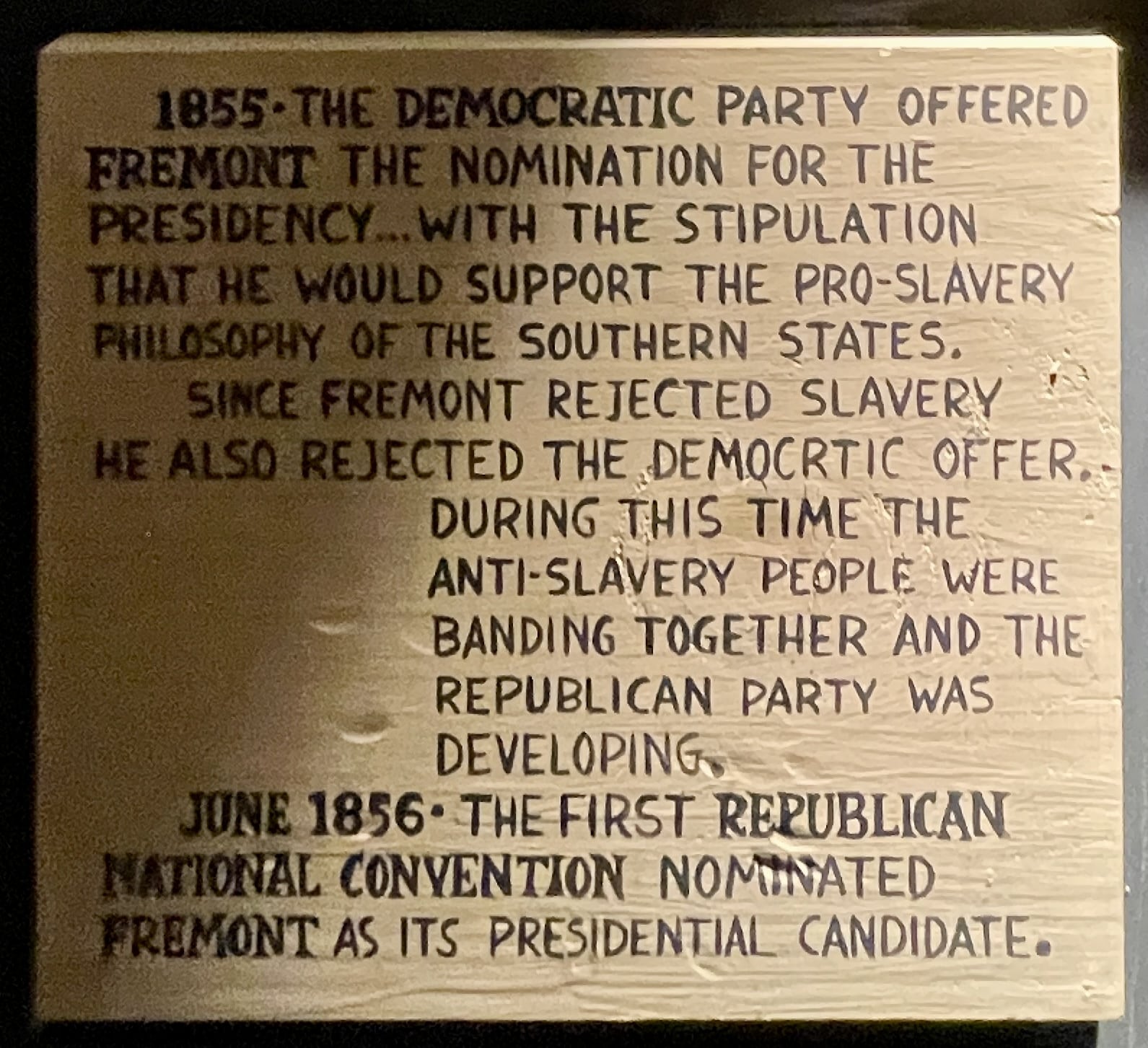
The charismatic Frémont certainly had name recognition, and his opposition to slavery in the West aligned well with the party’s platform of “Free Soil, Free Men, and Frémont.” The campaign also capitalized on the popularity of his wife, Jessie Benton Frémont, with slogans such as “We’ll Give ’em Jessie” to play on her name and her energetic platform as she campaigned beside her husband. Crowds gathered wherever John and Jessie appeared.
Despite his and his wife’s efforts, Frémont did not win the election: James Buchanan did. He had no interest in running again in 1860. So, the Republican Party nominated a different candidate, and this one would go on to win the election: Abraham Lincoln.
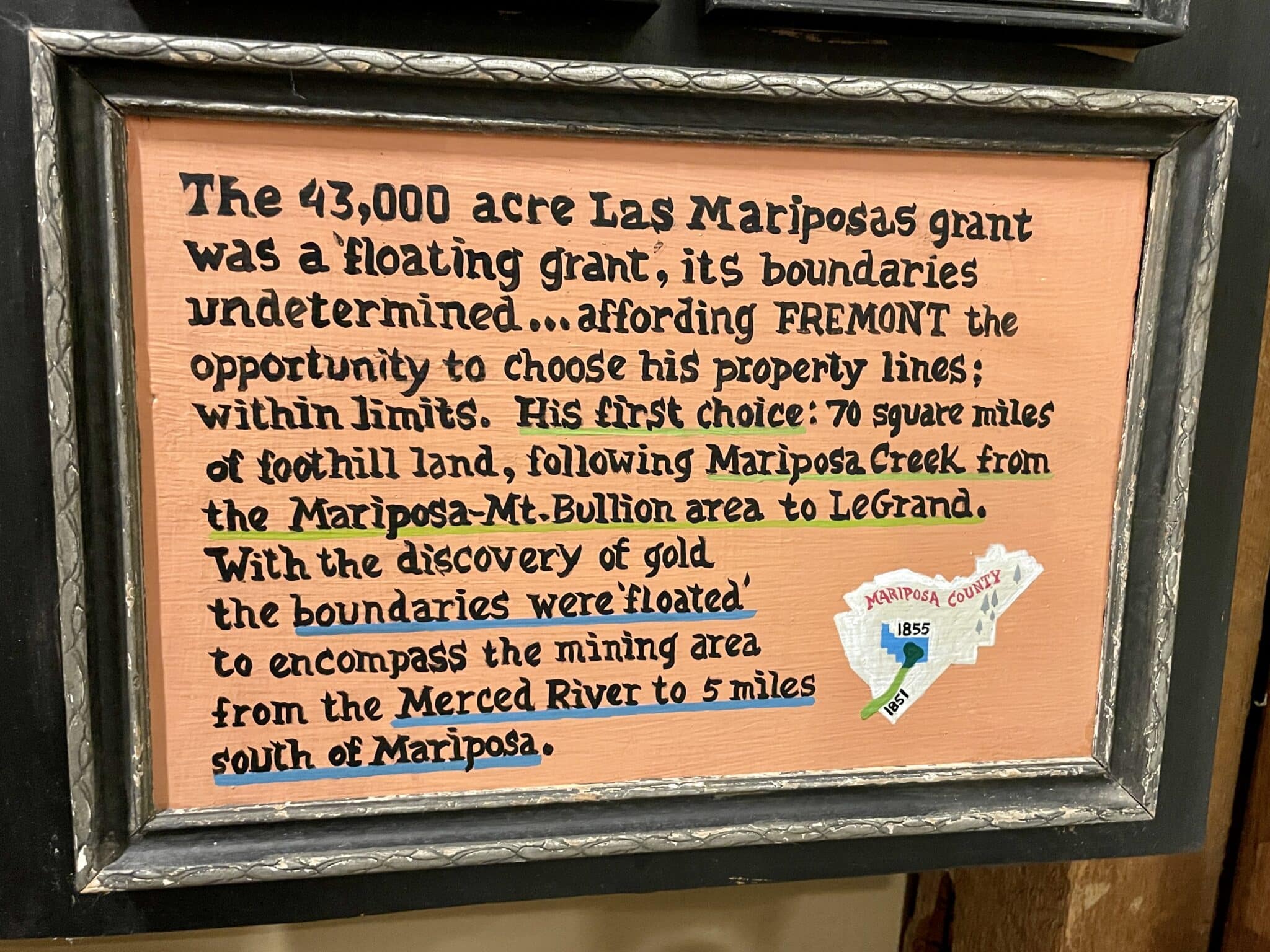
After his 1856 loss, Frémont returned to California to focus on his family and personal affairs. The U.S. Supreme Court had finally ruled in his favor in 1855, “ending a protracted legal battle over the legality and boundaries of [his land grant] Las Mariposas…. By now his enterprises at the 44,386-acre spread included mining, lumber-milling, and ranching operations and several small settlements – including the tiny company town of Bear Valley, where John maintained his offices at the Oso Hotel, the settlement’s only substantial building.” [2]
Frémont settled into his work and spent more time with his family, something he had not been able to do before because of his many mapping expeditions across the American West between 1842 and 1854. His wife Jessie appreciated this time they had together and wrote to a friend, “It’s so easy to take care of children when two help. I feel now as if we are a complete & compact family & really Mr. Frémont used to be only a guest – dearly loved & honored but not counted on for worse as well as better.” [3]
That peaceful time ended all too quickly, though, with the start of the Civil War. In July 1861, President Abraham Lincoln appointed Frémont to head the newly-formed Department of the West, which covered a vast area west of the Mississippi River and east of the Rocky Mountains.
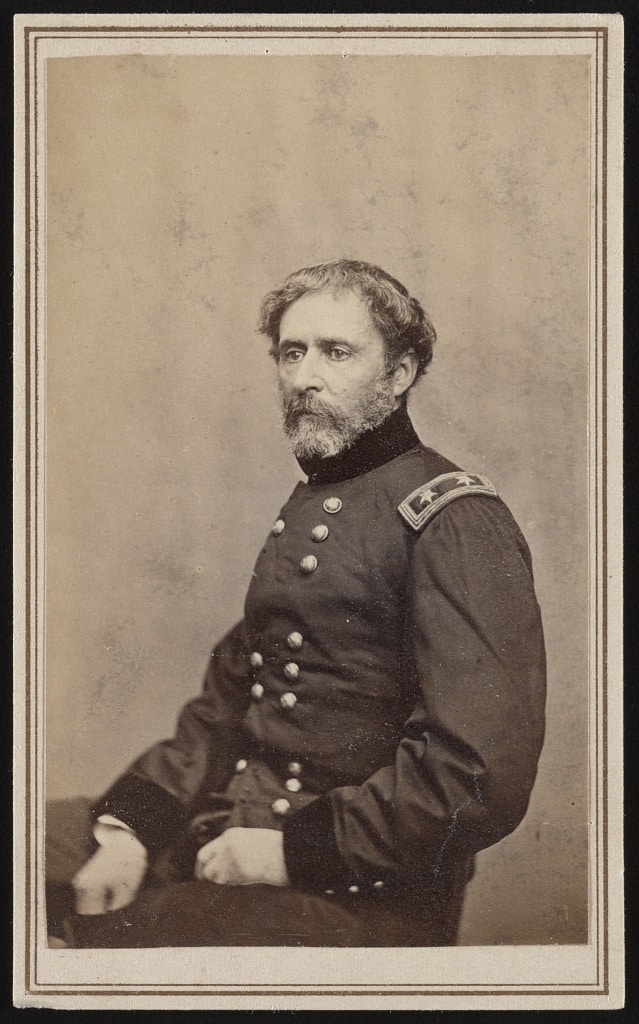
Frémont set up his headquarters in St. Louis. When he arrived on July 25, “he found a city in relative peace, but much of the rest of the state awhirl in chaos. It was clear that he would have to fight two wars: one against pro-Confederate Missourians engaged in guerrilla actions against Union forces within the state; another against regular Confederate troops determined to invade and secure Missouri as a Rebel state.” [5]
Making his task more difficult, Frémont only had about 16,000 troops under his control – and those troops were poorly trained and organized, under-equipped, and scattered throughout Missouri. With little guidance from Lincoln on what he should prioritize, Frémont decided to focus his attention on keeping Cairo, Illinois, in Union control due to its strategic location at the confluence of the Mississippi and Ohio rivers. Union leaders feared that, if Confederates could seize Cairo, “they could control the entire southern half of Missouri, Should that happen, they believed, it would be easy for the Confederates to extend their control over the southern halves of Illinois and Indiana, and to bring wavering Kentucky into the Confederacy.” [6]
Additionally, Missouri was operating with two governments: one supported by the South and led by Missouri’s previously-elected Gov. Claiborne Fox Jackson, who had fled the state capitol back in June; the other supported by the North and led by Provisional Governor Hamilton Rowan Gamble, who was appointed one week after Frémont’s arrival to the position by the Missouri State Convention. Frémont and Gamble would later clash over military authority and policy in Missouri.
Frémont soon discovered he was facing a three-front war: “In the southwest, Captain Nathaniel Lyon and his forces were pinned down in Springfield; in the southeast, Gen. Prentiss was pleading for reinforcements to shore up the Union line at Cairo; and, throughout Missouri, Frémont faced growing sabotage by Confederate irregulars.” [7]
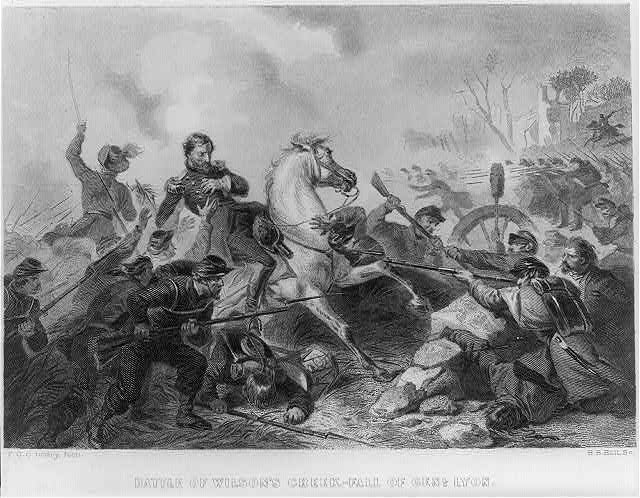
Without sufficient troops, Frémont faced hard choices. He warned Lyon that no reinforcements would be coming and advised him to retreat, but he gave him authority to decide what to do. Lyon and his forces attacked, and he was killed August 10 in the ensuing battle of Wilson’s Creek. The Union army was forced to retreat north, leaving southwestern Missouri in Rebel control.
Stirred by victory, the Missouri State Guard under Gen. Sterling Price pushed northward, gathering new recruits along the way. By the time Price reached Lexington, situated on the Missouri River, he had approximately 18,000 troops. There, after a three-day siege during which he and his troops used movable hemp bales for protection, 3,500 Union troops commanded by Col. James A. Mulligan were forced to surrender on Sept. 20.
Frémont was more successful at Cairo in late July: “Boarding his flagship City of Alton, he took personal command of the reinforcement operation – a flotilla consisting of thirty-eight hundred soldiers [all his available force] and eight large river steamboats. Faced with an impressive show of Union force, the Confederate troops threatening Cairo quickly fell back, and the river town remained under Union control for the war’s duration.” [8]
He soon did something else that had long-term benefits for the Union. After Lincoln appointed Ulysses S. Grant to the rank of brigadier general on August 5, Frémont – recognizing Grant’s potential – assigned him to command the strategic District of Southeast Missouri and Southern Illinois with headquarters in Cairo. Grant set about following Frémont’s order to eliminate all Confederate forces from southeast Missouri, and he soon proved his abilities in the battle of Belmont in November 1861 (read more here).
Despite Frémont’s successes in Cairo, Rebel forces now controlled about half the state of Missouri. What’s more, when Union troops were told to march to Lexington in anticipation of Price’s attack, cities like St Joseph were left unguarded, leading to severe attacks on Union supporters. These concerns led Fremont to take action – but his actions proved controversial, as explained in this excerpt from A State Divided, which begins by citing a Sept. 5, 1861 article from the White Cloud Kansas Chief:
“The present is an exciting time in Missouri, and is growing more so daily. Last week the troops were all removed from St. Joseph, which was a signal for the traitors to break out anew, after having been so long kept under. Squads of horsemen rode through the streets of that city, yelling for Jeff Davis, insulting Union men, and seizing property. They captured two United States recruiting officers and carried them away, and re-inaugurated a reign of terror and mobocracy…. The proclamation of Frémont, establishing martial law, and threatening confiscation, has run the excitement up to a fever pitch. It is life or death with the traitors, and they have proclaimed retaliation. To this end, they have commenced arresting Union men, particularly prominent ones, whom they intend to hold as hostages for the good treatment of secessionists.” [9]
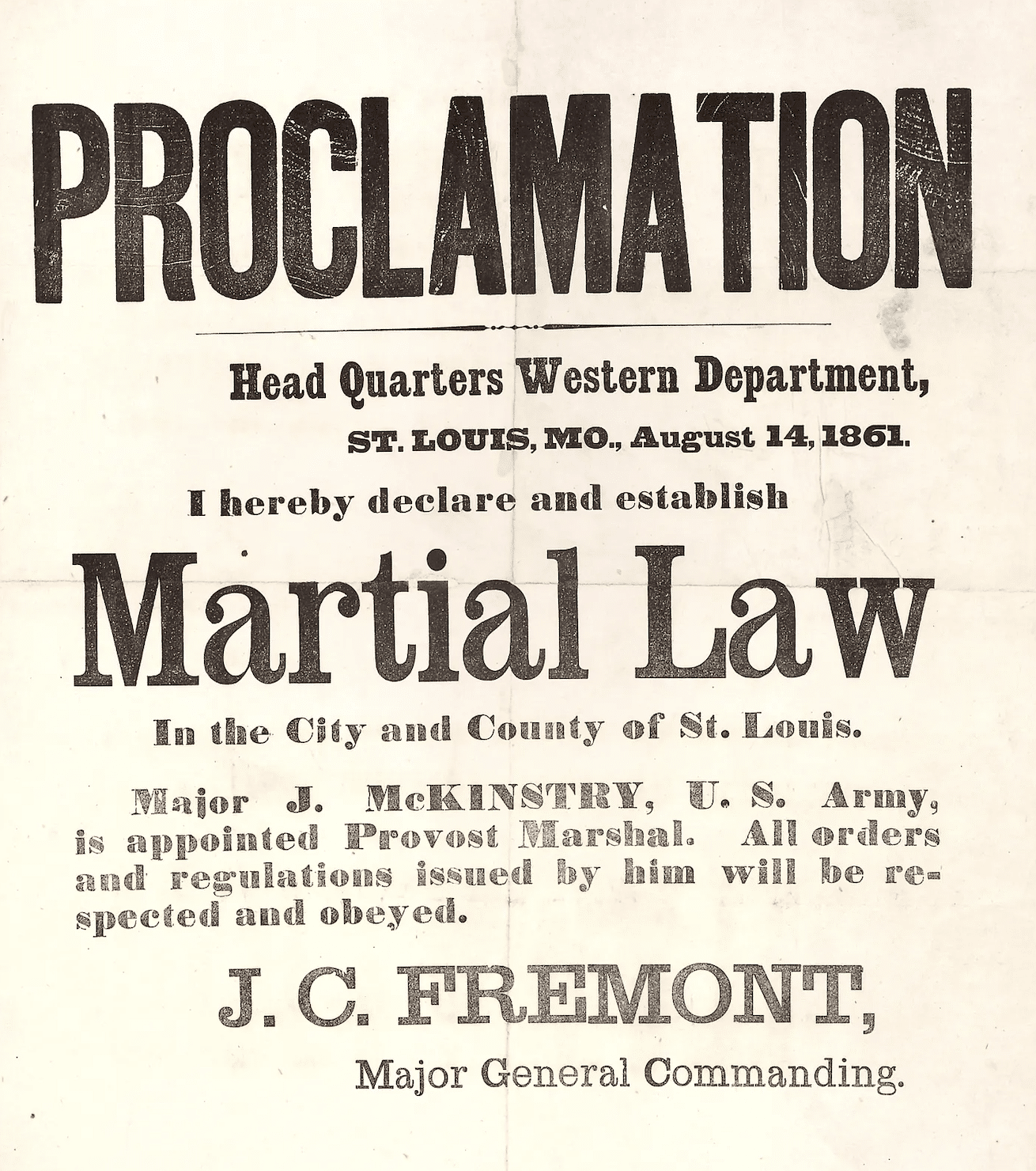
The “proclamation” mentioned above was that of Maj. Gen. John C. Frémont…. Confederate troops had been emboldened by the Union defeat at the Battle of Wilson’s Creek on August 10, 1861. They were infuriated by this proclamation. Issued on August 30, 1861, the “Frémont Emancipation” – citing concerns for public safety – placed the state of Missouri under martial law “in order to suppress disorders, to maintain as far as now practicable the public peace, and to give security and protection to the persons and property of loyal citizens.” What he said next, though, shocked many throughout the Union: “The property, real and personal, of all persons in the State of Missouri who shall take up arms against the United States, and who shall be directly proven to have taken an active part with their enemies in the field, is declared to be confiscated to the public use, and their slaves, if any they have, are hereby declared free.” [10]
Congress had already passed the First Confiscation Act on August 6, which allowed for the confiscation of property – including slaves – used for Confederate military purposes and declared that any owner who used his slave in such a manner would forfeit any claim to his property. However, Frémont’s proclamation took “confiscation” to a whole other level, not limiting it to fugitive slaves or those being used for military purposes. His proclamation created a major conundrum for President Lincoln, who was working hard to keep the border states of Maryland, Delaware, Missouri, and Kentucky in the Union. Targeting the institution of slavery in such a manner, he worried, might push them over the edge.
In a private letter to Frémont, dated Sept. 2, 1861, Lincoln wrote: “I think there is great danger that the closing paragraph, in relation to the confiscation of property, and the liberating slaves of traitorous owners, will alarm our Southern Union friends, and turn them against us—perhaps ruin our rather fair prospect for Kentucky…. Allow me therefore to ask, that you will as of your own motion, modify that paragraph so as to conform to the first and fourth sections of the act of Congress, entitled, ‘An act to confiscate property used for insurrectionary purposes,’ approved August 6th, 1861, and a copy of which act I herewith send you. This letter is written in a spirit of caution and not of censure.” [11]
Frémont refused to back down unless ordered to do so. Determined to hold the border states, Lincoln wrote to Frémont that he must rescind the edict, ordering “that the said clause of said proclamation be so modified, held, and construed, as to conform to, and not to transcend, the provisions on the same subject contained in the act of Congress entitled ‘An Act to confiscate property used for insurrectionary purposes’ Approved, August 6, 1861; and that said act be published at length with this order.” [12]
To Lincoln’s surprise, however, many Republicans and other northern abolitionists were angered by his response to Frémont’s proclamation, with one Republican congressman claiming, “Frémont’s proclamation stirred and united the people of the North during its ten days of life far more than any other event of the war.” Another complained, “If it is said that we must consult the border states, permit me to say damn the border states. A Thousand Lincolns cannot stop the people from fighting slavery.” One of his closest friends, Illinois Senator Orville Hickman Browning, wrote to criticize Lincoln’s response, stating his belief that “the only way to save the government was to strike a blow against slavery, and Frémont’s proclamation represented the government’s best weapon against the rebellion.” [13]
By late October, following reports of alleged incompetence by Frémont, Lincoln sent an order to remove Frémont from command of the Department of the West and replaced him in early November with Maj. Gen. David Hunter. However, while he opposed Frémont’s method of emancipation, the episode impacted Lincoln by shaping his opinions on the appropriate steps needed for emancipation and contributed to his own Emancipation Proclamation in January 1863, which freed slaves in those states in active rebellion against the United States. [14]
There is MUCH more that I could say about Frémont’s time in Missouri, his later command of the newly-formed Mountain Department, and the role Jessie played in all this. However, that is beyond the scope of this blog post, the purpose of which was to provide some explanations for how Frémont earned Lincoln’s rebuke and disfavor as a result of his actions in Missouri. It also illustrates why he is not one of the more celebrated generals of the Civil War.
He is, however, celebrated and remembered here on the West Coast in numerous locales. In my next post, the final in this series, I will share photos and stories from my recent travels where I have repeatedly encountered John C. Frémont – as well as his wife Jessie – and learned more about their lives before and after the Civil War.
End Notes:
- McQuade, Tonya Graham. A State Divided: The Civil War Letters of James Calaway Hale and Benjamin Petree of Andrew County, Missouri, 1862-65. Tonya Graham McQuade Publishing, 2024, pg. 25.
- Chaffin, Tom. Pathfinder: John Charles Frémont and the Course of American Empire. Hill and Wang, 2002, pg. 450.
- Jessie Benton Frémont to Elizabeth Blair Lee, June 2, 1860, in Jessie Benton Frémont, Letters of Jessie Benton Frémont, 227-29.
- Rockwood, George Gardner. “Major General John Charles Fremont of General Staff Regular Army Infantry Regiment, in uniform.” Library of Congress, 1861, https://loc.gov/pictures/resource/ppmsca.53247/.
- Chaffin, pg. 459.
- Ibid.
- Chaffin, pg. 462.
- Chaffin, pg. 463.
- “Hot Times in Missouri.” White Cloud Kansas Chief, 5 Sept 1861, Newspapers.com.
- Weber, Lawrence. “The Frémont Emancipation Proclamation.” Warfare History Network, https://warfarehistorynetwork.com/the-fremont-emancipation-proclamation/.
- Ibid.
- Ibid.
- Ibid.
- McQuade, pgs. 39-41.


Those interested can read more about Fremont’s 1856 campaign and his Civil War travails in my two books on those subjects — Lincoln’s Pathfinder: John C. Fremont and the Violent Election of 1856, and The Pathfinder and the President: John C. Fremont, Abraham Lincoln, and the Battle for Emancipation.
Thanks for chiming in! Yes, there is SO MUCH more to read. It was hard to condense this information to a blog post.
Tonya McQuade, your revelations in regard to the contributions of John C. Frémont to the Cause of the Union during 1861 are noteworthy, and most appreciated. However, there is one episode in John Frémont’s career that continues to be neglected: his role as Special Emissary to Europe, serving at the pleasure of President Lincoln. Shortly after the Attack on Fort Sumter, it was realized that the stockpile of arms was insufficient with which to fight a war that would likely involve hundreds of thousands of soldiers. And the manufacture of a sufficient quantity of new Springfield rifle-muskets would require months, perhaps years. So Special Emissary Frémont departed for Europe and visited government arsenals and arms manufacturers in England, Belgium and Vienna and bought all the serviceable modern arms then available and soon had 200000 rifle muskets on their way to New York City. Frémont and his agents then contracted for a further 1.9 million rifle muskets, 72000 carbines, 75000 pistols and 140000 swords and sabres on behalf of the U.S. Government.
One additional benefit to these purchases: European arms acquired by John Fremont and his agents were NOT available for purchase by the Confederacy: the cupboard was bare…
[See Chicago Daily Tribune of 24 March 1862 page 2 col.2 “Arms Purchased by the United States.”]
Thanks, Mike, for pointing out his important role in securing weapons for the Union. I actually had some of the information in my original piece, then realized it was far too long (and this was already going to be a 3-part series), so I cut it out. Glad you got the info in here in the comments!
Thank you for sharing such an intriguing Civil War-era connection to California history!
I just saw some more connections today when I visited Fort Mason in San Francisco, where John and Jessie Fremont lived for a while before the military took it over. I think there might be a Part IV! LOL.