John Lott – “The first colored man that shouldered a musket in the Union Army”
In a recent post about Civil War mysteries, I asked, “Who was John Lott?” The information I’ve since uncovered is a fascinating and unconventional story that stretches from southern Indiana to one of the war’s first engagements and, finally, to the battle of the Crater. What emerges is the story of a man whose journey was not of valor, but of violence, revealing a darker, seldom-told side of the war.
Situated along the Ohio River, Madison in Jefferson County was once among Indiana’s largest towns and a major hub for hog distribution. In 1860, it counted 7,883 white and 247 “free colored” residents.[1] When Abraham Lincoln called for 75,000 volunteers to serve 90 days, Jefferson County raised three companies that would become part of the 6th Indiana Volunteer Infantry.
Company E, “Washington Guards,” was organized by Jeremiah C. Sullivan, who was soon promoted to colonel of the 13th Indiana Regiment. John Gerber succeeded him, but on April 25 he advanced to major. Rufus Gale took command of the company just weeks shy of his 30th birthday. The son of a prominent hog dealer, Gale was himself a farmer, and his obituary remembered him as generous to a fault.[2]
The Madison companies assembled at Camp Morton, north of Indianapolis, where they were mustered into service. Their regiment fell under the command of Thomas Turpin Crittenden (1825–1905), an attorney and nephew of U.S. Senator John J. Crittenden of Kentucky. After serving in the Mexican-American War, Crittenden moved from Missouri to Madison, Indiana. He began as captain of Company A, but on April 25, when the regiment was mustered in, he was promoted to colonel.[3]
Among the sea of faces was one, conspicuously, of a darker hue than the rest. It belonged to a man named John Lott. What makes his presence even more striking is how seldom it was remarked upon, either during the war or after. Lott was a notorious figure in Madison, and it is difficult to believe that neither Capt. Gale nor Col. Crittenden knew exactly who he was.
On the day before Christmas Eve in 1854, Lott quarreled with his uncle, Cyrus Baptist Lott, near O’Neill Bayley & Co.’s Pork House and stabbed him above the ear, killing him. The following spring, while awaiting trial, he escaped from jail. It was among Madison’s earliest and most notorious murder cases.[4]
Nearly six years later, he somehow found his way into Rufus Gale’s company in the 6th Indiana. This was not like James Stone, who may have passed as white to enlist in Battery E, 1st Ohio Light Artillery. Indiana’s Black Codes were strict, requiring all black and mixed-race residents to register in their county. On that register, Lott was described as “Negro black, about 5 feet 9 inches high.” His uncle Cyrus was listed in similar terms, “about three fourths colored black.”[5]
Every recruit underwent a physical examination before being mustered in. Even a broken or missing tooth could be grounds for dismissal.[6] The Second Militia Act of 1792 limited service to “free able-bodied white male” citizens between the ages of 18 and 45, a restriction not amended to include African Americans until late 1862. For Lott to enlist alongside white recruits, multiple authorities would have had to look the other way.
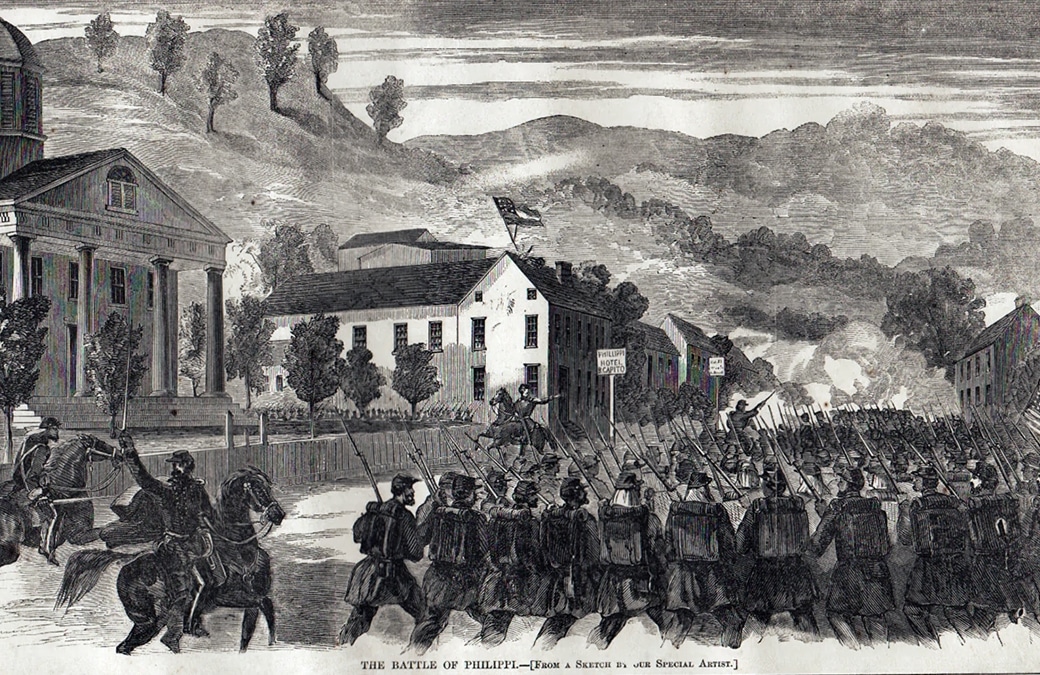
Lott accompanied the 6th Indiana into Virginia, where six companies, including E, took part in the attack on Philippi on June 3, 1861. Andrew J. Grayson, a sergeant in Company E, later described Lott as “the first colored man that shouldered a musket in the Union army, for I saw him standing in line with gun in hand and cartridge-box buckled to his hip when Capt. Gale’s company was drawn up in front of the Court House at Phillippi.”[7]
There is reason to believe, however, that Lott held a special status within the regiment. His name does not appear on the muster roll published by the state adjutant general, and rather than wearing a uniform like the others, he was described in “a red hunting shirt, fringed with buckskin, a slouch hat looped up at one side.” The Wheeling Daily Intelligencer referred to him as “Col. Crittenden’s servant,” while a soldier in the 14th Ohio called him “a negro waiter of one of the Indiana Colonels.”[8]
These brief descriptions suggest Lott had some connection to Col. Crittenden. He was likely serving as a scout or volunteer aide. The term “waiter” may have meant a personal attendant, not merely someone who served food.
In the aftermath of the Union victory at Philippi, discipline briefly unraveled. Colonel Frederick W. Lander, a volunteer aide to Maj. Gen. George B. McClellan, reluctantly admitted, “I cannot … deny that some unjustifiable acts were committed after the rout of the Secession forces at Phillippi. They arose from a general break of the tired troops to search the town for Secession flags, and concealed men and munitions.”[9]
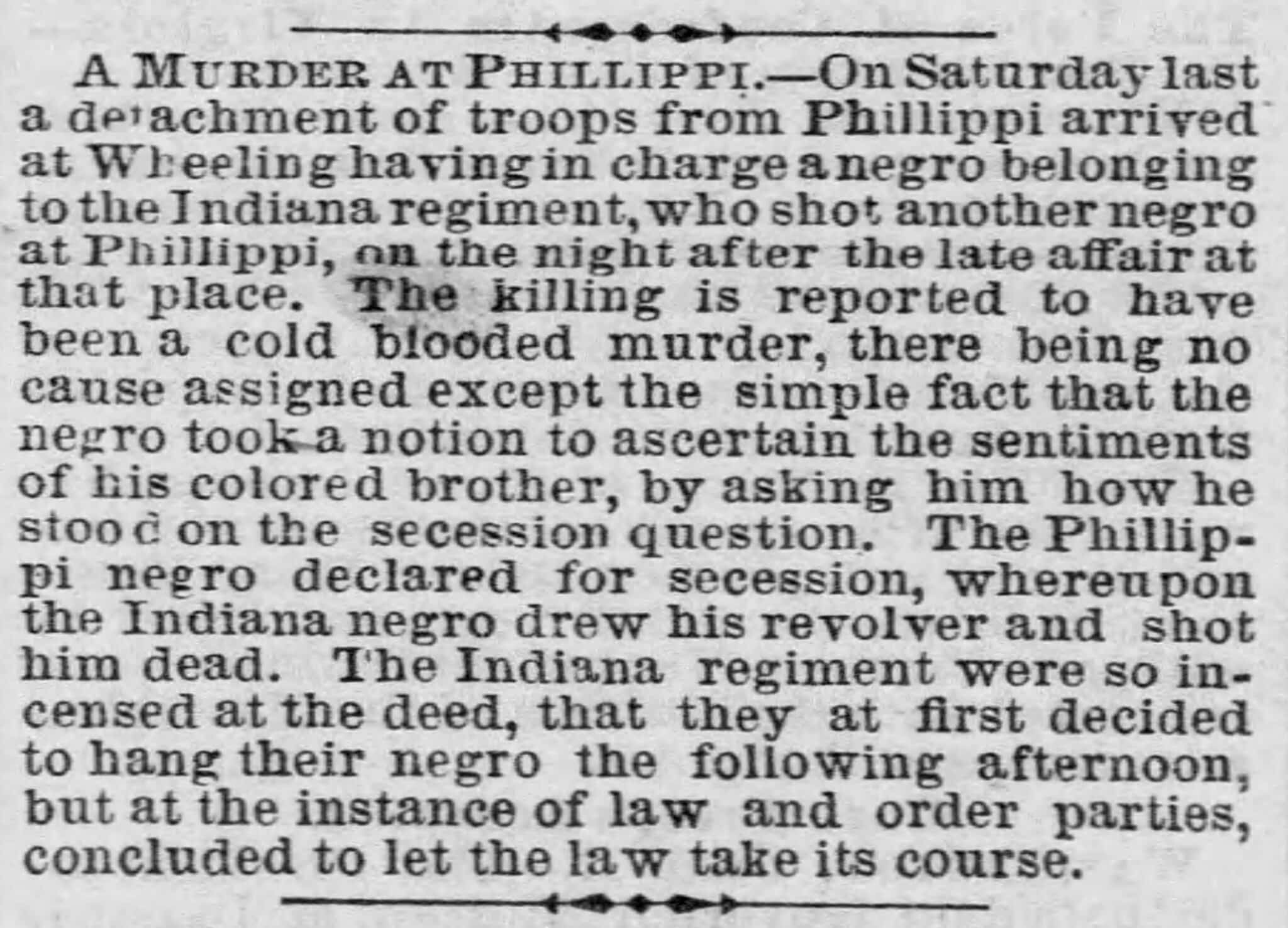
Sometime after the secessionists cleared the town, John Lott confronted an elderly black resident and asked if he was a “rebel.” The man answered yes, and Lott gave him fifteen minutes to retract it. When he refused, Lott shot him in the chest, killing him.[10]
One version printed in the Intelligencer read: “The killing was a cold blooded murder, from all we can learn, there being no cause assigned except the simple fact that the fellow took a notion to ascertain the sentiments of his colored brother by asking him how he stood on the secession question. The Phillippi negro declared for secession, whereupon the Indiana fellow drew his revolver and shot him dead.”[11]
“Was it murder? I think so,” Sgt. Grayson later wrote. “Lott was arrested and lodged in the Court House along with the rebel that shot Col. Kelly, and afterwards they were both sent back to Wheeling and lodged in jail.”[12]
In a June 4, 1861 letter to his hometown newspaper, 1st Lt. Aquilla Wiley, Company C, 16th Ohio, added some interesting details that, if true, indicate the victim wasn’t a local man, but a teamster hired to transport the army’s baggage:
“Today one negro shot another through the heart. The one that was killed had hauled a load of baggage for us from Grafton. He is said to have been a free negro and to have owned the team he drove. I know nothing about the particulars, but it is said to have been a wanton murder. The negro who did the act is arrested. I saw the dead negro in a stable this afternoon.”
The unidentified victim’s body was taken to Webster, a station on the B&O Railroad. I have not been able to determine where he was buried.[13]
Newspapers widely reported that Lott was to be hanged, even lynched, for his crime. Yet Grayson wrote that, when the regiment returned to Indiana at the end of its three-month enlistment, Maj. John Gerber stopped in Wheeling and released Lott from jail. “Lott was glad to see us looking so well,” he recalled. In the end, Lott appears to have suffered no real consequences beyond a brief stay in jail.[14]
But his story does not end there.
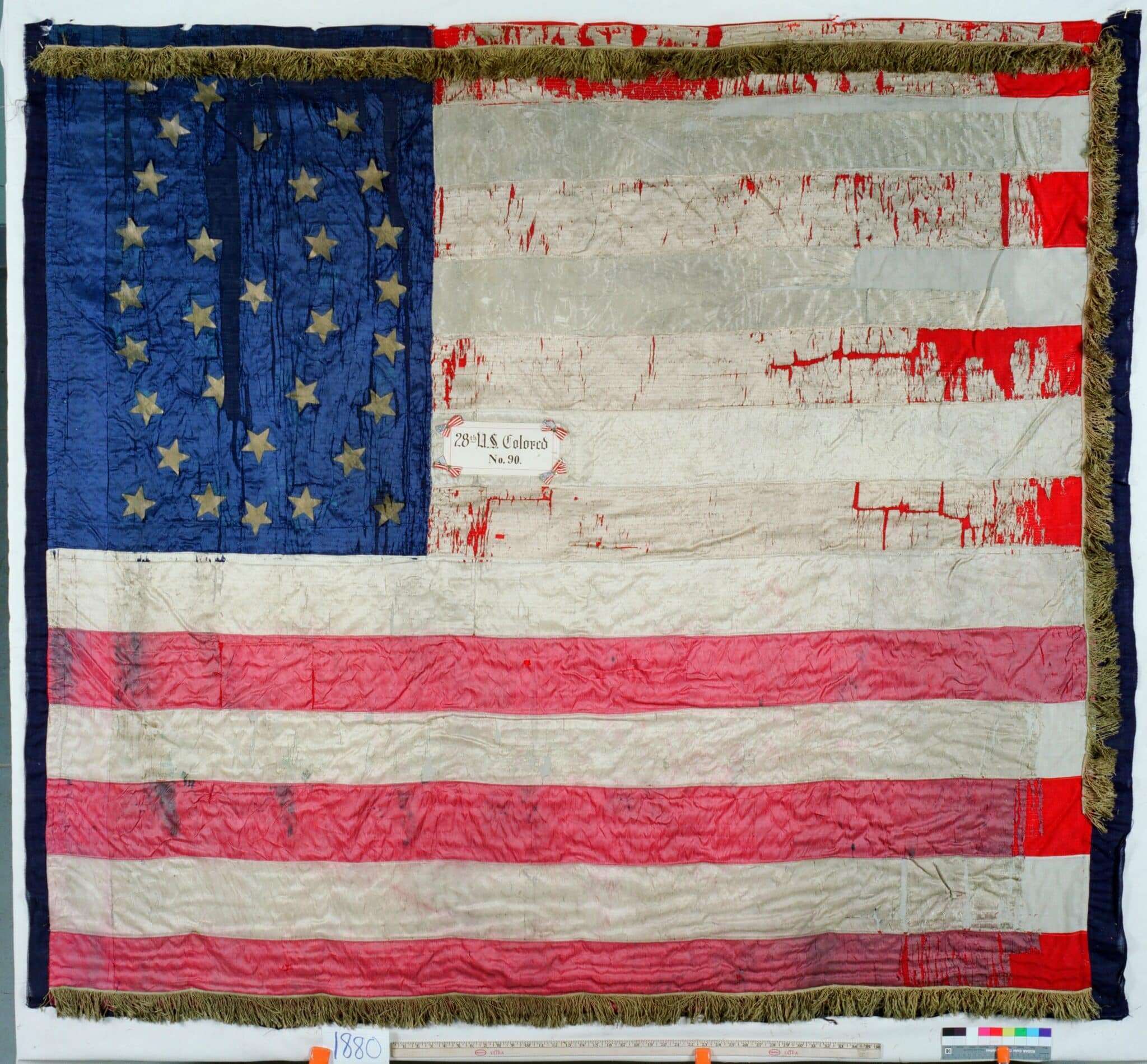
On November 30, 1863, the U.S. War Department authorized Indiana Governor Oliver P. Morton to raise a regiment of “colored” infantry. Enlistments began on December 24, and recruitment and training continued at Camp Fremont in Indianapolis through April 1864. The unit was designated the 28th Regiment of U.S. Colored Troops, with Capt. Charles Sawyer Russell, a Regular Army officer, in command.[15]
Lott joined Company A of the 28th U.S. Colored Troops. By February 1864, he was back in Madison recruiting for the regiment. He enlisted a man named Tobias Clay, who soon had a change of heart and fled to Louisville. Lott secured permission to retrieve him and, on March 1, returned to Madison with his prisoner. Before they could catch the train to Indianapolis, however, a friend of Clay’s tried to intervene. Lott warned him to stand back, and when he persisted, Lott blasted him with a shotgun. The man’s injuries were not believed to be fatal.[16]
The regiment enrolled only six companies before departing for Washington, DC in late April. During Grant’s Overland Campaign, the 28th served in Col. Henry G. Thomas’ 2nd Brigade, Brig. Gen. Edward Ferrero’s Fourth Division, IX Corps. On July 30, a massive explosion tore through Confederate fortifications outside Petersburg, Virginia. In what became known as the battle of the Crater, the 28th took on a supporting role, but was no less exposed to enemy fire.
In the confused tangle that followed, Thomas’ brigade attempted to push into the Confederate rifle pits. “The black men followed into the jaws of death, and advanced until met by a charge in force from the Confederate lines,” he later recalled. Only four of the 28th’s eleven officers made it out, and the regiment suffered 88 casualties in all.[17] While Lott’s comrades continued to serve with valor from Petersburg through the end of the war and beyond, he deserted on August 9, 1864, not long after the battle of the Crater.
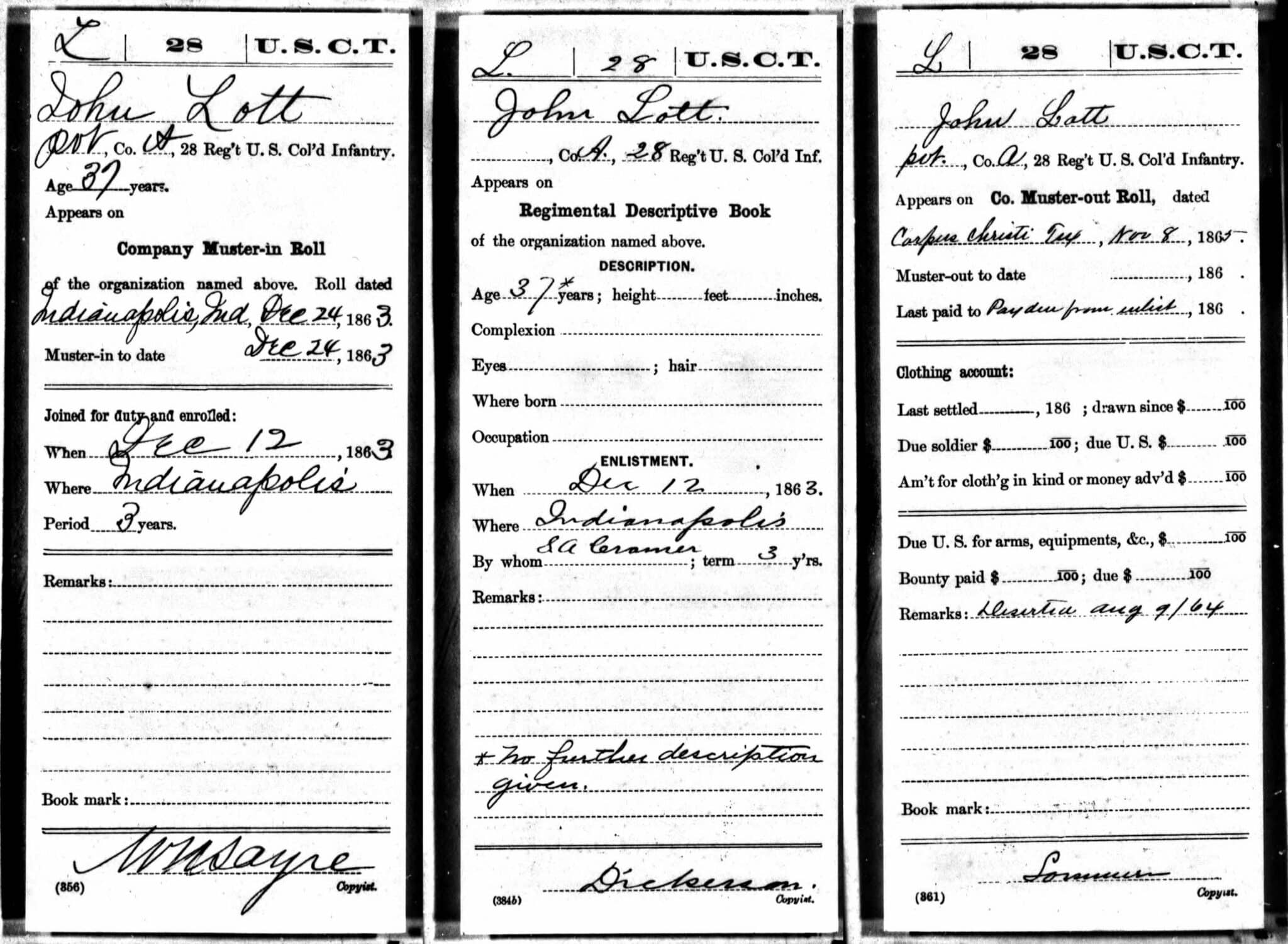
As far as I can determine, this is where Lott’s story ends. I have been unable to verify even the basic facts of his life, from his birth and death to what became of him after the war or where he is buried. We are left with only a brief window into a man who treated human life with casual disregard. He seemed made for war, but when faced with its brutal reality, could not stomach another battle. In the end, Lott leaves no legacy, only a scattering of incidents that hint at a life as unsettled as the war that briefly gave it purpose.
[1] Women’s Club of Madison, “The History of Madison,” Indiana Magazine of History 16 (December 1920): 320; U.S. Census, 1860.
[2] John M. Gresham & Company, Biographical and Historical Souvenir for the Counties of Clark, Crawford, Harrison, Floyd, Jefferson, Jennings, Scott, and Washington, Indiana (Chicago: Chicago Printing Company, 1889), 225; Capt Rufus Gale, Find a Grave, https://www.findagrave.com/memorial/98785108/rufus-gale.
[3] Emil Posey, “USA Brig. Gen. Thomas Turpin Crittenden” in North Alabama Civil War Generals: 13 Wore Gray, the Rest Blue (Huntsville: Tennessee Valley Civil War Round Table, 2012), 8-9; Report of the Adjutant General of the State of Indiana, 1861-1865, Vol. 2 (Indianapolis: W. R. Holloway, State Printer, 1865), 2-4.
[4] Madison Courier, December 26, 1854; Madison Courier, March 30, 1855; in a letter to the Madison Courier, printed June 10, 1861, Sgt. Andrew J. Grayson wrote, “John Lott—our Madison John, the negro who killed his uncle Bap. Lott—is with us.”
[5] “Stone, James A., Sr.,” Notable Kentucky African Americans Database, https://nkaa.uky.edu/nkaa/items/show/2734; “Register of Negros and Mulattoes,” Jefferson County Courthouse, Auditors Office, http://ingenweb.org/injefferson/jeffnegroregistries.html.
[6] Terry Reimer, “Recruiting Exams and Disqualifications for Military Service,” National Museum of Civil War Medicine, https://www.civilwarmed.org/surgeons-call/exams/
[7] Andrew J. Grayson, “The Spirit of 1861”: History of the Sixth Indiana Regiment in the Three Months’ Campaign in Western Virginia (Madison: Courier Print, 1875), 25.
[8] Cincinnati Daily Commercial, June 10, 1861; Wheeling Daily Intelligencer, June 7, 1861; Bryan Press, June 13, 1861.
[9] Madison Courier, June 19, 1861.
[10] Grayson, 25.
[11] Wheeling Daily Intelligencer, June 10, 1861.
[12] Grayson, 25.
[13] Bryan Press, June 13, 1861.
[14] Grayson, 45.
[15] Nicole Poletika, “Twenty-eighth Regiment U.S. Colored Troops,” Encyclopedia of Indianapolis, March 2021, https://indyencyclopedia.org/twenty-eighth-regiment-u-s-colored-troops-usct/.
[16] Madison Courier, March 2, 1864.
[17] Henry Goddard Thomas, “The Colored Troops at Petersburg,” in Battles and Leaders of the Civil War, Vol. 4 (New York: The Century Co., 1888), 565-67; The War of the Rebellion: A Compilation of the Official Records of the Union and Confederate Armies, Series I, Vol. XL, Part 1 (Washington: Government Printing Office, 1902), 248.


My family moved to Madison when I was nine and I graduated from high school there. My mom lived there until she passed last year. It was in elementary school there that I became fascinated with the Civil War and learned some about Madison’s role in the Underground Railroad. This is the first time I’d heard of John Lott. Thanks for the well-written and researched story.
Thank you! What a fascinating personal connection. In researching for this article, I contacted the Jefferson Co. History Library for information about him, but they couldn’t add anything I didn’t already have. I also contacted the circuit clerk’s office to see if they had any historical records dating back to the Cyrus Baptist Lott murder. Last I heard, their archivist was looking into it. Unfortunately, as you know, if you go back that far, surviving physical records are few and far between. I would love to be able to fully flesh out this story and find out exactly what happened.
Wow … that’s some story you pieced together … i think you’re right about his status with the 6th Indiana — not actually on the roles, but filled the role of the colonel’s personal servant and travelled w/the army … thanks!
Glad you enjoyed it!