Lincoln to Grant: “You were right, and I was wrong.”
My longtime collaborator and partner in crime, Kris White, paid a visit to the Historical Society of Pennsylvania in Philadelphia recently. Among the documents in their collection is one of my favorite pieces of writing by Abraham Lincoln. Kris came across it during his visit and sent me a picture.
Wow.
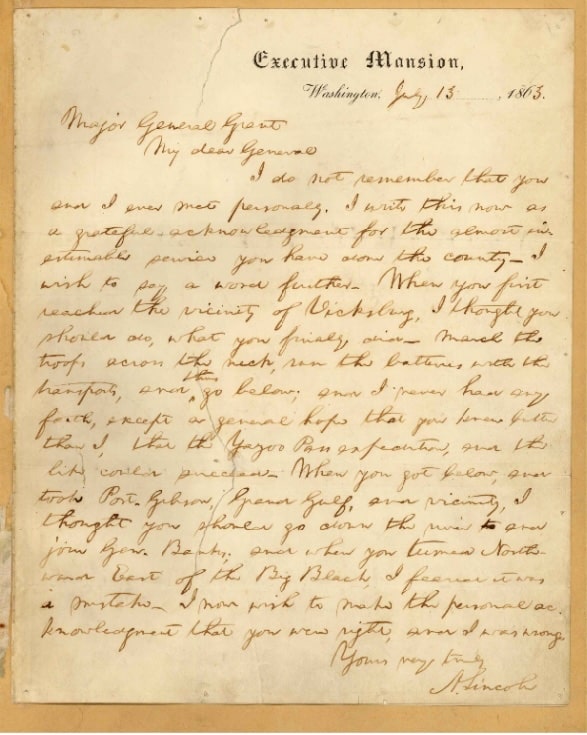
My thanks to Kris for sharing this awesome piece of history. You can find it online for yourself here.
You might be familiar with this letter, written on July 13, 1863, following Ulysses S. Grant’s capture of Vicksburg nine days earlier:
Major General Grant
My dear GeneralI do not remember that you and I ever met personally. I write this now as a grateful acknowledgment for the almost inestimable service you have done the country. I wish to say a word further. When you first reached the vicinity of Vicksburg, I thought you should do, what you finally did — march the troops across the neck, run the batteries with the transports, and thus go below; and I never had any faith, except a general hope that you knew better than I, that the Yazoo Pass expedition, and the like, could succeed. When you got below, and took Port-Gibson, Grand Gulf, and vicinity, I thought you should go down the river and join Gen. Banks; and when you turned Northward East of the Big Black, I feared it was a mistake. I now wish to make the personal acknowledgment that you were right, and I was wrong.
Yours very truly
A. Lincoln
I love Lincoln as a writer because he understands the concept of “audience.” He knows just what to write for any given audience—often multiple audiences at once, as the Emancipation Proclamation demonstrates. As a result, he managed to produce some of the most memorable flourishes of rhetoric in American history. As a writer, he soars.
I like Lincoln’s letter to Grant for a different reason, though. It’s not Lincoln’s felicity of expression here but his humility. “You were right, and I was wrong,” he admits in language as plain as it gets.
Lincoln didn’t need to send this letter to Grant. He didn’t know Grant. He didn’t really owe anything to Grant, who was only doing his job, after all. Took him long enough, right? Or Lincoln could’ve easily been excused for being too busy or for forgetting to write, considering the events unfolding in Pennsylvania simultaneous to those in Mississippi. Grant was far enough away, physically, that he might have been an abstraction.
And yet Lincoln took the time not only to write but to say, “You were right, and I was wrong.” This is the commander in chief admitting he was no armchair general.
What did it take for the president of the United States to make such an admission? What did it cost him?
I love this letter because was a quiet show of character and integrity. It was a sincere show of gratitude. It was an astounding show of humility. Imagine the confidence, the grace, the consideration.
This was Lincoln, as a leader and as a human being, at his finest.


Great revelation of an important Civil War document!
Why the delay in writing that letter?
1) Maybe because George Meade failed to pursue Lee after Gettysburg?
2) Maybe because of John McClernand: a “political General” in the true sense of the term… only MORE so. Not only was the Member of U.S. House of Representatives [from Southern Illinois] elevated to Brigadier General by President Lincoln’s own hand [in August 1861] but he was encouraged to write directly to Lincoln “from the field” …and bypass the Army chain of command. McClernand sent one, or both, of his February 1862 after-action reports [Fort Henry/Fort Donelson] to President Lincoln. And U.S. Grant believed “it was McClernand who spilled the beans” on his unauthorized visit to Brigadier General Don Carlos Buell at Nashville [for which infraction Grant was temporarily removed from command, replaced by Brigadier General Charles F. Smith.] Later in 1862, McClernand took leave from the Army of the Tennessee, travelled to Washington, and convinced President Lincoln to give Major General McClernand “an independent command of two Army Corps, and I will take Vicksburg” …thus undermining Major General Grant’s authority. McClernand failed to try for Vicksburg, and he was subsequently returned to Grant’s control. And Grant had McClernand removed from command of the XIII Corps during the May-July 1863 Vicksburg Campaign… sent home to await orders.
Ulysses S. Grant was not a fool. He KNEW John McClernand was on good terms with Abraham Lincoln and communicated frequently with the President. And Grant may have suspected Lincoln had a grudge against him [perhaps on account of the rumours of Grant’s drinking; perhaps for dismissing Lincoln’s “special friend” McClernand.]
And President Lincoln realized he had an opportunity to “clear the air” and send a heartfelt message of support to Grant [who was under a cloud from the War Department “for paroling Confederate prisoners too quickly after their surrender at Vicksburg.”] The Letter seems to have had the desired effect.
I think the two most likely reasons for the delay in writing the letter are that 1) Lincoln didn’t get word about Vicksburg’s fall until July 7, and 2) he was definitely preoccupied with Lee’s presence in Maryland and Meade’s attempt to bring Lee to bear.
Thanks for sending out this little gem — one of the most extraordinary documents in American civil-military relations. It reveals everything about Abraham Lincoln the man, and why he was arguably the best Commander in Chief in the nation’s history.
First, it demonstrates a complete absence of executive ego. In a city choked with politicos and armchair generals who constantly deflected blame and hoarded credit, the President wrote the five most difficult words for civilian authority to say to a military subordinate: “you were right, and I was wrong.” Lincoln’s sole priority was saving the Union. Whether the winning operational concept originated in the White House or at Grant’s headquarters did not matter to him in the slightest.
Second, the letter shows Lincoln’s homespun, yet sophisticated, grasp of theater-level operations. As he walks through the campaign — running the batteries, marching south of the bend, pivoting away from Banks to drive east, and cutting loose from his own logistics to cross the Big Black River — Lincoln isn’t speaking in vague platitudes. He was tracking Grant’s operations in detail, fully understanding the big risks Grant was taking.
Finally, it shows the ultimate manifestation of civilian control of the military: trusting the operational commander in the field. Even when Lincoln feared Grant’s inland pivot was a mistake, he resisted the temptation to micromanage, interfere, or barrage him with questions. He gave Grant complete operational leeway to fight his campaign, held his breath, and probably said a prayer or two. When Grant delivered the strategic prize of the Mississippi River, Lincoln offered unvarnished, humble accountability.
You would be hard-pressed to find a comparable document in the archives or presidential library of any wartime Commander in Chief in American history. It is a touchstone of what good civil-military relations looks like: The Commander in Chief establishes the strategic objective, and the commander in the field determines the operations and tactics to achieve it.
You wrote, “Lincoln’s sole priority was saving the Union.” I think that’s why he was as patient with George McClellan as he was, too. He was willing to set his own ego aside in his dealings with an incredible egomaniac because doing so best served the cause.
Grant was known to be taciturn, did he say anything to anyone, maybe Julia Grant, about this letter? I’m thinking that Grant felt that he didn’t need a letter from the President to know what an accomplishment it was, and he was already moving on to the next objective. Also, how did the letter end up in Pennsylvania? Tangent: And Kris White … I’ve seen few off-the-cuff remarks and expertise intermingled in a prepared presentation like his of this past symposium.
This letter is a powerful testament to Lincoln’s character and leadership.
Lincoln and Washington – without question the two best Presidents in the history of the United States.
Be Humble, Be Teachable
In his conclusion of Matchless Organization, The Confederate Army Medial Department author Guy R. Hasegawa makes a comment that sets Lincoln’s letter to Grant into context. Hasegawa writes about how meddling by Pres. Davis & I.
G. Samual Cooper frustrated Dr. Samuel Preston Moore’s administration of the Medical Department. Along with the incompetence of the provisioning department, they materially disrupted patient care. Davis wasn’t sending any you were right & I was wrong letters to anybody.
What Lincoln’s letter tells me is that he understood the mantra that my blacksmithing mentor drilled into me. “Be humble, be teachable.” Lincoln’s unsustainable curiosity powered his understanding & informed his decision making. He was someone who embodied the dictum that the more you know, the more there is to know.
That was why Lincoln did not see saying to Grant, “Thank you for educating me.” made him look weak or ignorant or offend his dignity. Lincoln’s teachable mind was a major strategic resource that led to the Union victory.
Should read, “… Lincoln’s insatiable curiosity…”
I actually read “insatiable.”
I have always loved this letter, as it is a masterful piece of leadership-via-correspondence. As I am sure you are aware, Catton quotes it in full on pages 488–89 of “Grant Moves South.” I think my attachment to the letter is, in part, because it was dated on my (future) birthday, July 13, 90 years before I took my first breath.
Something ironic to note, of course, is that the next day was when Lee escaped south across the Potomac into Virginia. The contrast between what Grant achieved and what Meade achieved no doubt influence Lincoln to write his infamous “unsent letter” to Meade, deploring the fact that Lee got away.