The Emancipation Proclamation’s Immediate Impact: A Case Study of Fredericksburg
As New Year’s Day, 1863, approached, millions looked forward to Lincoln signing the Emancipation Proclamation. In a speech delivered on Dec. 28, Frederick Douglass told a crowd that it “is a day of poetry and song, a new song. . . with the glorious morning of liberty about to dawn on us.” On January 1, as Lincoln signed the proclamation, he told his secretary of state William Seward, “I never, in my life, felt more certain that I was doing right, than I do in signing this paper.”[1]
Celebrations began in earnest throughout the north when word reached that Lincoln had signed the proclamation. “The bells of the city were rung, and one hundred guns fired at noon,” in New Bedford, Massachusetts, while in St. Johnsbury, Vermont, “the bells were rung three-fourths of an hour.” In Lancaster, Pennsylvania, “The Abolitionists of this city fired a salute of fifty guns” in honor of emancipation. [2]
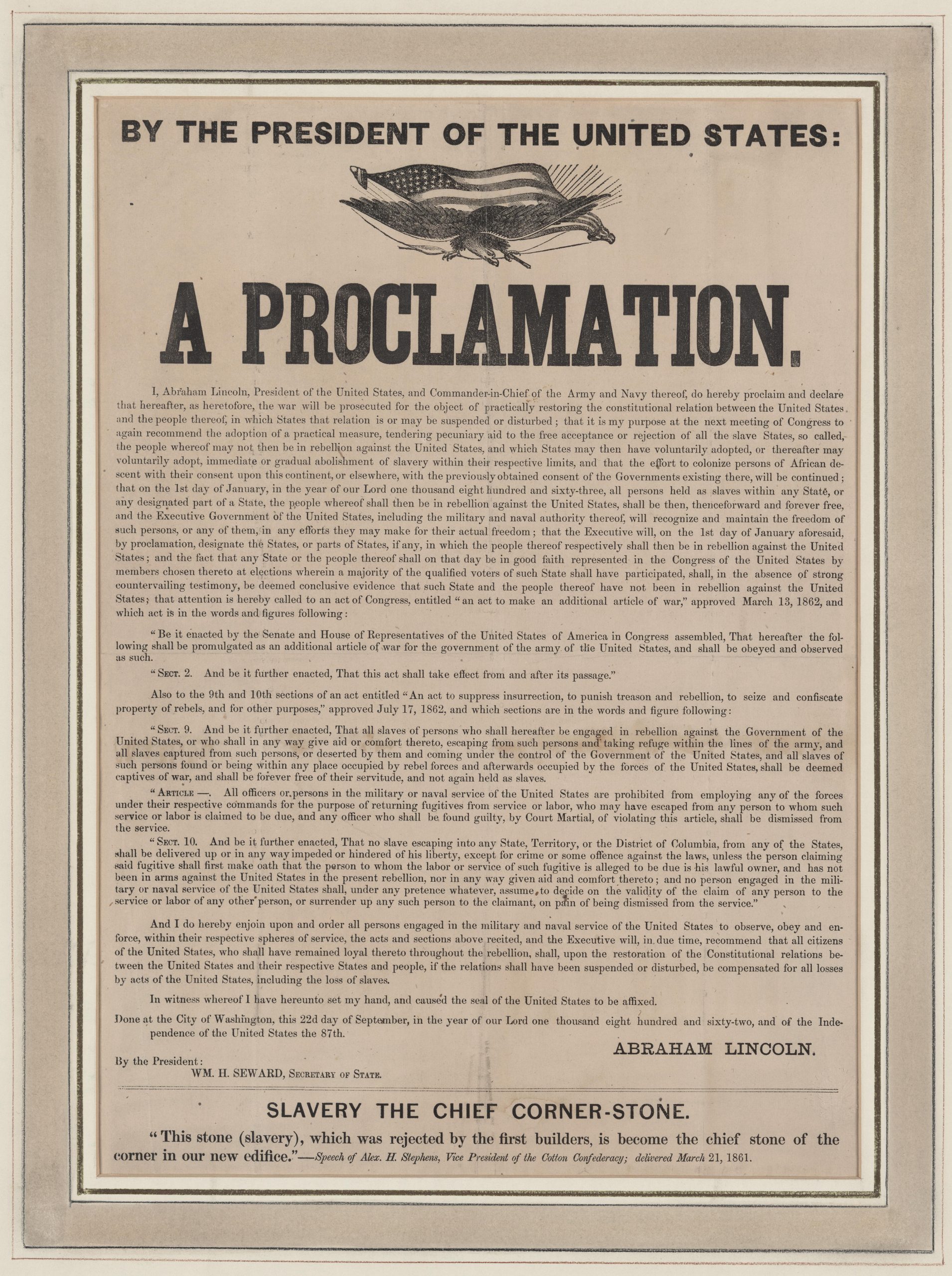

But in fact, Lincoln was wrong about one thing—there were “sudden results” from his proclamation. On word of emancipation, thousands of enslaved men, women, and children began moving towards freedom. Contrary to some who claim that the Emancipation Proclamation was useless because it didn’t free anyone, the rest of this piece will use the expanded community of Fredericksburg, VA, as a case study on the immediate impact of the proclamation.
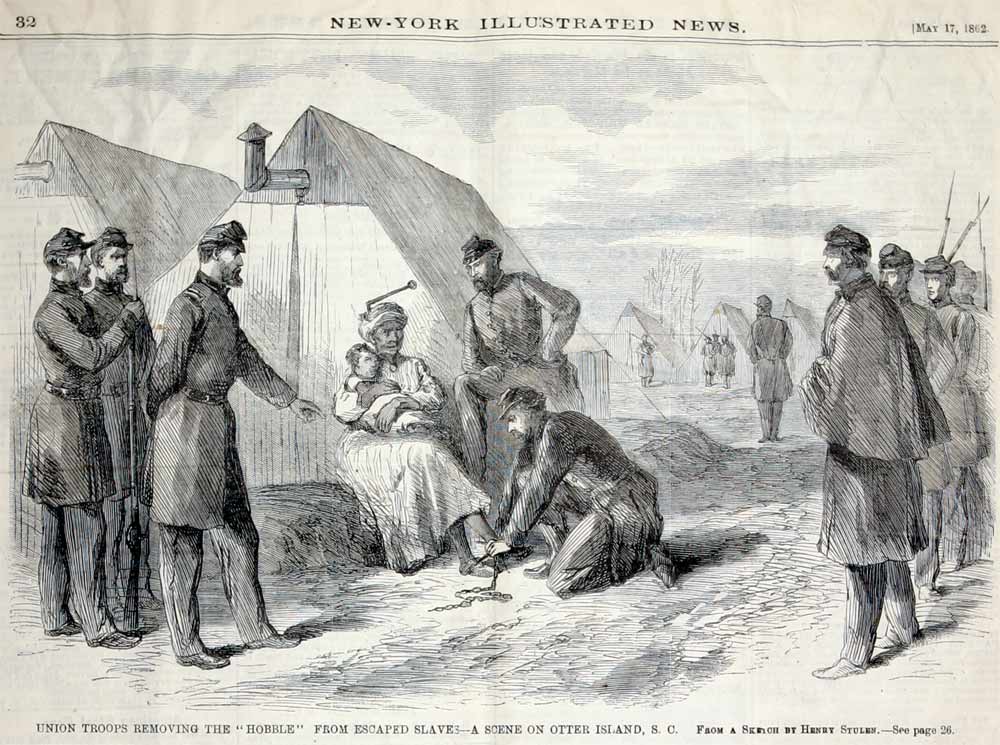
Fredericksburg had been through the ringer. Located midway between Washington, DC, and Richmond, the opposing armies exchanged the city multiple times. In the summer of 1862, almost 30,000 Federal forces were bivouacked in and around the town. Though they were in town before emancipation became a stated policy objective, these Union soldiers found themselves on the front line of social change as thousands of enslaved people fled to their lines, showing that formal policy or not, individuals would be drivers for their own liberty. Nearly 10,000 individuals seeking freedom that summer made their way to Fredericksburg, leaving one New Yorker to pen, “One sees the effects of war, and slavery. . . that would wring the tears out of any eyes that were half human.”[4]
The soldiers evacuated Fredericksburg in early September, leaving the town back under control of Confederate forces. Then, just two weeks before Lincoln signed the Emancipation Proclamation, the town weathered the largest battle of the Civil War as 200,000 combined forces dueled across the Rappahannock River, through the city’s streets, and onto the heights north and south of town. Both armies launched hundreds of shells into the city, leaving entire blocks leveled. Federal forces looted the town, furthering the destruction; many of the city’s structures had been utilized as hospitals, with the carnage to prove it. After its defeat, the US army retreated across the Rappahannock River, desolate and demoralized. Civilians began to return to the city and pick through the rubble. It was in this environment that word of Lincoln’s proclamation reached the front.
As US forces spread out across the countryside opposite Fredericksburg, they began to spread the word of the proclamation’s effect. Soldiers from the 8th Illinois Cavalry picketed Port Conway, about 30 miles southeast of Fredericksburg along the Rappahannock River. The troopers’ presence led many enslaved to begin fleeing, even before the proclamation’s official beginning on Jan. 1. One officer in the regiment wrote, “The slaves are continually leaving for our camps. They are better informed in regard of the objects and purposes of the war than many suppose.”[5]
The Illini’s work proved fruitful. At his own camp, artillerist George Breck, Battery L, 1st New York, penned the following on Jan. 5, 1863:
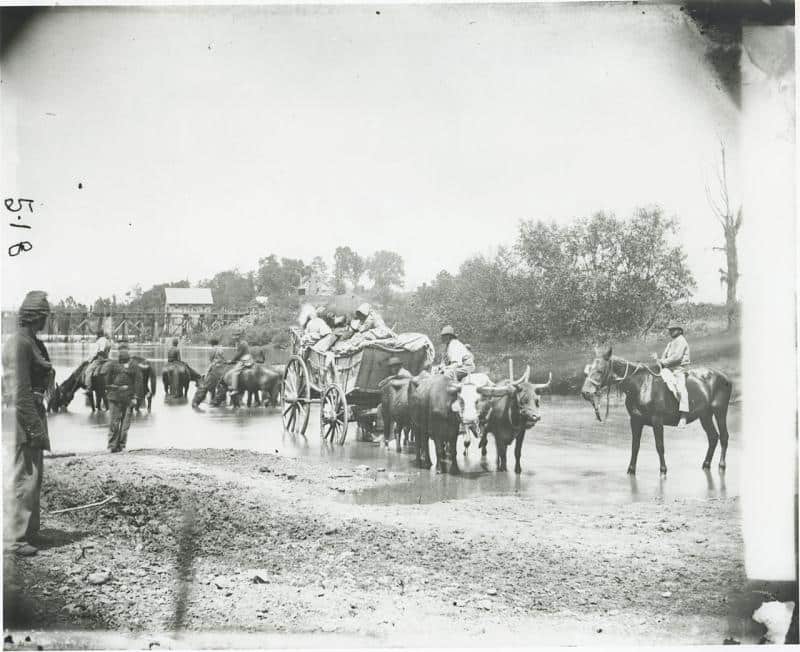
Small and large flocks of contrabands continue to pass our camp on their way to Washington. There is every variety of the African. Little negroes and big negroes, with all the intermediate sizes, from – we will not say how many days old, to four score years of age and upwards. A comical sight they present wending their way on foot, on mules, in old carts drawn by oxen – one small cart often carrying a family of half a dozen or more of the female class, with handkerchiefs tied about their heads, or their black “tresses” exposed to full view – and stowed away in the two wheel vehicle amid a conglomeration of household furniture, clothes, and blankets of varied hue and texture, may be seen, peering, little faces black as charcoal, relieved by white eyes; Uncle Toms and Aunt Dinahs, Sambos and Topsys – a complete representation of the colored population, of the “poor slave,” passengers for Freedom – swarming northward in response, we suppose, to the emancipation edict. These contrabands are mostly from King George’s county, one of the richest counties in the State we have been told, with fertile lands, extensive plantations and wealthy and intelligent citizens. The slaves, just before and since the first of January, have been leaving their “Ole Massa’s” in this section of the Old Dominion, taking with them all their personal effects, and, as observed, a sufficient number of mules, carts, etc., for the transportation of their families and household chattels. Whether their masters or owners attempt any interference with their going, or whether they bid them “depart in peace” and help them off, we cannot say. We heard the other day that the 8th Illinois Cavalry, who have been performing picket duty in St. George’s county and are at present, told the blacks that on the first day of January they would “then, thenceforward and forever be free,” and as a result of this information, the grand exodus above mentioned.[6]
It was not just those in the immediate presence of US soldiers who fled in the wake of the Emancipation Proclamation. Susan Chancellor, who lived at the famous Chancellorsville Plantation 12 miles to the west of Fredericksburg, remembered later in life, “After the Emancipation Proclamation our servants ran away to the Yankees, who were, I think, not very far away in Stafford County.”[7] The Chancellors’ neighbor Catherine Bullock wrote to Confederate officials, “My servants are gone to the Yankees.”[8]
The Emancipation Proclamation was an imperfect document, recognized even by its author, Abraham Lincoln. But far from the claim that it didn’t free anyone, the quotes above prove it had an immediate and visceral impact on communities. Confederate leadership recognized what the Emancipation Proclamation portended for their cause, leaving President Jefferson Davis to label the proclamation “the most execrable measure recorded in the history of guilty man.”[9]
For US soldiers, the arrival of thousands, and then tens of thousands, of freedom seeking individuals forced them to re-appraise their preconceived notions. While the average Union soldier had their own racist ideologies and a myriad of thoughts on slavery, they nonetheless recognized that for every slave who left a plantation or homestead, there was one less person helping drive the Confederate economy. The ever-quotable Major Rufus Dawes of the 6th Wisconsin summed the moment up: “If there remains any one in the army, who does not like the Proclamation, he is careful to keep quiet about it.”[10]
______________________________________________________________________________________________
[1] Frederick Douglass, The Day of Jubilee Comes: An Address Delivered in Rochester, New York, on December 28, 1862; Frederick Seward, Seward at Washington as Senator and Secretary of State (New York: Derby and Miller, 1891), 151.
[2] The Liberator, Jan. 16, 1863; The Vermont Watchman, Jan. 16, 1863; Lancaster Intelligencer, Jan. 6, 1863.
[3] Moncure Conway, Autobiography, Memories and Experiences, Vol. 1 (Boston: Houghton, Mifflin and Company, 1905), 381.
[4] Constant Hanks to his mother, Aug. 8, 1862, David M. Rubenstein Rare Book & Manuscripts Library, Duke University.
[5] Peter G. Beidler, editor, Army of the Potomac: The Civil War Letters of William Cross Hazleton of the Eighth Illinois Cavalry (Seattle: Coffeetown Press, 2013), 94-95.
[6] Daily Union & Advertiser, Rochester, New York, Jan. 12, 1863, published at New York State Military Museum and Veterans Research Center
[7] Sue Chancellor, “Recollections of Chancellorsville,” Confederate Veteran, June 1921, 213.
[8] Noel G. Harrison, Chancellorsville Battlefield Sites (Lynchburg: H.E. Howard, 1990), 15.
[9] Jefferson Davis, “Message to the Senate and House of Representatives of the Confederate States”, quoted in Frederick Moore, editor, The Rebellion Record: A Diary of American Events, Vol. 6 (New York: G.P. Putnam, 1863), 380.
[10] Rufus Dawes, Service with the Sixth Wisconsin (Marietta, E.R. Alderman & Sons, 1890), 126.


Thanks Ryan — great piece … you’re right — everywhere Union armies operated, thousands of enslaved people emancipated themselves.