The battle of Gettysburg, July 3,1863, Cemetery Ridge, Part III: “Cul-de-sac of death.”
Previous: Cemetery Ridge, Part II
Over near the Copse of Trees, and what would become the infamous “Angle”, the Union line waited. The 69th Pennsylvania and five companies from the 71st Pennsylvania watched the waves of Confederates moving closer and closer. The advance of the infantry was deliberate and disciplined. “On came those two charging lines of battle with the precision of troops on parade and the cool, steady marching of veterans, . . .” Pvt. Anthony McDermott of the 69th Pennsylvania recalled.
The gray clad troops heading toward the Pennsylvania boys were from brigadier generals’ Richard Garnett and Lew Armistead’s Virginia brigades. Garnett’s men marched out front with Armistead soldiers following. In all, ten regiments traversed the rolling open field and concentrated on the Copse of Trees. Union artillery rounds created havoc in their lines. Lieutenant John Lewis, 9th Virginia, Armistead’s brigade recounted the advance: “Crash after crash came the shot and shell. Great gaps were being made in the lines only to be closed, and the same steady, move forward . . . ”
On the Virginians came. About 100 yards out near the Emmittsburg Road, some Union infantry rifles began peppering the Rebels; most waited ‘til their foe was closer. Both blasts wrecked the Confederate ranks. Major Charles Peyton led the 19th Virginia of Garnett’s brigade. “Our line, much shattered, still kept up the advance until within about 20 paces of the wall, when, for a moment, it recoiled under terrific fire that poured into our ranks both from the batteries and from their sheltered infantry.” Garnett went down some 20 paces from the wall. The Confederates recovered and “rushed forward with unyielding determination . . . to plant the Southern banner on the walls of the enemy.”
With the entire area engulfed in smoke and deafening noise, the companies from the 69th and 71st Pennsylvania near the Angle found Confederate rifles against their chests; from the gun powder discharged, flames burned their clothes. The Virginians reclined and fired away “at the top of the wall where” they could see a head. The Pennsylvania boys “blazed back so hard that in about a minute [the gray clad troops] rushed over the wall.
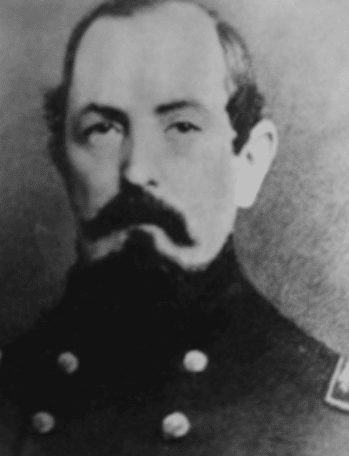
The meleé was grotesque: Col. Dennis O’Kane of the 69th Pennsylvania collapsed mortally wounded, shot through the chest. A minié ball struck O’Kane’s second in command, Lt. Col. Martin Tschudy. He died on the spot, hit in the bladder. Private William Hayes toppled with a bullet to the head. “Corporal [Hugh] Bradley, of this company [D], a powerful man, was using his piece as a club very effectively, but was overpowered by numbers and had his skull crushed by a blow from a musket in the hands of a rebel.” Another Confederate from the 28th Virginia dispatched a Yankee with his bayonet. The Union line at the Angle broke under the weight of the attack with the 69th Pennsylvania’s right companies refusing the line (bending back 90 degrees). It would be here that the 69th Pennsylvania earned the nickname “Rock of Erin”.
Armistead rushed through the gap with about 200-250 Virginia soldiers. Lieutenant J. Irving Sale, 53rd Virginia, later described the scene. We “poured over the wall, [Armistead] waved his hat and sword and yelled: ‘Now give ’em the cold steel, boys,’” The general and his men ran straight into a “cul-de-sac of death.”[1] He crumpled mortally wounded as did many others, while other Virginians fought back as best as possible.
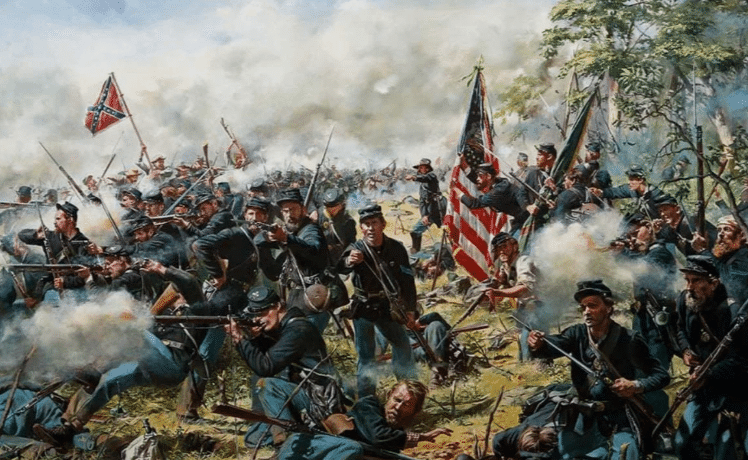
Armistead’s bloodied, vicious troop had smashed headlong into at least twelve Union regiments that had realigned up on the ridge and around and in the Copse of Trees. There was no sense of regimental organization, just a mass of dirty, ruthless blue-clad soldiers. The regimental historian for the 19th Massachusetts described the two lines colliding. “…Foot to foot, body to body and man to man they struggled, pushed, and strived and killed . . . hatless, coatless, drowned with sweat, black with powder, and blind with dust, with fiendish yells and strange oaths they blindly plied the work of slaughter.”
Corporal John Day Smith, 19th Maine, remembered the meleé as well. “We were all loading and firing and yelling and pushing towards the gap now filled with the exultant rebels . . . We would load, run to the front and fire . . . the color bearers . . . would toss their colors up and down to show the enemy we were not going to give . . .” The crazed Union mob, fueled by battle adrenaline, rushed the Confederates; some fled, while others were captured.
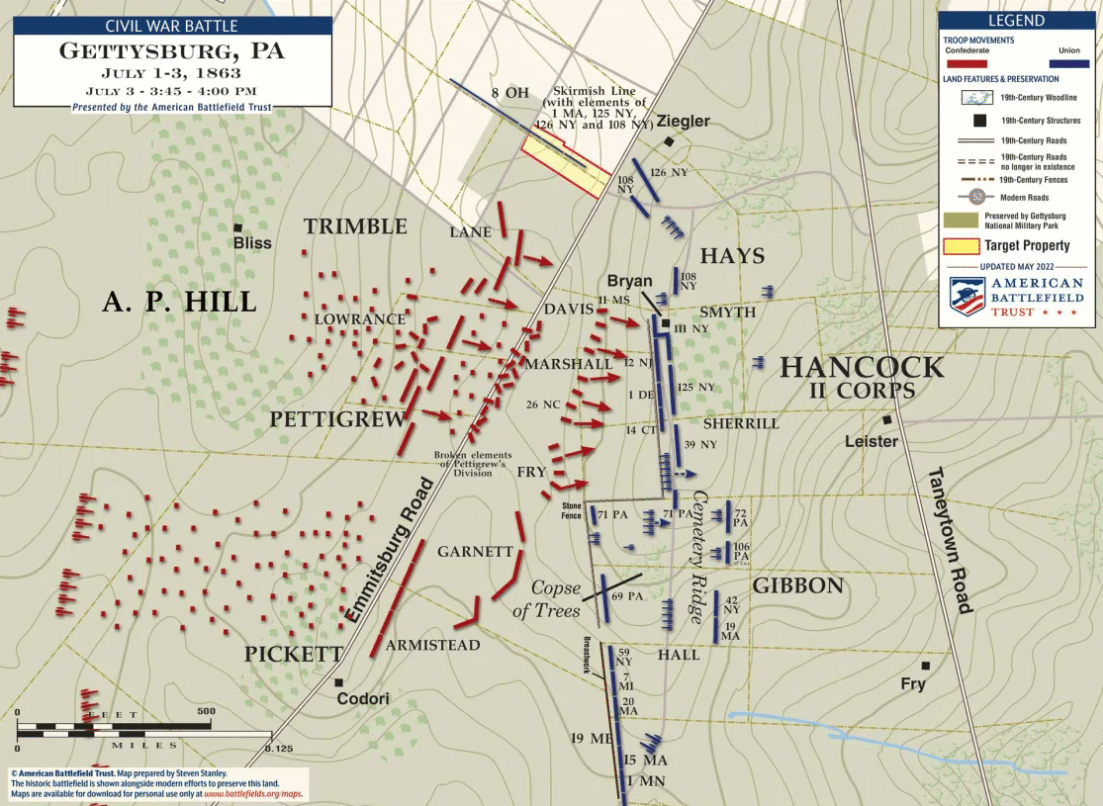
The dead and dying lay everywhere. Armistead’s brigade entered the battle with approximately 1,570. His five regiments counted 1,057 killed, wounded, or missing. Garnett’s five regiments tallied 905 casualties out of 1,405. Regimental officers took a heavy toll of casualties. Colonel William White, 14th Virginia, and Col. John Bowie Magruder, commander of the 57th Virginia, Armistead’s brigade, were mortally wounded. Armistead’s other three colonels fell wounded. Garnett’s regiments counted three colonels dead: Col. John B. Strange, 19th Virginia, Col. Robert C. Allen, 28th Virginia, Col. William D. Stuart, 56th Virginia. At least one Confederate woman was captured.
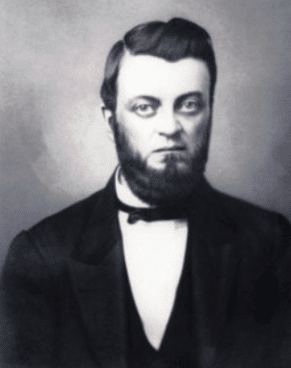
Three Union brigades had fought in this sector. Brigagier General William Harrow listed 1,366 men on his roster prior to the battle. He lost 567 killed, wounded, or missing. The 1at Minnesota sustained 77% casualties on July 2 and their commander, Col. William Colvill, had been severely wounded. The 1st Minnesota then suffered another 24 killed or wounded on July 3. Brigadier General Alexander Webb’s brigade deployed 1,244. His regiments took the brunt of the attack at the Angle and Copse of Trees and counted 491 casualties. Colonel Norman J. Hall fielded 922 and tallied 377 killed or wounded. The dead and wounded were also scattered just north of the Copse of Trees near Bryan’s Farm.[2]
Next: Cemetery Ridge, Part IV
[1] For “cul-de-sac of death” see David E. Johnson, The Story of a Confederate Boy in the Civil War. Radford, VA: Commonwealth Press, 1914, 212. David was a member of the Seventh Virginia Infantry regiment, Kemper’s Brigade. He was wounded during the preceding cannonade and couldn’t participate in the infantry charge. Whoever described the entire battle to him was quite descriptive. I do think some of Kemper’s men got caught up with Armistead’s and Garnett’s brigades.
[2] Scott Hartwig’s presentation, http://www.gdg.org/Gettysburg%20Magazine/scott1.html. John Day Smith, The History of the Nineteenth Regiment of Maine Volunteer Infantry, 1862-1865, 1909. Anthony W. McDermott, A Brief History of the 69th Regiment Pennsylvania Veteran Volunteers, 1889. JoAnna McDonald, A Walk in Time: Goodbye, Boys! Goodbye! A Walking Guide the High Water Mark, Gettysburg, July 2-3, 1863. Burd Street Press. 1999. James Hessler. and Wayne Motts, Pickett’s Charge at Gettysburg: A Guide to the Most Famous Attack in American History. Savas Beatie, 2015. Carol Reardon, Pickett’s Charge in History and Memory. The University of North Carolina Press, 2003. David Shultz, “Double Canister at Ten Yards”: The Federal Artillery and the Repulse of Pickett’s Charge, July 3, 1863. Reprint Savas Beatie, 2017. Both paintings are by Don Troiani.


Compelling stuff, great quotes!