Robert E. Lee – Between Marble and Ruin
Earlier this year, I wrote a review of The Buried Cause: Unearthing Hidden History in the Lee Monument Cornerstone, which was, essentially, an autopsy of Robert E. Lee—his legacy, the Confederacy, its monuments, and the “Lost Cause.” With the removal of three more statues from the Virginia State Capitol grounds, I felt the need to revisit the topic, something I’ve been mulling over for the past several months.
I’m not an expert on Robert E. Lee, nor am I here to dissect every moment of his life. I’m sure he had personal failings, and he certainly had flaws as a military commander. I’m not someone who idolizes historical figures. But he was far from the mustache-twirling villain some have tried to make him out to be in recent years.
This portrayal is so at odds with the image of Lee I’ve formed in studying the American Civil War. Until very recently, even many of his critics seemed to agree that he was a genteel man of great personal character—honorable, self-effacing, a man of deep religious faith, willing to sacrifice everything in pursuit of what he believed was right. Then, in defeat, he did his best to accept the outcome of the war and help heal the national divide.
But, as Ralph Waldo Emerson said, “Every hero becomes a bore at last.”[1]
Scholars began chipping away at the mythic Lee long ago, perhaps starting with Thomas L. Connelly’s The Marble Man (1977) and continuing with Alan T. Nolan’s Lee Considered (1991). For an older generation that came of age in the immediate aftermath of World War II, those works probably felt revolutionary. For my generation, though, Nolan’s assertion that “I do not deny Lee’s greatness, but I have tried to deal with him as a human being” seems quaint, almost as if it came from another universe compared with the way his legacy is treated today.[2]
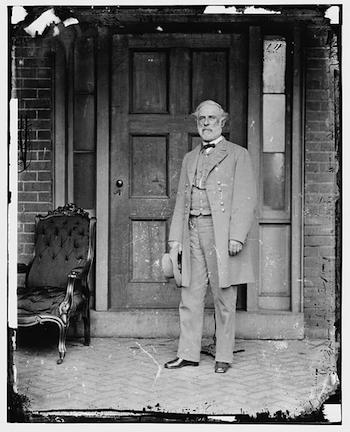
In the past decade or so, Lee has become a victim of the very idolization he neither sought nor wanted, recast as a symbol of white supremacy, elites, Jim Crow, racism, and a dozen other “isms.” Political iconoclasts have waged a campaign of damnatio memoriae, insisting that every statue of him be defaced, torn down, removed, or destroyed, and that his name and likeness be erased from public view.[3]
I’m not a Southern apologist or neo-Confederate partisan. Though I live in Virginia, I grew up in the Chicago suburbs and certainly wasn’t raised to venerate Lee in the Land of Lincoln. Most of my relatives immigrated to the United States long after the Civil War. The only branch of my family I can trace in America to the Revolutionary War is Pennsylvania Dutch. As far as I know, I’m the first person in my family to ever live below the Mason-Dixon Line. All of which is to say, I have no regional bias or personal affinity for Lee.
But Robert E. Lee is part of the Southern tradition, and therefore part of the American tradition. Southerners are Americans, after all. And, whether you want to acknowledge it or not, Virginia was a leading state in the Confederacy. Slavery was, unfortunately, a central part of that history. Nearly all the state’s prominent citizens before 1865 were slaveholders or profited or benefited from it in some way. That fact can never be papered over or erased, no matter how many plaques or statues are removed or things renamed.
Although Lee grew up in modest circumstances, he was not a man of humble background. His family’s roots ran deep in Virginia. Richard Lee I arrived in the Virginia Colony from England in 1639 and quickly became one of its wealthiest and most influential landowners. His son, Richard Lee II, followed in his footsteps, serving in both the Virginia House of Burgesses and the Governor’s Council. Over the next two centuries, the Lees would leave a mark on the Old Dominion and the United States generally.[4]
Two members of the family, Francis Lightfoot Lee and Richard Henry Lee, signed the Declaration of Independence. Richard also served as president of the Continental Congress. Another descendant, Henry “Light-Horse Harry” Lee III, gained fame in the Revolutionary War and later served as Governor of Virginia. He gave a famous eulogy at George Washington’s funeral, declaring him “first in war, first in peace, and first in the hearts of his countrymen.”
When he fell on hard times, he moved his family to Alexandria, including his two-year-old son, Robert Edward Lee.[5]
Robert E. Lee became a career officer in the U.S. Army, serving with distinction in the Mexican-American War and later as superintendent of the U.S. Military Academy at West Point. He married Mary Anna Custis, great-granddaughter of Martha Washington, and for a time lived at Arlington House, her family’s plantation overlooking the Potomac River and the nation’s capital. He commanded the forces that retook the federal arsenal at Harpers Ferry from John Brown.
When Virginia voted to secede from the Union in the spring of 1861, Lee accepted command of the state’s militia forces, a herculean task that seemed, at times, beyond his abilities. He was not enthusiastic about secession, and some Confederates initially questioned his commitment to the cause. His lone field command that fall was a complete mess, and if not for Joseph E. Johnston’s wounding the following spring, he might have spent the war behind a desk.[6]
But fate had other plans, and Lee eventually emerged as one of the most recognizable generals on either side, forging an army that earned the respect and even admiration of its opponents. After three years of hard fighting, he surrendered his army at Appomattox Court House on April 9, 1865, then spent the remaining years of his life as president of Washington College, urging his former comrades to accept the new status quo. He died in Lexington, Virginia, on October 12, 1870.[7]
Following his death, Lee became a larger-than-life symbol. To some, he embodied the Confederacy’s “Lost Cause” and an idealized vision of Southern manhood. To others, he represented reconciliation between North and South, a figure who rose above ugly sectionalism in the aftermath of war. Not even a few decades after the war, Lee biographies appeared alongside those of Abraham Lincoln, Ulysses S. Grant, and Lloyd Garrison in books with titles like Heroes of the Great Republic (1887) and Heroes of the Nation (1898).
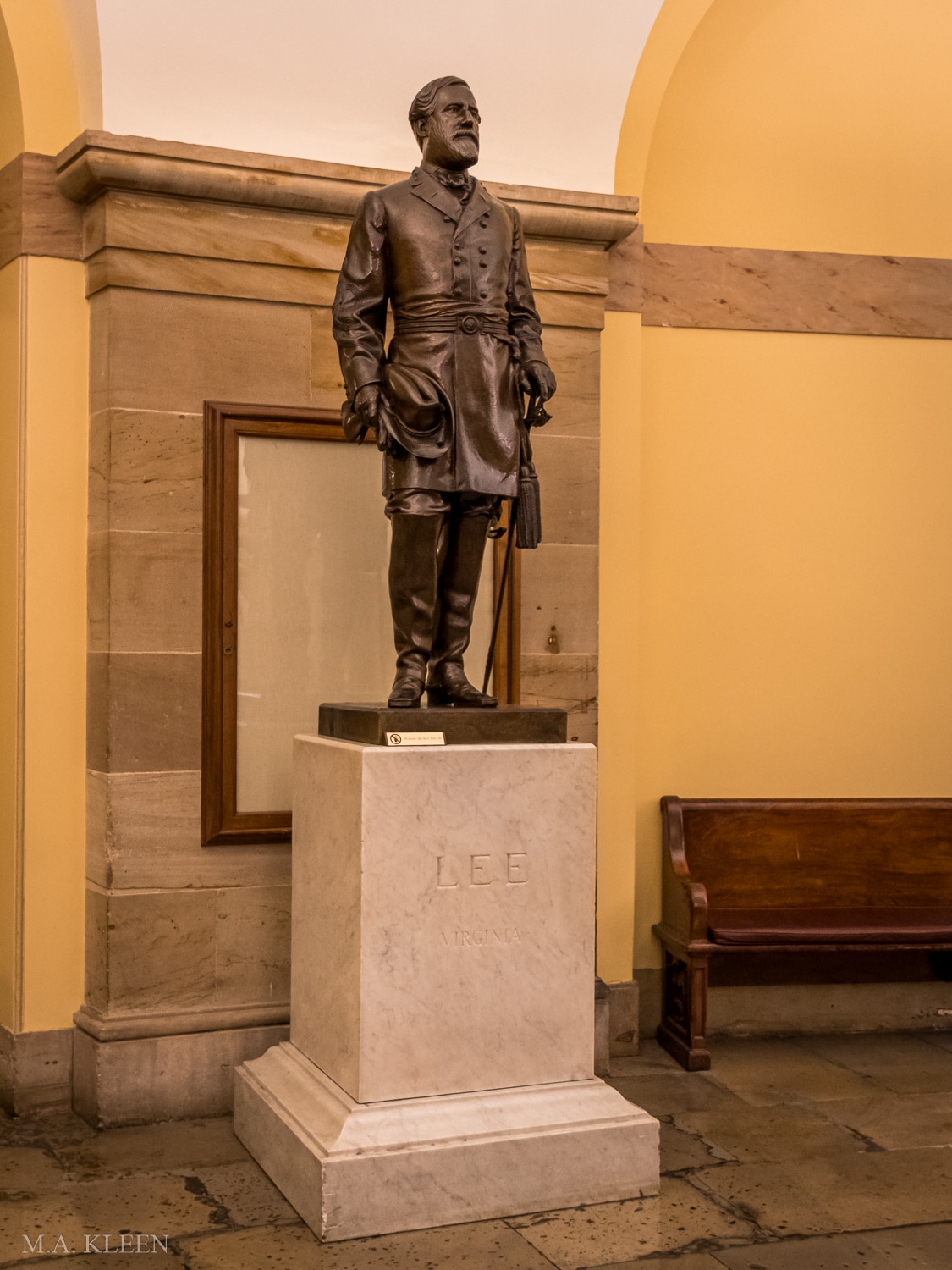
His likeness appeared on U.S. postage. Arlington House was made a national memorial, and both a transcontinental highway from Washington, D.C., to San Diego and a U.S. military base, Fort Lee (1917–2023), were named in his honor. A statue of Lee represented Virginia in Statuary Hall at the U.S. Capitol from 1909 to 2020.[8]
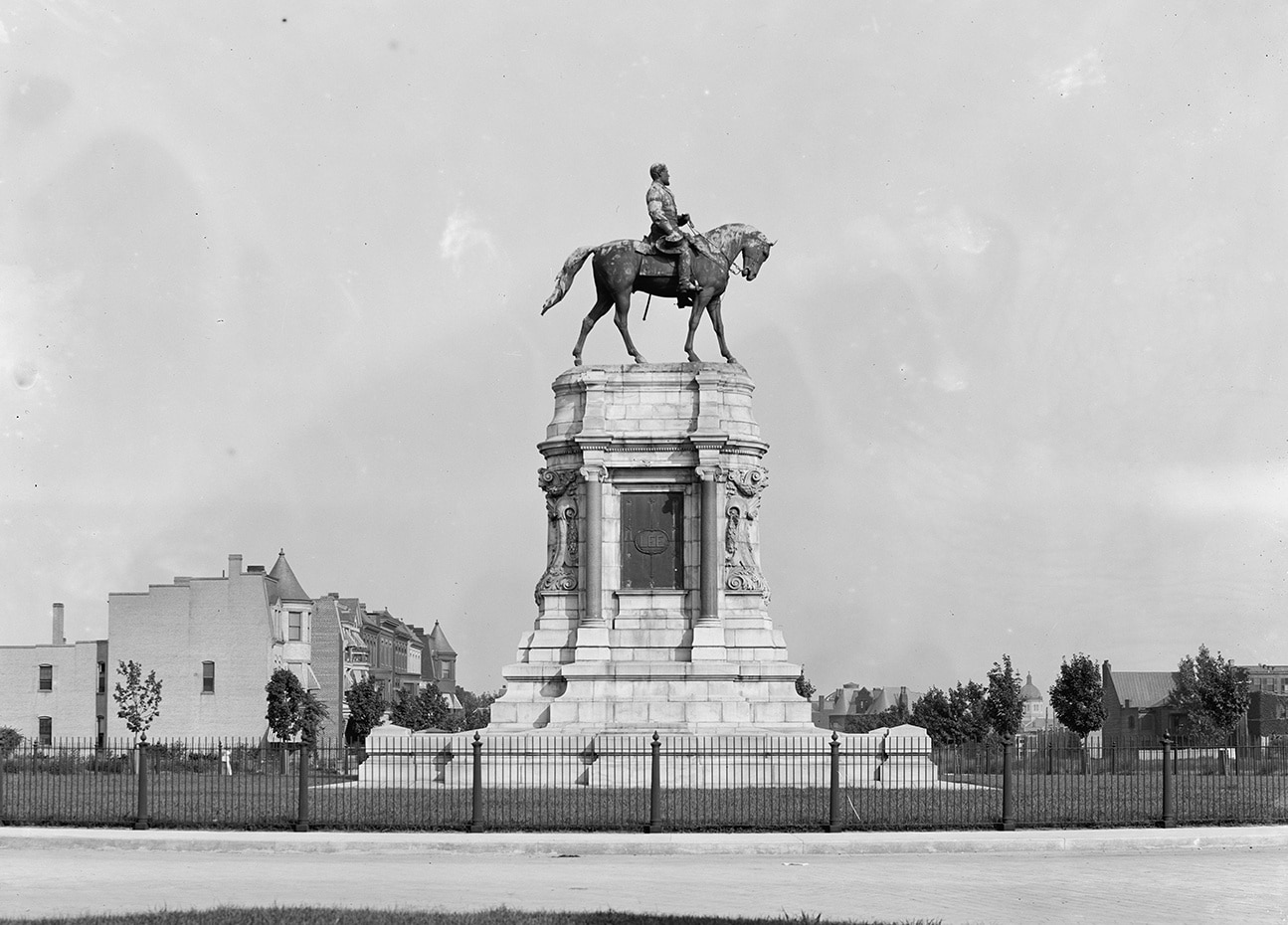
Most relevantly, in 1890 a large equestrian statue by the French sculptor Jean Antonin Mercié was erected on Monument Avenue in Richmond, Virginia, where it stood for 131 years. It was a historically significant artwork in its own right and, along with the other monuments on the avenue and Civil War sites and museums, a huge tourist draw.
President Franklin D. Roosevelt lauded Lee as a “knightly figure without reproach and without fear” and hailed him as “one of our greatest American Christians and one of our greatest American gentlemen.” Dwight D. Eisenhower famously hung a portrait of Lee in the Oval Office and called him “one of the supremely gifted men produced by our Nation.” When signing the bill that posthumously restored Lee’s citizenship, President Gerald R. Ford remarked that “as a man, he stood as the symbol of valor and of duty” and that “General Lee’s character has been an example to succeeding generations.”[9]
Why would these American presidents, who hailed from different political parties and very different political perspectives, sing the praises of a man with no redeeming qualities?
At Lee’s 1907 centennial, Charles Francis Adams Jr., the great-grandson of John Adams and a Union cavalry officer during the Civil War, called him “one of our sacred men” whom we “wish to resemble.” What a remarkable change that today, 156 years after his death, Lee provokes more outrage than he did among the men who fought against him on the battlefield.[10]
In my opinion, the trouble is not simply that Lee is now judged too harshly, it is that he has seldom been judged with much balance at all. Lee as an infallible hero is just as cartoonish and absurd as Lee the villain.
He should be understood as a complex and consequential American historical figure, not as either heroic myth or modern scapegoat. Erasing his memorials does not erase the history that produced him, and reducing him to a symbol to be torn down does nothing to illuminate the full, messy, contradictory history that made him significant in the first place.
[1] Ralph Waldo Emerson, Representative Men (Phillips, Sampson and Company, 1850), 32.
[2] Alan T. Nolan, Lee Considered: General Robert E. Lee and Civil War History (University of North Carolina Press, 1991), xi.
[3] Ty Seidule, Robert E. Lee and Me: A Southerner’s Reckoning with the Myth of the Lost Cause (St. Martin’s Publishing Group, 2021); Eric Foner, “The Making and the Breaking of the Legend of Robert E. Lee,” The New York Times, August 28, 2017, https://web.archive.org/web/20170829021217/https://www.nytimes.com/2017/08/28/books/review/eric-foner-robert-e-lee.html; Adam Serwer, “The Myth of the Kindly General Lee,” The Atlantic, June 4, 2017, https://www.theatlantic.com/politics/archive/2017/06/the-myth-of-the-kindly-general-lee/529038/
[4] “The Lee Family of Stratford Hall,” Stratford Hall Historic Preserve, https://www.stratfordhall.org/leefamily/
[5] Burton J. Hendrick, The Lees of Virginia: Biography of a Family (Little, Brown, and Company, 1935).
[6] Thomas L. Connelly, The Marble Man: Robert E. Lee and His Image in American Society (Alfred A. Knopf, 1997), 16-17; Allen C. Guelzo, Robert E. Lee: A Life (Alfred A. Knopf, 2021), 201; Jonathan Horn, The Man Who Would Not be Washington: Robert E. Lee’s Civil War and His Decision That Changed American History (Scribner, 2015), 143-44.
[7] The outline of R. E. Lee’s life is generally well-known and there are many excellent and extensive biographies of him. The opinions of his military performance are my own.
[8] James C. Cobb, “How Did Robert E. Lee Become an American Icon?” Humanities 32 (July/August 2011), https://www.neh.gov/humanities/2011/julyaugust/feature/how-did-robert-e-lee-become-american-icon
[9] Franklin D. Roosevelt, “Address on the One Hundredth Anniversary of the Virginia Military Institute. Lexington, Virginia,” November 11, 1939, https://www.presidency.ucsb.edu/documents/address-the-one-hundredth-anniversary-the-virginia-military-institute-lexington-virginia; Franklin D. Roosevelt, “Remarks at the Unveiling of the Robert E. Lee Memorial Statue, Dallas, Texas,” June 12, 1936, https://www.presidency.ucsb.edu/documents/remarks-the-unveiling-the-robert-e-lee-memorial-statue-dallas-texas; Gerald R. Ford, “Remarks Upon Signing a Bill Restoring Rights of Citizenship to General Robert E. Lee,” August 05, 1975, https://www.presidency.ucsb.edu/documents/remarks-upon-signing-bill-restoring-rights-citizenship-general-robert-e-lee
[10] Charles Francis Adams, Lee’s Centennial: An Address (Americana House, 1948), 69. Of course, as others have pointed out, some Union veterans and African Americans did oppose the erection of statues in Lee’s honor at the time, but theirs was far from the prevailing view. If every statue required unanimous approval, there would be no public art. See: Samuel Flowers, “The Explosive Opposition to Lee in Statuary Hall,” Emerging Civil War, July 27, 2026, https://emergingcivilwar.com/2026/07/27/the-explosive-opposition-to-lee-in-statuary-hall/


